Why Understanding Common Elevator Problems Can Save Lives and Money
- The hidden degradation curve: most elevator problems develop gradually through small, detectable warning signs that building occupants learn to ignore only a trained technician learns to act on them before they escalate.
- Financial stakes: a door contact fault costing a minor repair if caught at a quarterly visit can cascade to a full control board failure if left untreated repair cost multiplies 10-50x at each escalation stage.
- Safety stakes: the four most common elevator problems globally (door system failures, brake anomalies, rope wear, and control faults) account for the majority of elevator-related injuries all are preventable with early detection and correct maintenance.
- Damascus context: grid instability, 40°C+ summer heat, and seasonal dust storms mean Damascus elevators experience common problems at accelerated rates compared to temperate markets local expertise in Syria’s specific operating environment is not optional, it is essential.
Problem #1 Elevator Door Faults (The #1 Call-Out Reason Globally)
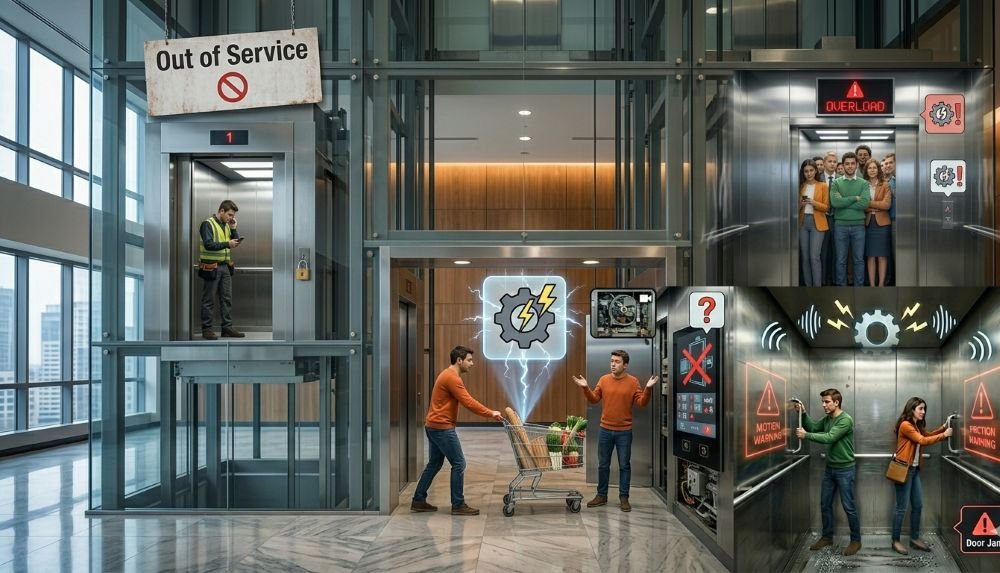
Root Causes of Elevator Door Problems
- Mechanical wear: door operator motor brushes, drive belt, and cam-follower wheels wear progressively each has a measurable end-of-life threshold detectable at routine maintenance visits before failure occurs.
- Alignment drift: door panel misalignment caused by building settlement, repeated impact from heavy loads, or thermal expansion of the sill groove produces closing-force anomalies and interlock engagement failures.
- Damascus dust factor: khamseen particulate accumulates in door sill grooves and on contact surfaces friction increases, door speed drops, and the operator motor overheats trying to close against the resistance; this is the #1 Damascus-specific problem driver.
- Electrical faults: door interlock micro-switch wear, safety edge (light curtain) sensor drift, and door operator controller board failures the most frequent corrective repair items in Hard System’s Damascus service portfolio.
Symptoms, Diagnostic Signs & Solutions
- Symptom: doors open and close slowly or incompletely → Diagnostic: measure door closing time (EN 81-20 §5.3) and closing force; check operator belt tension and cam-follower condition → Solution: belt replacement, cam-follower swap, operator alignment reset.
- Symptom: elevator refuses to move despite doors appearing closed → Diagnostic: test each interlock circuit individually with a multimeter; check interlock hook engagement depth → Solution: hook adjustment or replacement; electrical contact cleaning or replacement.
- Symptom: doors open and reopen erratically → Diagnostic: inspect light curtain beam alignment and door edge sensitivity calibration → Solution: curtain realignment; sensor replacement if response threshold has drifted outside specification.
- Damascus-specific solution: Hard System’s quarterly door protocol includes sill groove cleaning, contact cleaning, and closing-force measurement the single most effective maintenance activity for preventing Damascus door call-outs.
Prevention Strategy
- Monthly lubrication and adjustment of door operator, sill groove cleaning, and interlock gap check reduces door-related call-outs by an estimated 80% in Hard System’s Damascus portfolio data.
- Condition-based replacement schedule: operator motor brushes replaced at measured wear limit; drive belt replaced at measured elongation neither on calendar age nor after failure.
- Door panel surface inspection: impact damage from commercial traffic requires straightening or replacement before misalignment cascades to operator damage a low-cost repair that prevents a high-cost one.
- Hard System’s door fault early-warning checklist: a 5-point visual inspection guide provided to building managers for use between scheduled maintenance visits.
Problem #2 Elevator Entrapment During Power Cuts
Root Causes Specific to Damascus
- Syria’s grid load-shedding: Damascus elevators experience 3-5x more power interruption events per year than regional averages making entrapment the most reported user complaint in Hard System’s Damascus portfolio.
- ARD failure: depleted battery below rescue capacity, ARD control circuit fault, or no ARD installed all three scenarios produce the same outcome: passengers stranded between floors with no automatic rescue.
- UPS system failure: a degraded UPS battery bank appears functional during normal operation but fails to deliver adequate power during an actual outage the failure is silent until the outage occurs, making battery capacity measurement (not visual check) the only valid test.
- Control board PSU failure: the elevator’s internal DC power supply can fail independently of the mains supply, producing a locked-out controller even when grid power is present a frequently misdiagnosed fault.
Symptoms, Diagnostic Signs & Solutions
- Symptom: elevator stops mid-travel during a power cut and does not self-rescue → Diagnostic: ARD battery load test to minimum rescue voltage; ARD control circuit continuity check → Solution: battery replacement; ARD circuit repair; Hard System 24/7 emergency response for trapped passengers.
- Symptom: elevator self-rescues to wrong floor, doors do not open → Diagnostic: ARD directional logic and floor-level sensor check → Solution: ARD software parameter correction; floor-level sensor replacement.
- Symptom: elevator fails randomly with no apparent power issue → Diagnostic: DC PSU voltage measurement under load; inspect internal board capacitors for bulge → Solution: PSU board replacement from Hard System’s Damascus parts stock.
- Damascus emergency protocol: Hard System’s 24/7 call centre dispatches within 2 hours for any passenger entrapment in contracted buildings the emergency number is displayed in every Hard System-maintained elevator cabin.
Prevention Strategy
- ARD battery capacity load-test at every maintenance visit regardless of contract tier non-negotiable in Damascus given Syria’s grid interruption frequency.
- UPS battery health assessment including load test (not just voltage check) at every quarterly or monthly visit visual inspection alone cannot detect capacity degradation.
- Surge protection installation: power spikes during grid restoration cause control board failures a quality surge-protection module is a one-time preventive investment with a high corrective-avoidance ROI in Damascus’s grid environment.
- Hard System’s power resilience package: surge protection + quality UPS with correctly sized battery bank + ARD battery monitoring standard on all new installations; available as retrofit for existing Damascus elevators.
Problem #3 Abnormal Sounds and Vibrations
Root Causes of Elevator Noise and Vibration
- Guide rail lubrication failure: dry or contaminated guide rails cause guide shoes to produce squealing or grinding noise the acoustic warning of metal-to-metal contact that accelerates both rail and shoe wear exponentially.
- Roller guide shoe wear: rubber rollers harden and develop flat spots with age produces a rhythmic thumping or vibration correlated to roller circumference and car speed, detectable by frequency analysis.
- Drive sheave groove wear: worn V-shaped grooves cause rope slip and vibration produces an irregular shudder during acceleration and deceleration, detectable by ride-quality meter before it becomes audible to passengers.
- Damascus thermal factor: the -2°C to 40°C seasonal temperature range causes differential expansion in rail joints and bracket fixings producing clicking or banging sounds that indicate loose rail joints requiring torque verification.
Symptoms, Diagnostic Signs & Solutions
- Symptom: continuous squealing during travel → Diagnostic: identify location (pit, mid-shaft, top) by sound origin; inspect guide shoe contact surfaces and rail profile → Solution: lubrication replenishment; guide shoe replacement if worn below minimum thickness.
- Symptom: rhythmic thumping correlated to travel speed → Diagnostic: rotate roller guide shoes by hand to identify flat spots; measure roller diameter against specification → Solution: roller guide shoe set replacement a planned maintenance item, not an emergency repair.
- Symptom: shuddering during start or stop → Diagnostic: ride-quality accelerometer measurement; sheave groove profile measurement with groove gauge → Solution: sheave re-grooving or replacement; rope re-tensioning; VFD deceleration curve tuning.
- Symptom: intermittent banging from shaft → Diagnostic: physical inspection of all rail bracket bolts and fishplate connections for looseness → Solution: torque verification and re-tightening; expansion joint gap measurement.
Prevention Strategy
- Guide rail lubrication at every maintenance visit using the correct viscosity grade for Damascus summer temperatures the single most effective noise and vibration prevention measure available.
- Roller guide shoe diameter measurement at each quarterly visit replacement scheduled before flat-spot development, not after audible symptoms appear.
- Annual ride-quality assessment using calibrated accelerometer: Hard System records the A95 comfort metric and trends it deterioration triggers sheave inspection before passenger-perceptible vibration develops.
- Rail bracket torque verification: included annually in Hard System’s Damascus protocol given the thermal expansion cycle not a standard European maintenance item, but essential in Syria’s temperature range.
Problem #4 Elevator Stopping Between Floors (Levelling Faults)
Root Causes of Levelling Problems
- Floor sensor (vane/magnet) drift: the position sensor that communicates floor level to the controller can drift due to vibration, temperature change, or physical impact producing stops consistently above or below floor level.
- VFD parameter drift: the deceleration curve determining where the car stops drifts over time produces gradual levelling deterioration that passengers notice before engineers do, making passenger reporting an early-warning system.
- Brake adjustment: partial brake drag creates an asymmetric deceleration profile in up vs. down travel the elevator levels correctly in one direction and consistently under or overshoots in the other.
- Rope stretch and elongation: new ropes stretch during the first 3-6 months of operation; aged ropes develop permanent elongation both conditions shift calibrated floor-level positions and require re-tensioning and re-calibration.
Symptoms, Diagnostic Signs & Solutions
- Symptom: elevator consistently stops 2-5 cm above or below floor level → Diagnostic: measure levelling accuracy in both directions at all floors; check floor sensor mounting and gap → Solution: floor sensor position adjustment; VFD levelling parameter recalibration.
- Symptom: levelling accuracy deteriorates progressively over weeks → Diagnostic: measure rope tension vs. installation baseline; check for new-installation stretch → Solution: rope re-tensioning (complimentary at month 4 under Hard System contracts); VFD curve recalibration.
- Symptom: elevator overshoots in one direction only → Diagnostic: brake drag measurement (current and temperature rise at standstill); compare up vs. down travel stopping positions → Solution: brake adjustment or pad replacement; VFD deceleration curve asymmetry correction.
- Hard System’s levelling audit: every maintenance visit includes a levelling accuracy spot-check at each floor the +/-5 mm EN 81-20 §5.2.5 tolerance is treated as a pass/fail threshold, not a guideline, at every Hard System visit.
Prevention Strategy
- VFD parameter documentation at installation and comparison at every annual visit parameter drift is detectable before it reaches the passenger-perceptible threshold when trending data is available.
- Floor sensor mounting verification included at every quarterly visit bracket loosening is common in buildings with vibration sources (generators, HVAC plant) adjacent to the shaft.
- Rope tension measurement at month 4 of operation (new installation) and annually thereafter Hard System’s contracts include a free first-year rope re-tensioning visit to address normal installation stretch.
- Brake system measurement: brake force test and pad thickness recorded at every quarterly visit asymmetric levelling is often the first visible symptom of a brake requiring attention before it becomes a safety concern.
Problem #5 Control System and Electrical Faults
Root Causes of Control and Electrical Problems
- Control board component ageing: capacitors, relays, and PLC modules have finite operational lifespans capacitor electrolyte dries, relay contacts pit, and PLC firmware develops errors; all are progressive, measurable failure modes.
- Damascus power quality: voltage fluctuations (commonly +/-10% in Syria vs. the +/-5% design tolerance of many European control boards), harmonics from industrial equipment, and spike-and-sag cycles accelerate electronic component ageing beyond manufacturer-assumed baselines.
- Dust contamination on PCBs: conductive dust on circuit board surfaces creates partial short circuits causing intermittent faults the most diagnostically frustrating failure mode because it is temperature and humidity dependent and may not be reproducible on demand.
- Wiring insulation ageing: Damascus’s heat cycling causes wiring insulation to become brittle and crack producing intermittent faults that are difficult to trace without systematic insulation resistance (Megger) testing.
Symptoms, Diagnostic Signs & Solutions
- Symptom: random fault codes with no consistent pattern → Diagnostic: visual PCB inspection for dust, capacitor bulge, relay pit marks; insulation resistance test on all wiring → Solution: PCB compressed-air purge; capacitor replacement; insulation repair at break points.
- Symptom: elevator fails to respond to floor calls intermittently → Diagnostic: test call button circuits and wiring continuity; check controller input voltage levels; monitor controller fault log for patterns → Solution: call button replacement; wiring repair; controller power supply repair.
- Symptom: floor indicators and buttons show incorrect information → Diagnostic: check communication bus (serial/CAN) between controller and car-top electronics; inspect travelling cable condition → Solution: communication bus parameter reset; travelling cable replacement if insulation is damaged.
- Damascus-specific solution: Hard System installs surge-protection modules as standard on all new installations and as retrofit on existing control boards eliminating the most common Damascus-specific electrical fault driver at source.
Prevention Strategy
- Monthly compressed-air purge of control cabinet cooling vents the single most effective step against dust-induced PCB contamination in Damascus’s particulate environment; takes 5 minutes, prevents a multi-day control board replacement.
- Annual insulation resistance (Megger) test on all wiring harnesses: identifies degrading insulation before it produces a fault; included in Hard System’s annual comprehensive inspection.
- Capacitor visual inspection at every quarterly visit: swollen tops or electrolyte leakage are early visual indicators of imminent failure capacitor replacement is inexpensive; the downstream board damage of an undetected capacitor failure is not.
- Surge-protection module: Hard System’s Damascus standard one-time installation cost that reduces control board corrective replacement frequency by an estimated 70-75% based on portfolio performance data.
Problem #6 Brake System Faults
Root Causes of Brake Problems
- Brake pad wear: elevator brake pads wear progressively harder to detect than automotive brakes because the brake is applied continuously at standstill; pad contact measurement is the required assessment method, not visual observation alone.
- Brake spring fatigue: the return spring applying the brake loses preload force over time a weakened spring produces slow engagement (overshoot on stopping) or incomplete engagement (fails to hold rated load at standstill).
- Brake coil overheating: in Damascus’s 40°C+ ambient, brake coil insulation degrades faster than European baselines coil resistance increases, release force reduces, and the brake may not fully open during travel, creating drag and mechanical heat.
- Oil contamination: hydraulic oil or lubricant contamination of the brake friction surface dramatically reduces holding force typically caused by a leaking bearing seal above the brake assembly; a source identification and seal repair resolves the root cause.
Symptoms, Diagnostic Signs & Solutions
- Symptom: car drifts slightly after stopping at a floor → Diagnostic: brake holding force test (125% rated load stationary test per EN 81-20 §12.4); measure brake gap → Solution: brake gap adjustment; brake pad replacement if worn below minimum thickness.
- Symptom: car vibrates or shudders during travel → Diagnostic: check for partial brake engagement (gap too small); measure brake coil voltage and current draw → Solution: brake gap reset to manufacturer specification; coil replacement if resistance is out of tolerance.
- Symptom: elevator stops with a jolt rather than smoothly → Diagnostic: brake release timing measurement; spring preload force measurement → Solution: spring replacement; brake controller timing parameter adjustment in VFD program.
- Hard System safety protocol: any brake anomaly triggers an immediate out-of-service recommendation brake faults are NEVER deferred in Hard System’s corrective event classification system, regardless of whether the elevator appears to be running.
Prevention Strategy
- Brake gap measurement at every quarterly maintenance visit: gap between pad and drum/disc is the primary leading indicator of pad wear recorded and trended to predict replacement timing before wear reaches the safety threshold.
- 125% load holding test annually: required by EN 81-20; Hard System conducts this as part of the annual comprehensive inspection and records the result in the client maintenance log.
- Brake coil resistance measurement annually: detects insulation degradation early; in Damascus’s heat environment, coil replacement is scheduled proactively based on measured resistance trend rather than waiting for performance failure.
- Oil contamination inspection at every visit: visual check of the brake assembly for oil traces if found, the source bearing seal is identified and replaced before the contamination damages the brake friction surface beyond repair.
Problem #7 Hydraulic Elevator-Specific Problems
Root Causes of Hydraulic Elevator Problems
- Hydraulic fluid leaks: the most common hydraulic elevator problem caused by cylinder seal wear, pipe joint degradation, or valve body seal failure; produces slow car descent or inability to hold position at floor level under load.
- Fluid viscosity degradation: Damascus summer heat (40°C+) causes fluid viscosity to drop below the minimum effective operating range the pump works harder, fluid temperature rises, and seal degradation accelerates in a compounding feedback loop.
- Pump and motor overheating: insufficient fluid cooling in a hot machine room, combined with degraded fluid, causes the hydraulic power unit to exceed its thermal cutout temperature elevator stops until the unit cools, creating intermittent availability issues.
- Underground cylinder corrosion: in-ground cylinders in older Damascus buildings are susceptible to soil moisture and contaminated groundwater corrosion a slow-developing problem that manifests first as minor fluid loss and car creep, then as a major structural issue.
Symptoms, Diagnostic Signs & Solutions
- Symptom: car creeps downward at standstill → Diagnostic: monitor car position over 10 minutes; check fluid level and inspect valve body for internal bypass → Solution: valve body seal replacement; pressure relief valve adjustment; fluid top-up with correct grade.
- Symptom: elevator slows and stops before reaching the top floor → Diagnostic: measure hydraulic fluid temperature; check fluid level; test pump output pressure → Solution: fluid temperature management (cooling fan); fluid change with heat-stabilised grade; pump service.
- Symptom: oil puddle in machine room or shaft → Diagnostic: trace source cylinder head seal, pipe coupling, or valve body; check cylinder for corrosion → Solution: seal replacement at source; pipe replacement; in-ground cylinder lining if corroded.
- Damascus-specific solution: Hard System specifies heat-stabilised hydraulic fluid for all Damascus installations and includes annual fluid viscosity and contamination testing as part of every hydraulic elevator maintenance contract.
Prevention Strategy
- Annual hydraulic fluid health check: viscosity measurement, contamination assessment, and additive depletion test Hard System replaces fluid on condition, not on calendar schedule, to match Damascus’s actual degradation rate rather than a European baseline.
- Cylinder seal inspection at every annual visit: external inspection of the cylinder head seal for weeping catching a slow seal leak before it becomes a hydraulic dump saves the cylinder, the machine room floor, and potential environmental contamination.
- Fluid temperature monitoring: a bimetallic thermometer on the reservoir is checked at every visit a rising baseline temperature is an early indicator of fluid degradation or cooling system inadequacy.
- Hard System’s heat-stabilised fluid specification: all new hydraulic installations and fluid changes in Damascus use a fluid formulated for high-temperature continuous operation not the standard European specification that assumes 20°C ambient conditions.
Why Common Elevator Problems Occur Faster in Syria
Power Grid Instability The Problem Multiplier
- Load-shedding frequency: Damascus elevators experience more power interruption cycles per year than nearly any comparable urban market each cycle stresses control board capacitors, triggers ARD activation, and degrades UPS battery capacity cumulatively.
- Voltage fluctuation: Syrian grid voltage commonly deviates +/-10% from nominal outside the +/-5% tolerance of many European elevator control board designs causing component stress and accelerated electronic ageing beyond manufacturer-assumed service life.
- Hard System’s grid-resilience standard: surge protection module + quality UPS with correctly sized battery bank + ARD battery monitoring at every visit the minimum three-element package Hard System recommends for any Damascus elevator regardless of type or age.
- Portfolio evidence: Hard System’s Damascus contracted buildings fitted with the full power-resilience package experience an estimated 75-80% fewer grid-related corrective events than buildings without the package a documented portfolio outcome, not a marketing claim.
Extreme Temperature & Dust The Accelerated Wear Environment
- Summer heat (40°C+): lubricant viscosity loss, motor insulation ageing, hydraulic fluid viscosity degradation, and capacitor electrolyte drying all accelerate non-linearly above 35°C component failure rates at 40°C ambient are significantly higher than at 20°C.
- Seasonal dust storms: khamseen particulate infiltrates door mechanisms, control board vents, rope grooves, and guide-shoe liners converting minor wear into accelerated failure at rates Hard System estimates at 30-40% above European baseline conditions.
- Temperature cycling: the -2°C to 40°C seasonal range in Damascus exceeds the thermal expansion assumptions of many European installation standards requiring rail fastener torque verification and expansion joint checks not in European maintenance protocols.
- Hard System’s climate-adapted protocol: all Damascus maintenance programmes include heat-grade lubrication, monthly dust-clearance steps, and thermal fastener checks built from 15+ years of operational data in Syria’s specific operating environment.
Common Elevator Problems Symptom Quick-Reference Guide
Traffic-Light Symptom & Action Table
| Symptom | Priority / Action |
| Doors won’t close / reopen erratically | AMBER — Schedule repair within 7 days; check sill groove first |
| Elevator stops between floors | RED — Out-of-service; call Hard System emergency line immediately |
| Unusual noise or vibration during travel | AMBER — Log details; schedule diagnostic visit within 14 days |
| Not responding to floor calls | AMBER — Check main isolator; if clear, call Hard System same day |
| Car drifts after stopping at floor level | RED — Out-of-service; brake fault suspected; call Hard System now |
| Burning smell from machine room or shaft | RED — Out-of-service immediately; call Hard System + fire response |
| Door opens when car is NOT present at floor | RED — LIFE SAFETY EVENT — block door access; call Hard System now |
| Repeated power-cut entrapments | RED — ARD/UPS fault; do not wait for next visit; call Hard System |
| Slow door closing speed | GREEN — Monitor; log at next maintenance visit; no immediate action |
| Minor levelling inaccuracy (less than 1 cm) | GREEN — Monitor; raise at next Hard System maintenance visit |
Warning Signs That Require Immediate Out-of-Service and Emergency Call
- Any brake anomaly drifting at standstill, jolting stops, or unusual travel resistance: out-of-service the elevator immediately and call Hard System before any passengers board.
- Burning smell from the machine room or shaft: out-of-service immediately; call Hard System emergency line AND building fire response protocol simultaneously.
- Elevator door opens at a floor when the car is NOT present: LIFE-SAFETY EVENT block landing door access immediately; call Hard System emergency line this scenario is responsible for the majority of elevator fatalities.
- Repeated entrapment events: even if the elevator is currently running, multiple entrapments indicate an unresolved ARD or UPS fault schedule an emergency diagnostic visit immediately, do not wait for the next planned maintenance visit.
Frequently Asked Questions — Common Elevator Problems
| Question | Key Talking Points |
| What is the most common elevator problem in Damascus? | Door faults sill groove contamination from dust is the #1 call-out driver; followed by power-cut entrapments due to Syria’s grid instability; both are preventable with correct maintenance. |
| How do I know if my elevator needs emergency repair? | Any brake anomaly, door opening without the car present, burning smell, or passenger entrapment is a life-safety event requiring immediate out-of-service and emergency call to Hard System. |
| Can common elevator problems be prevented? | Door faults and entrapments: 80%+ preventable with correct preventive maintenance; brake and control faults: 70%+ preventable; some random electronic failures are partially preventable with surge protection. |
| How quickly does Hard System respond to elevator emergencies in Damascus? | 2-hour on-site target for Priority 1 events (entrapment, safety device failure) for all contracted buildings; Hard System’s 24/7 operations centre is always active. |
| What causes an elevator to stop between floors? | Most common causes: power cut with ARD failure, levelling fault (floor sensor or VFD drift), or safety circuit activation (door interlock or overspeed governor) each requires different diagnostic approach. |
| How long does elevator repair take in Damascus? | Minor repairs (door contact, light curtain): 1-3 hours with parts on-hand from Hard System’s Damascus warehouse; major repairs (control board, brake): 1-3 days depending on parts availability. |
| Does Hard System repair elevators installed by other companies? | Yes Hard System provides diagnostic assessments and corrective repairs on any brand of elevator in Damascus regardless of the original installer; a condition audit is performed first. |
Get Your Elevator Diagnosed and Fixed by Hard System Today
If any symptom in this article matches what your elevator is doing right now, the next step is professional diagnosis not a deferred maintenance visit.
Book a Free Elevator Diagnostic to Get a Free Preventive Maintenance Strategy Assessment