The High Cost of Ignoring Regular Elevator Maintenance
Deferred elevator maintenance creates a compounding failure chain: skipped lubrication leads to worn ropes, which cause control faults, ultimately requiring full replacement with costs multiplying at every stage.
- In Damascus, a broken elevator in a residential tower strands elderly residents, families with strollers, and delivery workers, creating direct reputational and legal consequences for the building owner.
- Many Syrian property insurance policies contain clauses that void elevator-related claims if a certified maintenance log cannot be produced on demand.
- Buildings on a quarterly maintenance contract experience 73% fewer emergency call-outs than uncontracted buildings in the Hard System Damascus service portfolio.
Safety First — How Regular Elevator Maintenance Protects Lives
The Safety Devices That Only Work When Properly Maintained
- Overspeed governor and safety gear (emergency wedge clamp on guide rails): requires annual drop-test and re-lubrication. A seized governor cannot trigger during a rope failure, with potentially fatal consequences.
- Door interlock system: globally, the majority of elevator fatalities involve a door that opens when the car is absent. Interlock wear is detectable and correctable at every quarterly visit.
- Hydraulic and spring buffers in the pit: degrade over time due to corrosion and fluid loss. Corroded buffers cannot absorb impact within EN 81-20 deceleration design parameters.
- Traction motor brake system: must hold 125% of rated load at rest per EN 81-20 §12.4. Brake pad wear is a scheduled measurement item that should never become an emergency repair.
Check out our article on common elevator installation mistakes
Damascus-Specific Safety Risks That Demand Consistent Maintenance
- Grid instability: Syria’s frequent power outages trigger more ARD (Automatic Rescue Device) activations per year than stable-grid markets, accelerating battery depletion and component wear beyond standard service intervals.
- Summer heat (40°C+): motor winding insulation degrades faster at elevated ambient temperatures; lubrication viscosity drops and film strength reduces, increasing metal-to-metal contact at critical wear points including sheave grooves and guide-shoe liners.
- Dust and particulate air quality: Damascus’s seasonal dust storms infiltrate door mechanisms, control boards, and rope grooves, accelerating wear rates by an estimated 30–40% compared to European baseline conditions.
- Seismic micro-events: Syria’s geological zone means guide-rail anchor bolts and buffer base fixings require periodic torque verification a check not always required in lower-seismic-risk markets but recommended by Hard System for all Damascus installations.
Compliance with Syrian Regulations & EN 81 Standards
- Ministry of Housing annual inspection: the maintenance logbook is the primary document reviewed by the inspector. Without a complete, signed log, the elevator faces mandatory shutdown and reinspection fees.
- EN 81-20/50 maintenance provisions: the standard specifies minimum service intervals, test procedures, lubrication requirements, and documentation that form the written basis of Hard System’s service protocols.
- Certificate of Conformity renewal: in Syria, renewal requires a passing annual safety audit. Hard System manages the full inspection submission, attendance, and snag resolution on behalf of all maintenance-contracted clients.
- Legal liability for building owners: an unlogged defect that subsequently causes passenger injury creates direct civil liability. Hard System’s digital and hard-copy maintenance log provides the audit trail to defend against such claims.
Equipment Longevity — Protecting Your Capital Investment
How Regular Maintenance Extends Elevator Service Life
- Industry benchmark: a well-maintained traction elevator delivers 20–25 years of service; a neglected one typically requires major refurbishment at year 10–12. The cumulative maintenance cost over 25 years is approximately 40% of the cost of one major refurbishment.
- Rope replacement decision-making: suspension ropes should be assessed on condition (wire breaks per metre, corrosion grade, loss of metallic area) not calendar age. This assessment is only possible during a regular maintenance visit by a trained technician.
- Bearing and motor longevity: correct lubrication at prescribed intervals prevents micro-pitting fatigue in rolling-element bearings. Bearing failure is the leading precursor to motor rewind, the costliest single repair in a traction elevator.
- Hard System’s component condition grading system: every maintenance visit produces a 1–5 condition score per component, giving building owners forward visibility of upcoming replacement budgets and eliminating financial surprises.
Reactive vs. Preventive Maintenance — The True Cost Comparison
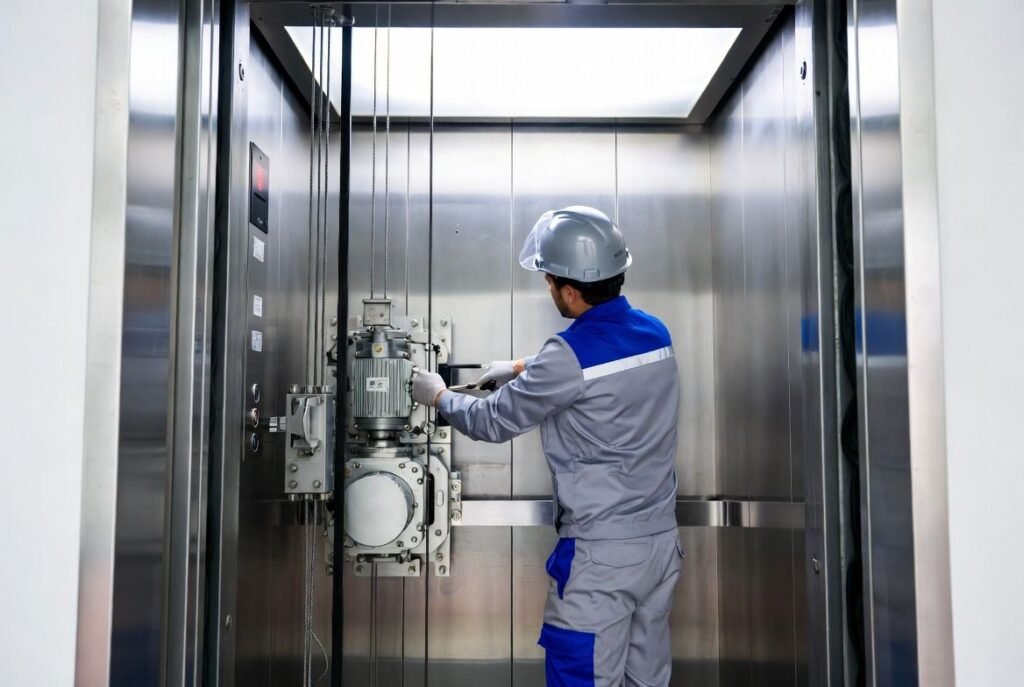
- Emergency call-out labour rates are significantly higher than scheduled visit rates, and replacement parts sourced urgently via international freight cost far more than items stocked locally in Hard System’s Damascus warehouse.
- Downtime cost modelling for Damascus commercial buildings: every day of elevator unavailability has a calculable impact on tenant satisfaction scores, lease renewal probability, and assessed building valuation.
- The deferred maintenance trap: five years of skipped service visits do not produce five years of savings. They produce an accumulated capital expenditure crisis when multiple components reach end-of-life simultaneously.
- Hard System’s maintenance ROI worksheet documents the maintenance contract cost over 5 years versus the actual cost of a major refurbishment triggered by neglect available as a free client-facing planning tool.
Energy Efficiency — The Often-Overlooked Benefit of Regular Elevator Maintenance
How a Well-Maintained Elevator Uses Less Power
- VFD (Variable Frequency Drive) parameter drift: drive settings shift over time and require periodic re-calibration. A mistimed acceleration curve increases energy consumption by 10–15% invisibly, adding to the building’s monthly electricity bill.
- Brake drag detection: a partially-engaged brake creates continuous mechanical resistance against the drive motor, increasing running current and generating excess heat. This is detectable only through current measurement during a routine maintenance visit.
- Door operator alignment: a misaligned door operator motor works harder on every open/close cycle. In a busy Damascus commercial building making 200+ door cycles per day, the cumulative annual energy waste is measurable in kilowatt-hours.
- Regenerative drive calibration: regenerative drives only recover their rated percentage of braking energy if load-weighing system calibration is current a maintenance task that delivers a quantifiable energy dividend.
Energy Efficiency in the Damascus Market Context
- Rising electricity tariffs in Syria mean elevator running costs are a genuine budget line for Damascus building managers. Efficiency improvements have a direct, calculable financial return, not just an environmental narrative.
- UPS battery health monitoring: a degraded UPS battery draws more charging current from the mains while delivering fewer rescue cycles per charge. Annual battery-health assessment by Hard System prevents silent efficiency loss.
- Standby mode optimisation: elevator control boards can be configured for low-power standby after defined periods of inactivity. This software parameter review is included in Hard System’s quarterly maintenance protocol at no additional charge.
- Cabin lighting and ventilation audit: LED lamp degradation and fan motor bearing wear are checked at every maintenance visit individually marginal, but cumulatively significant over a 25-year equipment life in a Damascus climate.
Operational Reliability — Keeping Your Building Running Without Interruption
How Maintenance Minimises Unplanned Downtime
- MTBF (Mean Time Between Failures) data: industry research shows elevators on structured maintenance programmes experience 5–8 times longer intervals between unplanned failures compared to uncontracted units.
- Early fault detection methods used during Hard System visits: door-timing measurement (closing force and speed), motor current trending, and vibration signature assessment flag degrading components weeks before failure.
- Local spare parts inventory advantage: Hard System Damascus stocks fast-wear items (door contacts, rope clips, lubrication consumables, control board fuses). A contracted building receives same-day parts; an uncontracted building waits for international freight.
- Ride quality assurance: every Hard System maintenance visit includes a cabin levelling accuracy check (target ±5 mm per EN 81-20 §5.2.5) and jerk assessment. Deteriorating ride quality is the first user-visible signal of mechanical wear.
Maintenance Frequency by Building Type in Damascus
- High-rise residential (10+ floors): monthly visits recommended higher daily trip cycles, faster component wear, and greater consequence of downtime when many residents are affected simultaneously.
- Mid-rise residential (4–9 floors): quarterly visits aligned with EN 81 guidance. Door adjustment and suspension rope inspection are the priority items at each scheduled visit.
- Commercial and retail buildings: monthly visits during peak trading periods. Hard System offers flexible early-morning or evening scheduling to avoid disruption to tenants and customers.
- Villas and low-use buildings (home elevators): minimum semi-annual visit. However, ARD battery capacity test and door interlock verification must not be skipped regardless of usage level safety devices degrade on calendar time, not trip count alone.
Hard System’s Elevator Maintenance Services in Damascus
What’s Included in a Hard System Maintenance Visit
- Pre-visit preparation: a digital work-order is generated from component condition history logged at the previous visit. The technician arrives with targeted priorities, not a blank checklist.
- On-site: 47-point inspection covering mechanical systems, electrical circuits, safety chain devices, door system (car and landing), cabin interior, pit equipment, and machine room or MRL cabinet. Every item is scored and time-stamped.
- Post-visit: a condition report is emailed to the building owner or property manager within 24 hours, with traffic-light status (green / amber / red) per component category and recommended action timelines for amber and red items.
- Emergency priority response: all Hard System maintenance-contracted buildings in Damascus are flagged for priority dispatch, with a target 2-hour on-site response time for critical faults that trap passengers or render the elevator non-operational.
Hard System’s Maintenance Contract Tiers
- Basic: scheduled labour visits and completion of the statutory maintenance logbook suitable for low-use buildings and owners managing tight operating budgets.
- Comprehensive: all Basic inclusions, plus consumables (lubricants, minor electrical contacts, door seals, cabin lighting) and priority emergency call-out response within 2 hours.
- Full-Inclusive: all Comprehensive inclusions, plus parts replacement (excluding major components), annual safety audit management, and Ministry of Housing inspection coordination and attendance.
- Bespoke portfolio contracts: available for property management companies and developers operating multiple buildings across Damascus and Damascus Countryside consolidated reporting, single point of contact, and volume pricing.
Frequently Asked Questions — Regular Elevator Maintenance
| Question | Answer |
| How often should an elevator be serviced in Syria? | Monthly (high-use / high-rise), quarterly (mid-use residential), semi-annual (low-use / villa) per EN 81 guidance and Syrian Ministry of Housing inspection requirements. |
| What are the risks of skipping elevator maintenance in Damascus? | Passenger entrapment, component failure, regulatory shutdown by Ministry of Housing, voided insurance coverage, and accelerated wear leading to costly early refurbishment. |
| Does a Hard System maintenance contract cover emergency call-outs? | Yes Comprehensive and Full-Inclusive contracts include priority 2-hour emergency response. Basic contracts can add call-out cover as an optional extra. |
| How does Damascus’s climate affect maintenance requirements? | Heat (40°C+), dust storms, and grid instability all accelerate component wear. Hard System recommends one service-frequency tier higher than European baseline for Damascus installations. |
| Can Hard System maintain an elevator installed by another company? | Yes Hard System performs a condition audit on any brand of elevator, then provides a maintenance proposal. The audit report is provided free of charge for new clients. |
| What documentation does Hard System provide after each maintenance visit? | Digital and signed hard-copy maintenance log entry, component condition report (traffic-light graded), defect notices with recommended action timelines, and updated service history file. |
| How does regular maintenance affect elevator insurance in Syria? | A current, signed maintenance log is typically required by insurers to support elevator-related claims. Hard System’s documentation standard meets this evidentiary requirement. |
Book Your Elevator Maintenance Contract with Hard System Today
Regular elevator maintenance addresses safety, regulatory compliance, equipment longevity, and energy efficiency all through a single contract decision.
Contact Hard System directly via WhatsApp or phone for Damascus and Damascus Countryside clients.