Why Safety Standards for Elevator Installation Are Non-Negotiable
Elevator failures are almost never random. They result from skipped standards or unqualified installation teams and the consequences fall on the property owner, not the contractor who cut corners.
In Syria, legal liability for elevator incidents falls directly on the property owner when no valid compliance certificate exists. Insurance policies in Damascus are tightening too: carriers increasingly require documented EN 81 compliance before covering any elevator-related incident.
Hard System (the best elevator company in Syria) has managed 100+ compliant installations in Damascus with zero failed final safety inspections. Here is the full picture of what compliance actually requires and what happens when it is ignored.
The International Framework EN 81 Series Explained
EN 81-20 Safety Rules for Construction & Installation of Lifts
EN 81-20 is the primary global standard governing all new elevator installations. It covers the shaft, car, machinery room, and every safety device fitted to the system from minimum clearances and door locking mechanisms to speed governors and overspeed protection.
EN 81-20 superseded both EN 81-1 (traction elevators) and EN 81-2 (hydraulic elevators). Many projects in Damascus still reference those outdated editions, which creates a compliance gap that only surfaces at inspection time. Hard System designs and installs exclusively to EN 81-20, ensuring every project is future-proof against code tightening.
EN 81-50 Tests & Examinations for Elevator Safety Components
EN 81-50 is the companion standard to EN 81-20. Where EN 81-20 defines what must be installed, EN 81-50 defines how every safety-critical component must be type-tested and examined covering braking systems, safety gears, buffers, interlocks, and overspeed governors.
Non-certified components fail EN 81-50 tests and void the installation certificate. This is a hidden but extremely costly risk on budget projects. Hard System sources only EN 81-50 certified components and provides full documentation with every installation package.
EN 81-28 & EN 81-70 Alarm Systems & Accessibility
EN 81-28 mandates a two-way emergency communication system inside the car especially critical given Damascus’s frequent power outage conditions, where passengers can be trapped for extended periods without a functioning intercom.
EN 81-70 covers accessibility provisions for people with disabilities. This is required for public buildings and increasingly expected in residential developments. Damascus municipal planning guidelines are moving toward mandatory EN 81-70 compliance for all buildings above five floors.
Hard System installs compliant alarm systems and accessible cab interiors on all projects as a baseline specification not as an optional upgrade.
Syrian Building Code Requirements for Elevator Safety
National Code Alignment with EN 81
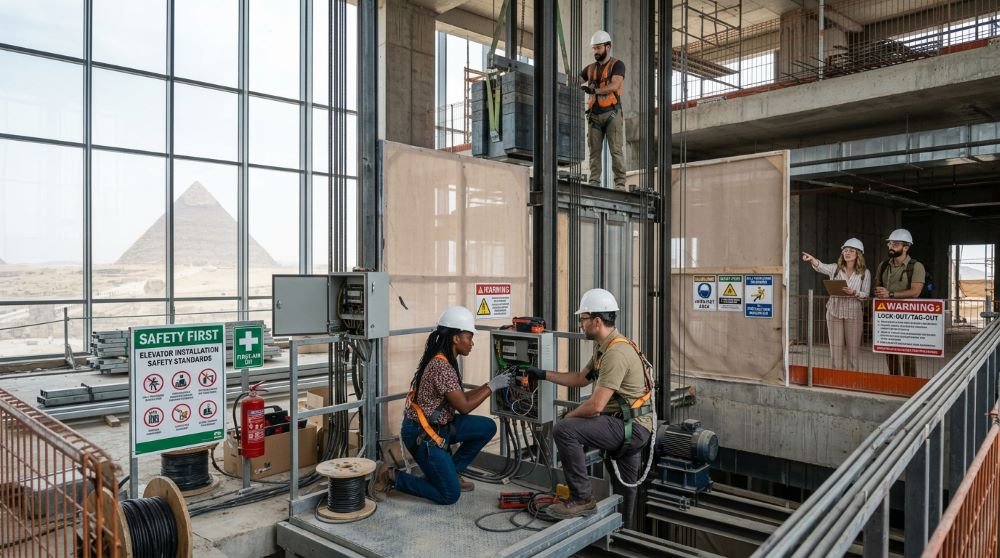
Syria’s National Building Code formally references EN 81. Full compliance with the EN 81 series satisfies the Syrian code simultaneously there is no separate domestic standard that requires parallel documentation.
Both the building permit and the occupancy certificate in Damascus require documented elevator safety compliance. A third-party inspection by a licensed engineer is mandatory before first use, covering the shaft, pit, machine room, car, and all safety devices. Hard System manages the complete documentation and inspection process on behalf of clients.
Damascus Municipality Permit & Inspection Process
The process runs in three defined stages:
- Stage 1: Technical drawings submitted to the municipality engineering department for pre-approval.
- Stage 2: Site inspection at practical completion before the elevator is commissioned and handed over to the client.
- Stage 3: Annual re-inspection certificate required lapsed certificates create immediate legal and insurance exposure for the property owner.
Hard System maintains an active working relationship with Damascus municipality offices, which measurably reduces approval timelines compared to self-managed submissions.
Mandatory Safety Devices Under Syrian / EN 81 Requirements
- Overspeed governor & safety gear: must arrest the car if descending speed exceeds 115% of rated speed.
- Door interlock system: prevents car movement unless all landing and car doors are fully closed and locked.
- Pit stop switch, final limit switches, and buffers: compulsory at both ends of travel inspected at every annual visit.
- Car lighting & emergency lighting: minimum 50 lux at floor level; battery-backed emergency lamp required.
Critical Safety Devices & Their Installation Requirements
Overspeed Protection Governor & Safety Gear
The governor rope triggers the safety gear mechanically if descending speed exceeds the set limit. No electrical power is required it is a pure mechanical failsafe. Safety gear must be tested under full load at rated speed during commissioning, not at reduced load or speed; a reduced-load test does not satisfy EN 81-50 requirements.
Governor rope tension and condition must be verified at every annual maintenance visit. Damascus’s frequent power fluctuations increase motor stress and heat cycling; Hard System specifies governors rated for high-cycle environments on all installations.
Door Safety Systems Interlocks & Light Curtains
Landing door interlocks are the single most-inspected component on any elevator. They must be mechanically and electrically locked before the car can move no software override is acceptable. The car door protective device must be a full-height multi-beam light curtain under EN 81-20; the old single rubber edge is no longer compliant.
Door open/close kinetic energy is capped by EN 81-20 to prevent injury and must be verified with a calibrated force gauge at commissioning. Damascus’s dust levels accelerate wear in door tracks; Hard System specifies sealed-track door systems as standard on all projects.
Electrical Safety Earthing, ELCB & Isolators
All metalwork the car frame, counterweight, guide rails, and shaft steelwork must be bonded to a common protective earth. An Earth Leakage Circuit Breaker (ELCB) or RCD is mandatory to protect against electric shock in the pit and machine room. A dedicated isolator switch at the machine room entrance allows safe de-energization without entering the machine space.
Earthing quality is highly variable on older Damascus sites. Hard System conducts earth loop impedance testing on every installation and documents the result a figure your inspector will ask for.
Buffer & Pit Safety Requirements
Oil buffers are required for speeds above 1.0 m/s; spring buffers apply at lower speeds. Both must be EN 81-50 certified and engineered to decelerate the car or counterweight from rated speed to rest within the deceleration limits defined in the standard.
The pit stop switch must be within easy reach of a person standing in the pit and is tested at every periodic inspection. Pit lighting requires a permanent switched fixture accessible from inside the pit and from the landing above.
Power Backup & Electrical Safety The Damascus Priority
ARD Automatic Rescue Device (Power Failure Protocol)
EN 81-20 §5.10.7 requires that an elevator return to a landing and open its doors on mains power failure. The Automatic Rescue Device (ARD) fulfils this using battery or capacitor power for a single rescue operation. The ARD must be tested monthly to verify battery health.
In Damascus, outages can run 6–12 hours. An ARD alone is insufficient for these conditions. A UPS or generator interlock is the responsible specification Hard System makes this the default on every project, not an optional extra.
| Hard System Power Specification Damascus Standard |
| ARD: Fitted as standard on all installations (EN 81-20 §5.10.7 minimum requirement) |
| UPS: Sized for a minimum of 3 full return-to-floor cycles with low-battery alarm to BMS |
| Generator interlock: Automatic start once generator power is stable; MEP coordination documented |
| SPD: Surge protection devices at main panel AND elevator controller input |
| VFD: Variable frequency drives on all traction motors reduces starting current up to 60% |
Generator Interlock & UPS Integration
When a building has a backup generator, the elevator must interlock to start automatically once generator power is stable. Transfer time from mains to generator must not exceed the ARD battery reserve MEP coordination between the elevator contractor and the MEP engineer is mandatory during design, not an afterthought at commissioning.
UPS on elevator control panels protects against voltage spikes and brownouts that corrupt control logic this is one of the most common failure modes on Damascus elevators. Hard System provides full MEP coordination documentation to prevent interlock conflicts with other building services.
Surge Protection & Earthing in High-Fluctuation Grids
Damascus’s grid regularly experiences voltage fluctuations of ±15%. Elevator control boards are highly sensitive to transient spikes, and a single unprotected surge event can corrupt the control logic permanently. Surge protection devices at the main panel and at the elevator controller input are a minimum specification.
Variable frequency drives on traction motors provide inherent surge tolerance, reduce starting current by up to 60%, and improve energy efficiency simultaneously. Hard System specifies VFDs on all traction installations as a baseline.
Fire Safety Standards for Elevator Installation
Firefighters’ Elevator Requirements (EN 81-72)
Buildings above a defined height require a dedicated firefighters’ elevator with a fire-rated shaft and protected lobby. EN 81-72 specifies a one-hour fire rating on the shaft enclosure, a protected power supply, and a priority recall switch at the fire service entrance.
Firefighters’ mode bypasses normal passenger controls, allowing direct floor selection by emergency services under Phase 2 operation. Newer high-rise residential projects in the Mezze and Kafr Sousa corridors of Damascus are now subject to firefighters’ elevator requirements under updated planning conditions.
Fire-Rated Shaft Enclosure & Landing Doors
Shaft walls must achieve the required fire resistance rating typically EI 60 or EI 90 depending on building classification. Landing doors must carry an identical or higher fire resistance rating to the shaft enclosure. Certified fire doors only; non-rated doors void both the elevator certificate and the building’s fire compliance.
All penetrations in shaft walls cable entries, ventilation openings must be fire-stopped to maintain the rating. This is frequently overlooked on projects where the elevator contractor and the builder are not coordinating actively. Hard System specifies fire-rated landing doors as standard on all projects with more than six floors.
Elevator Recall on Fire Alarm Activation
Phase 1 recall: on fire alarm activation, all elevators automatically return to the designated recall floor (ground level) and doors open removing all passengers and making the system available to emergency services. Phase 2 switches the firefighters’ elevator to manual key operation.
Integration with the building fire alarm control panel (FACP) is mandatory and must be coordinated during MEP design it cannot be added as a site fix during commissioning. Hard System provides the FACP integration specification as part of the electrical design package on every project.
Ongoing Compliance & Maintenance The Annual Obligation
Mandatory Annual Inspection Regime
Damascus municipality requires annual inspection by a licensed engineer. The inspection certificate must be displayed inside or adjacent to the elevator car. A failed inspection results in a mandatory shutdown notice loss of use, legal exposure, and reputational damage for the building.
The checklist covers all safety devices, electrical earthing, door interlocks, governor and safety gear, buffers, lighting, and emergency communications. Hard System maintenance contracts include full pre-inspection preparation. Clients across the Hard System portfolio achieve a first-time pass rate.
Preventive Maintenance Schedule
| Interval | Tasks Required |
| Monthly | Door operation & force check, oil levels, ARD test, emergency lighting test, intercom function test |
| Quarterly | Governor rope condition, brake adjustment, guide rail lubrication, control panel visual inspection |
| Annually | Full load test, safety gear drop test, governor calibration, earth loop impedance test, buffer condition assessment |
Hard System provides digitally recorded maintenance logs for every visit. These records are admissible as evidence of compliance in any legal dispute involving the property owner.
Modernization & Upgrade to Current Safety Standards
Pre-2000 installations in Damascus frequently lack: full-height light curtains, EN 81-20 compliant door interlocks, and ARD. All three are now required for any elevator in legal operation. A non-compliant elevator carries unlimited liability for the building owner in the event of any incident regardless of the age of the installation.
Safety-critical upgrades can be phased to spread cost: door systems first, then electrical, then mechanical components. Hard System offers a free safety audit for any existing elevator identifying the minimum works required to achieve compliance, with no obligation to proceed.
Choosing between Elevators and Escalators? Check out our comprehensive guide on Elevators and Escalators to learn about the latest technologies and safety features.
FAQ Safety Standards for Elevator Installation
Which safety standard applies to my elevator in Syria?
EN 81-20 (installation) and EN 81-50 (component testing) apply to all new elevator installations in Syria. Existing installations are assessed against the EN 81 edition current at their installation date, with mandatory upgrades required for safety-critical items that have changed. Hard System issues a written standards compliance statement with every installation a document your insurer and municipality will accept.
What happens if my elevator fails the annual inspection?
Damascus municipality issues a closure notice. The elevator cannot legally operate until all defects are rectified and a re-inspection is passed. Building owners face potential civil liability if the elevator was operated with known defects and ‘I didn’t know’ is not a defence when the annual inspection is a documented legal requirement.
Hard System offers emergency remediation to restore compliance within 48–72 hours in most Damascus cases and manages the re-inspection coordination on the owner’s behalf.
Is a UPS mandatory for elevators in Syria?
ARD is the minimum requirement under EN 81-20. A standalone UPS is not currently mandated by the code. However, Damascus power reliability makes UPS essential in practice and insurance providers and premium property developers are increasingly requiring UPS as a contractual specification. Hard System specifies it on all projects as a professional standard.
How often must the safety gear be tested?
A full load safety gear drop test is required at commissioning and at every major maintenance interval typically every five years, or per the inspection authority’s schedule. Governor calibration is required annually as part of the standard maintenance cycle. Hard System conducts all mandatory tests with the client or their representative present and provides a signed test report.
Why Hard System Is Damascus’s Authority on Elevator Safety Compliance
The only Damascus-based firm offering pre-pour shaft audit, EN 81 design review, and post-installation certification under one contract.
Every project is managed by a licensed structural and electrical engineer not a sales team.
Free safety audit for existing elevators minimum compliance scope identified at no cost or obligation.
Is your elevator or your new build fully compliant with current safety standards?
Hard System will tell you free of charge.