Introduction: The Hidden Efficiency Crisis in Syria’s Multi-Floor Restaurants
Every day across Syria’s hotels, restaurants, hospital cafeterias, and commercial dining facilities, kitchen staff carry loaded trays up flights of stairs — slowly, dangerously, and expensively. A single staff member making ten trips per service between a basement kitchen and a ground-floor dining room loses approximately 45 minutes of productive working time daily. In a busy restaurant running two services per day, that is 90 minutes of pure labour waste — every single day — from a problem that a properly specified food lift eliminates entirely.
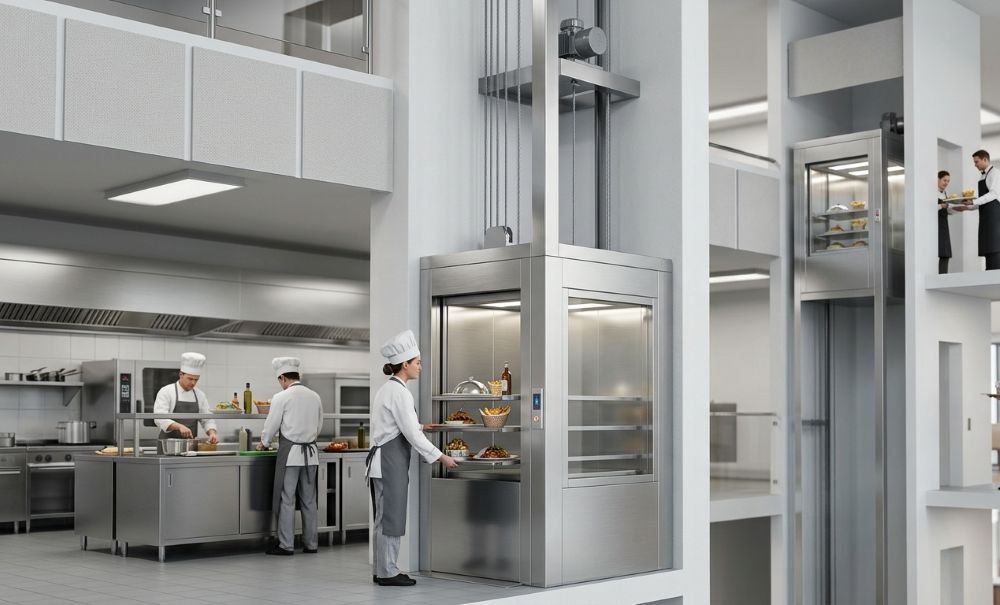
The food lift — also called a dumbwaiter, service lift, or kitchen lift — is one of the most cost-effective investments a Syrian restaurant owner, hotel operator, or healthcare facility manager can make. Yet despite their clear operational ROI, food lifts remain chronically under-specified and under-invested in Syria’s food service sector. The most common reason? Building owners and operators simply do not know enough about the product, the price range, or how to buy correctly.
This guide changes that entirely. From entry-level manual dumbwaiters to fully automated food service lift systems for multi-floor hotels, we cover every type, every specification variable, every true cost component, and every Syria-specific consideration that should drive your purchasing decision. By the end, you will know exactly what you need, what it costs, and how Hard System delivers it.
Section 1: What Is a Food Lift and Why Does Every Multi-Floor Syrian Restaurant Need One?
A food lift — technically classified as a service lift or dumbwaiter — is a small freight elevator designed specifically to transport food, beverages, dishes, laundry, documents, and other service items between floors of a building. Unlike passenger elevators, food lifts carry no passengers. They are mechanical workhorses: compact, efficient, and designed for the continuous high-cycle-rate operation that busy commercial kitchens demand.
In Syrian commercial hospitality — restaurants, hotels, hospital cafeterias, wedding halls, rooftop dining venues, and multi-floor commercial facilities — the food lift is the arterial connection between production (kitchen) and service (dining area). Without it, staff become the transport system, with all the labour cost, injury risk, food spillage, and service delay that entails.
Who Needs a Food Lift in Syria?
- Multi-floor restaurants with kitchen on a different level than the dining area
- Hotels with room service from a centrally located kitchen
- Hospital cafeterias and clinical nutrition departments serving multiple ward floors
- Wedding halls and banquet venues with ground-level kitchens and elevated ballrooms
- Rooftop restaurants and sky bars in Syrian commercial towers
- Commercial office buildings with staff cafeterias on a different floor from the kitchen
- Supermarkets and retail food outlets with storage on a lower floor
- Pharmacies with dispensary storage across multiple floors
- Laundry operations in hotels needing linen transport between floors
| $2,400 | Annual labour cost saving from eliminating manual floor-to-floor food transport in a busy Syrian restaurant running 2 services daily — at current Syrian hospitality labour rates. Food lift installation pays for itself. |
Section 2: The Four Main Types of Food Lifts — Which One Does Your Operation Need?
Not all food lifts are the same — and choosing the wrong type for your operation means either under-serving your volume requirements or over-investing in capacity you do not use. The four types below cover the full range of Syrian commercial hospitality and healthcare applications.
| TYPE 1 | Manual Rope / Counterweight Dumbwaiter — USD 800 – 2,500 installed |
| • Operation: Hand-pulled via rope and pulley with counterweight balance — no electric motor required • Capacity: 20–50 kg per trip • Car dimensions: Typically 400×400mm to 600×600mm floor area, 500–700mm height • Speed: Manual — approximately 0.15–0.25 m/s depending on operator • Rise height: Practical maximum 4–6 metres (one floor difference) • Power requirement: None — fully mechanical • Best for: Low-volume operations, budget-constrained installations, unreliable power supply areas • Limitation: Labour-intensive, limited capacity, no speed control, unsuitable for high-volume service Syria Note: Manual dumbwaiters are the most power-supply-independent food lift option — a genuine advantage in Syrian areas with severe or unpredictable power outages. However, their limited capacity and manual operation make them unsuitable for busy commercial restaurants. They are most appropriate for small family-run operations or as backup systems. |
| TYPE 2 | Electric Dumbwaiter — Standard Commercial — USD 3,500 – 8,500 installed |
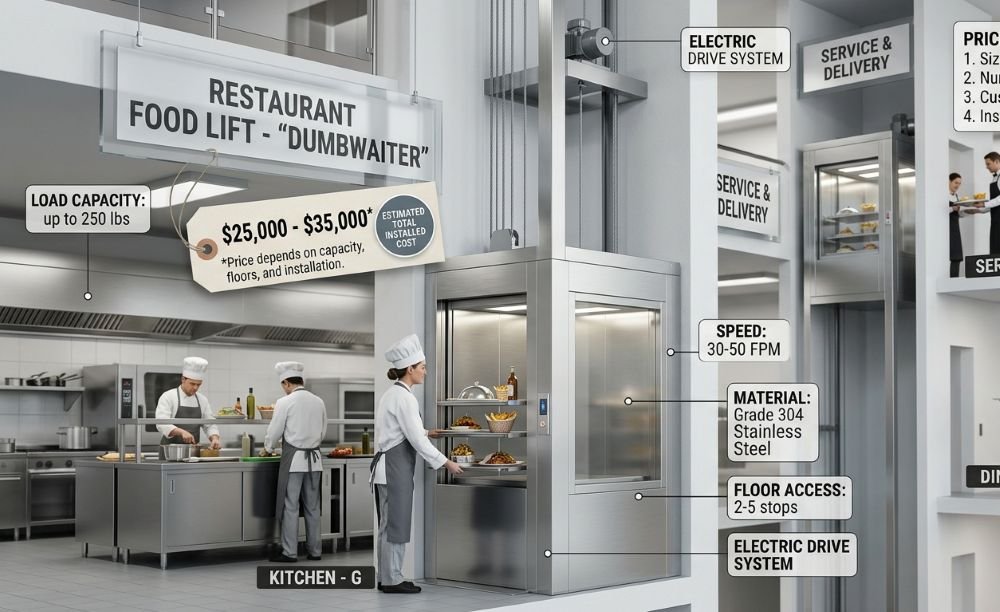
| • Operation: Electric motor with control panel, call-send buttons at each floor • Capacity: 50–150 kg per trip (standard commercial range) • Car dimensions: 600×600mm to 900×900mm floor area, 700–1,000mm height • Speed: 0.3–0.5 m/s (adjustable via VFD on premium models) • Rise height: 2–12 metres (multi-stop configurations available) • Power requirement: Single-phase 220V or three-phase 380V depending on motor rating • Floors served: 2–4 floors standard, more with extended rail system • Best for: Standard restaurant operations, small hotels, hospital nutrition departments, pharmacy multi-floor • Features: Stainless steel car interior (hygiene specification), interlocked landing doors, overload sensor, emergency lowering Syria Note: The electric dumbwaiter is the most appropriate food lift type for the majority of Syrian commercial restaurants and hospitality operations. Specify single-phase 220V motor for sites with unreliable three-phase supply. Always include a UPS backup for emergency lowering — a critical feature given Syria’s power interruption frequency. Hard System stocks in-country parts for all electric dumbwaiter brands we install. |
| TYPE 3 | Hydraulic Food Service Lift — Heavy Duty — USD 9,000 – 22,000 installed |
| • Operation: Hydraulic ram or screw-drive system for smooth, vibration-free movement • Capacity: 150–500 kg per trip — suitable for full trolley loads • Car dimensions: 900×900mm to 1,200×1,200mm floor area — accommodates full service trolleys • Speed: 0.15–0.25 m/s (slower, gentler movement ideal for plated food) • Rise height: 2–6 metres per hydraulic unit (tandem systems for greater heights) • Power requirement: Three-phase 380V, dedicated circuit • Best for: Hotels with room service trolleys, hospital meal distribution systems, large wedding halls, high-volume restaurant kitchens • Features: Full trolley access, floor-level loading (no step), stainless steel hygienic interior, full glass or solid door options, smooth start/stop for plated dishes Syria Note: Hydraulic lifts are the correct specification for Syrian hotel room service operations and hospital meal distribution — any application where full trolleys loaded with plated meals must be transported without spillage or vibration. The hydraulic system’s smooth movement profile protects plated presentation. Specify triple-sealed hydraulic cylinder seals for Syrian summer temperatures (hydraulic oil viscosity changes significantly above 40°C operating temperature). |
| TYPE 4 | Automated Multi-Floor Food Lift System — USD 18,000 – 55,000+ installed |
| • Operation: Fully automated with touchscreen control, multiple call points, and programmable dispatch logic • Capacity: 100–300 kg per trip (varies by model) • Car dimensions: 800×800mm to 1,200×1,200mm — configured to project requirements • Speed: 0.5–1.0 m/s with soft-start/stop • Rise height: No practical limit — serves any number of floors • Power requirement: Three-phase 380V with dedicated control panel • Floors served: 3–15+ floors standard • Best for: Multi-floor hotels, hospital nutrition complexes, large commercial kitchen-to-multiple-dining-area operations, luxury residential towers • Features: Touchscreen dispatch, priority floor assignment, usage logging, remote monitoring capability, full stainless hygienic interior, interlocked fire-rated landing doors Syria Note: Automated multi-floor food lift systems represent the premium end of the Syrian hospitality and healthcare market. They are the correct specification for any Syrian hotel with 5+ floors of room service, any hospital with centralised kitchen serving 3+ ward floors, and any multi-level commercial dining complex. Hard System provides full system design, installation, commissioning, and maintenance for automated food lift systems — including remote monitoring integration. |
Section 3: Food Lift Price in Syria — The Complete Cost Breakdown
The purchase price of a food lift unit is only one component of the true installed cost. Syrian building owners and restaurant operators who have been surprised by final project costs after receiving an attractive initial quotation have almost always encountered the same set of hidden cost components. This section presents the complete cost picture.
3.1 The Full Installed Cost — What Is Included and What Is Usually Not
| Cost Component | Manual Dumbwaiter | Electric Dumbwaiter | Hydraulic Lift | Automated Multi-Floor |
| Unit purchase price (FOB Syria) | $500–$1,200 | $2,000–$5,500 | $5,000–$14,000 | $10,000–$35,000 |
| Shaft / hoistway civil works | $200–$600 | $800–$2,500 | $1,500–$4,000 | $3,000–$10,000 |
| Electrical installation | None | $400–$900 | $600–$1,500 | $1,500–$4,000 |
| Landing doors (per floor) | $150–$300 each | $300–$600 each | $500–$1,000 each | $700–$1,500 each |
| Stainless steel car interior upgrade | N/A | $300–$700 | Included | Included |
| UPS emergency lowering system | N/A | $300–$600 | $400–$800 | Included |
| Commissioning and testing | Minimal | $200–$400 | $400–$800 | $800–$2,000 |
| Import duties and freight (approx.) | $100–$250 | $400–$1,200 | $800–$2,500 | $2,000–$6,000 |
| TOTAL INSTALLED (estimate) | $800–$2,500 | $3,500–$8,500 | $9,000–$22,000 | $18,000–$55,000+ |
| Always request a fully itemised quotation that explicitly includes civil works, electrical installation, all landing doors, UPS system, import duties, and commissioning. Quotations that show only the unit price are systematically underrepresenting the true project cost by 35–60%. Hard System provides complete scope quotations as standard practice. |
3.2 The Syria-Specific Cost Adjustments
Several cost factors specific to the Syrian market affect the final installed price of any food lift. Currency exchange rate exposure is the first: all food lift equipment is priced in USD or EUR. Between project approval and equipment delivery (typically 8–14 weeks), exchange rate movements directly affect the Syrian pound equivalent cost. Hard System locks in equipment pricing at the time of purchase order to protect clients from exchange rate deterioration during the delivery window.
Customs duties and import classification is the second factor. Food lifts are classified under different HS codes depending on their drive mechanism and primary function — with duty rates varying accordingly. Incorrect HS classification — a common error with ad-hoc importers — results in unexpected duty surcharges at port clearance. Hard System’s established import process uses correctly classified documentation for every food lift type we import.
Shaft construction quality is the third factor. A food lift shaft that is not built to the correct dimensions (typically within ±10mm of design specification) causes installation complications that add USD 400–1,500 to installation cost in rework and modification. Hard System provides detailed civil works drawings to the building’s contractor before shaft construction begins — eliminating the most common source of installation cost overruns.
3.3 Price by Capacity — The Most Commonly Misunderstood Specification
| Capacity | Typical Application in Syria | Unit Price Range (USD) | Installed Cost Range (USD) |
| 25–50 kg | Small restaurant, pharmacy, home use | $600–$2,000 | $1,200–$4,000 |
| 50–100 kg | Standard restaurant, café, small hotel | $1,800–$4,500 | $3,500–$8,000 |
| 100–200 kg | Medium hotel, hospital nutrition dept | $3,500–$8,000 | $7,000–$16,000 |
| 200–300 kg | Large hotel, banquet hall, multi-floor dining | $6,000–$14,000 | $12,000–$25,000 |
| 300–500 kg | Hospital meal distribution, industrial kitchen | $10,000–$25,000 | $18,000–$45,000 |
| Most Syrian restaurant owners under-specify food lift capacity. The correct capacity is the maximum single-trip load you will ever need to move — not the average load. A food lift that trips its overload sensor every third trip will develop mechanical problems within 18 months and cause service disruptions that cost more than the initial capacity upgrade would have. Always specify capacity at 130% of your current maximum load. |
Section 4: Critical Specifications to Evaluate Before Purchasing
4.1 Car Interior Specification — Hygiene Is Not Optional
Food lifts in restaurants, hotels, and healthcare facilities must meet hygiene specifications appropriate for food-contact environments. The car interior must be constructed of food-grade stainless steel (Grade 304 minimum, Grade 316 for healthcare applications). Standard painted steel interiors are inappropriate for food service use — paint surfaces chip and harbour bacteria. Any food lift quotation for a Syrian restaurant or hospital that does not specify stainless steel interior should be rejected or upgraded.
Floor construction is a specific hygiene consideration. The car floor must be level with each landing to allow tray and trolley movement without lifting. A floor height differential of more than 15mm at any landing is a spillage and injury risk. Verify that the landing levelling accuracy is documented in the installation specification.
4.2 Landing Door Specification
Every floor served by the food lift must have a landing door — a physical barrier that prevents items from falling into the shaft when the car is at another floor. Landing doors must be interlocked with the car position: the car cannot move while any landing door is open, and a landing door cannot open when the car is not present at that floor. This interlock is a mandatory safety requirement, not an optional feature.
In Syrian commercial kitchens, landing door durability is a practical concern. Stainless steel landing doors resist the cleaning chemicals used in commercial kitchen environments. Powder-coated steel is acceptable for non-kitchen landings (dining areas, offices). Plastic or thin-gauge painted steel doors are inadequate for commercial food service use.
4.3 Control System Specification for Syria
Syria’s power supply instability makes control system specification more critical than in most international markets. The control board must include surge protection and voltage regulation to protect against the ±15–25% voltage fluctuations common in Syria’s commercial grid. A UPS system for emergency lowering is mandatory — when power fails with the food lift between floors and loaded with dishes, manual lowering capability prevents food spoilage and service disruption.
Call-send button placement is a practical operational consideration. In busy Syrian kitchen environments, controls must be operable with one hand (the other carrying a load) and must be resistant to water, steam, and food contamination. IP44-rated or higher control buttons are the minimum standard for kitchen-level landings.
4.4 Shaft Design Considerations
The food lift shaft must be designed as an integral part of the building structure — not an afterthought. Shaft dimensions must provide the correct clearances around the car on all four sides (typically 50–75mm minimum), adequate space for guide rails and counterweight (where applicable), and access panels for maintenance. A shaft that is too small forces the installer to use non-standard components or compromises maintenance access.
Fire rating is a building code consideration that is frequently overlooked in Syrian food lift installations. Where a food lift shaft penetrates a fire compartment boundary (such as between a kitchen and a dining area on separate floors), the shaft structure and landing doors may need to meet fire resistance ratings. Hard System’s project engineers review fire compartmentation requirements as part of every installation specification.
4.5 Capacity and Speed — The Service Volume Calculation
Selecting the correct capacity and speed requires a simple service volume calculation. Determine the maximum load per trip (heaviest single service load you will ever send), the number of trips required per hour at peak service, and the round-trip cycle time at the specified speed. If the cycle time multiplied by the peak trips per hour exceeds 60 minutes, you need either a higher speed or a second food lift.
For a Syrian restaurant with 80 covers, running 2 services per day, a standard 100 kg capacity electric dumbwaiter at 0.4 m/s typically provides adequate throughput. For a Syrian hotel with 150 rooms running room service, a 200 kg hydraulic lift or an automated multi-floor system is the minimum appropriate specification.
Section 5: Syrian Operating Conditions — What Your Food Lift Specification Must Account For
5.1 Power Supply Reliability
Syria’s commercial power supply experiences regular outages and voltage fluctuations that affect food lift operation in two critical ways. First, a food lift that stops between floors during a power outage with a loaded car creates an immediate service disruption and — if the car is carrying hot food — a food safety risk. UPS emergency lowering is mandatory in the Syrian context, not optional. Second, sustained voltage fluctuations below 350V cause electric motors to draw excess current, accelerating motor winding degradation.
Hard System specifies automatic voltage regulation and UPS emergency lowering systems as standard on all electric and automated food lift installations in Syria. These two components, adding approximately USD 400–900 to the installation cost, prevent the most common Syrian-specific failure modes and protect the motor warranty.
5.2 Summer Temperature Effects
Syrian summer ambient temperatures affect food lift performance in ways that international specifications do not account for. Electric motor windings in single-phase motors not rated for 40°C+ ambient temperatures experience accelerated insulation degradation during Syrian summer operation. Hydraulic systems using standard ISO 46 hydraulic oil experience viscosity reduction above 50°C operating temperature, causing inconsistent lift speed and potential seal damage. Hard System specifies tropical-rated motors and high-viscosity-index hydraulic oil for all Syrian food lift installations.
5.3 Dust and Kitchen Humidity Environment
Commercial kitchen environments in Syria combine high humidity from cooking operations with the fine dust particles that enter from external air. This combination creates a particularly aggressive environment for food lift mechanical and electrical components. Control board enclosures must be IP44 rated minimum (IP54 preferred) to resist steam and humidity ingress. Guide rail lubrication systems must use lubricants that resist displacement by moisture rather than standard dry-environment greases.
5.4 Parts Availability — The Brand Selection Imperative
The same parts availability reality that affects escalators applies equally to food lifts in Syria. A food lift brand without established in-country spare parts distribution is a liability risk. When the control board fails — an event that will occur at some point in the unit’s life — a 4-month parts wait means 4 months of manual stair transport. Hard System maintains in-country stock of control boards, motor assemblies, and door mechanism components for every food lift brand we install.
Section 6: The Return on Investment Case — Numbers That Justify Every Syrian Food Lift Purchase
The food lift investment decision should not be made on the basis of purchase price alone. The correct financial framework is return on investment across a 5-year horizon, incorporating labour savings, reduced crockery breakage, improved service speed, and reduced staff injury risk.
| ROI Factor | Calculation Basis | Annual Saving (USD) | 5-Year Value (USD) |
| Labour time saving | Staff member @ 90 min/day saved × 300 days × USD 4/hr | $1,800 | $9,000 |
| Reduced crockery breakage | 30% reduction in transit breakage × avg $2,000/yr breakage cost | $600 | $3,000 |
| Improved table turn time | 5-min faster service × 20 tables × 2 services × $3/table margin × 300 days | $1,800 | $9,000 |
| Reduced staff injury cost | 1 fewer slip/trip incident/year × avg $500 incident cost | $500 | $2,500 |
| Food quality improvement | Reduced spillage and temperature loss — estimated conservatively | $400 | $2,000 |
| TOTAL ANNUAL SAVING (estimate) | $5,100 | $25,500 | |
| Mid-range food lift installed cost | $6,000 – $8,500 | ||
| Payback period | 14 – 20 months |
| ROI SUMMARY: A standard commercial food lift installation in a Syrian restaurant or hotel generates estimated annual savings of USD 4,000–6,500 against an installed cost of USD 3,500–8,500. The payback period of 14–20 months makes the food lift one of the most rapidly self-financing investments in Syrian commercial hospitality. |
Section 7: The Syrian Food Lift Buyer’s Verification Checklist
Use this checklist to evaluate any food lift quotation before signing. Every item represents a common source of either cost overruns or operational disappointment in Syrian food lift projects.
- Does the quotation include shaft civil works, or just the lift unit?
- Are all landing doors (one per floor served) included and specified as stainless steel or appropriate grade?
- Is the car interior specified as food-grade stainless steel (Grade 304 minimum)?
- Does the electrical specification include surge protection and AVR for Syria’s power conditions?
- Is a UPS emergency lowering system included — essential for Syria’s power interruption environment?
- Is the motor specified for 45°C+ ambient temperature operation?
- Are the landing door interlocks confirmed as meeting the safety standard (car must be present before door can open)?
- Does the supplier stock in-country spare parts for the control board and motor?
- What is the warranty period — and does it explicitly cover power-related electrical failures?
- Does the supplier provide detailed shaft civil works drawings for your contractor?
- Is the food lift capacity specified at 130% of your current maximum load?
- What is the supplier’s emergency response time for service calls?
- Is there a structured preventive maintenance contract available?
- Has the supplier visited your site and verified the shaft dimensions before issuing the final price?
Frequently Asked Questions (FAQ)
Q1: What is the minimum ceiling height and shaft dimensions required for a food lift installation in Syria?
For a standard electric dumbwaiter with 100 kg capacity, the minimum shaft dimensions are approximately 800mm × 800mm internal clear dimension, with a pit depth of 300–400mm below the lowest landing level and a headroom of 500–600mm above the highest landing. The shaft walls must be constructed to support the guide rail loads. For hydraulic lifts with trolley access, the car dimensions and shaft must be sized accordingly — typically 1,000mm × 1,000mm minimum shaft internal dimension. Hard System provides full shaft specification drawings for every project before civil works begin.
Q2: How long does a food lift installation take from order to operation?
For a standard electric dumbwaiter, the typical timeline is 8–12 weeks from purchase order to operational commissioning: 6–8 weeks for equipment manufacturing and shipping, 1–2 weeks for customs clearance and site delivery, and 3–7 days for installation and commissioning. The shaft civil works (if not already complete) run in parallel with the equipment order and typically take 1–3 weeks depending on the number of floors. Projects where the shaft is ready when equipment arrives achieve commissioning at the short end of the range. Hard System manages the import and delivery timeline on behalf of clients.
Q3: What maintenance does a food lift require, and how much does it cost?
A commercial food lift requires monthly preventive maintenance including lubrication of guide rails and moving parts, safety system functional testing, door interlock verification, and electrical system check. The annual maintenance cost for a standard commercial dumbwaiter in Syria is USD 800–1,800 depending on the unit type and service tier. Hard System offers structured annual maintenance contracts for all food lifts we install, with monthly service visits and in-country emergency response.
Q4: Can a food lift be used to transport laundry, documents, or other items in addition to food?
Yes — food lifts classified as service lifts can transport any non-hazardous service items: laundry, documents, medical supplies, retail goods, and similar items. The specification should reflect the full range of intended use — particularly if medical supplies or regulated items will be transported, as hygiene and access control specifications may differ from a pure food service installation. Hard System designs service lift specifications to accommodate the full operational scope, including access-controlled landings for restricted-area applications.
Q5: Is a food lift the same as a goods lift, and are there weight limit differences?
Food lifts (dumbwaiters) and goods lifts (freight elevators) are distinct equipment categories under international classification. Food lifts are designed for items only — no passengers, smaller cars (typically up to 300 kg and 1.2m × 1.2m car floor area), and are approved only for service items. Goods lifts are larger freight elevators that can carry pallet loads and are used in warehousing and industrial applications. If your Syrian restaurant or hotel needs to transport items heavier than 300 kg or requires platform loading with a forklift, a goods lift specification is required.
Q6: Do food lifts come with any standard warranty in Syria?
The industry standard warranty for commercial food lift equipment is 12 months for mechanical components and 12 months for electrical/control components from date of commissioning. Hard System provides a 12-month installation warranty on all food lift projects covering parts and labour for warranty-covered failures. Equipment manufacturer warranties are maintained separately and are valid only when the unit is installed and maintained by an authorised service provider — which Hard System is for all brands we sell.
Q7: What is the difference in price between a locally assembled food lift and a fully imported unit?
Several Syrian suppliers offer locally assembled dumbwaiters using imported motors and domestically fabricated car and shaft components. These units typically cost 25–40% less than fully imported equivalent units. The trade-off is quality consistency — locally fabricated structural components and door mechanisms vary significantly in precision and durability, and are typically not covered by any manufacturer’s quality warranty. For temporary or low-cycle-rate applications, locally assembled units may be appropriate. For commercial restaurants and hotels running 50+ cycles per day, Hard System recommends fully imported units with verifiable quality certification.
Q8: Can a food lift be installed in an existing restaurant without closing the business?
Yes — in most cases. The installation of a food lift shaft typically requires 3–5 days of construction work that can be isolated from the operational dining area. The food lift installation itself typically takes 2–4 days. In most Syrian restaurant renovation projects, Hard System has completed food lift installations during business hours by confining the work zone and establishing a temporary service arrangement for the affected floor. We provide a detailed installation phasing plan for every restaurant project where business continuity during installation is required.
Conclusion: The Right Food Lift at the Right Price — with the Right Syrian Partner
A food lift is not a luxury for Syrian restaurants and hospitality operators — it is an operational necessity for any multi-floor food service business that takes its efficiency, staff safety, and service quality seriously. The return on investment is clear, the payback period is short, and the operational impact is immediate. The only question is which type and specification is right for your specific operation.
The price range is wide — from USD 800 for a manual dumbwaiter to USD 55,000+ for a fully automated multi-floor hotel system — because the applications are wide. What matters is matching the specification to your actual operational requirements, your building’s physical constraints, and Syria’s specific operating conditions. Buying the wrong specification, or buying from a supplier without in-country parts and service capability, costs far more than the initial saving suggests.
Hard System has installed and maintained food lifts, service lifts, escalators, and elevators across Syria’s commercial, hospitality, healthcare, and residential sectors. Our team combines factory-trained installation engineering, complete import logistics management, in-country parts inventory, and structured preventive maintenance contracts — everything a Syrian food service operator needs to make a food lift investment that performs for 15–20 years.
| Ready to Get an Accurate Food Lift Price for Your Syrian Restaurant or Hotel? Hard System offers free site assessments and fully itemised quotations for all food lift types — from standard restaurant dumbwaiters to automated multi-floor hotel systems. No hidden costs. No guesswork. |