
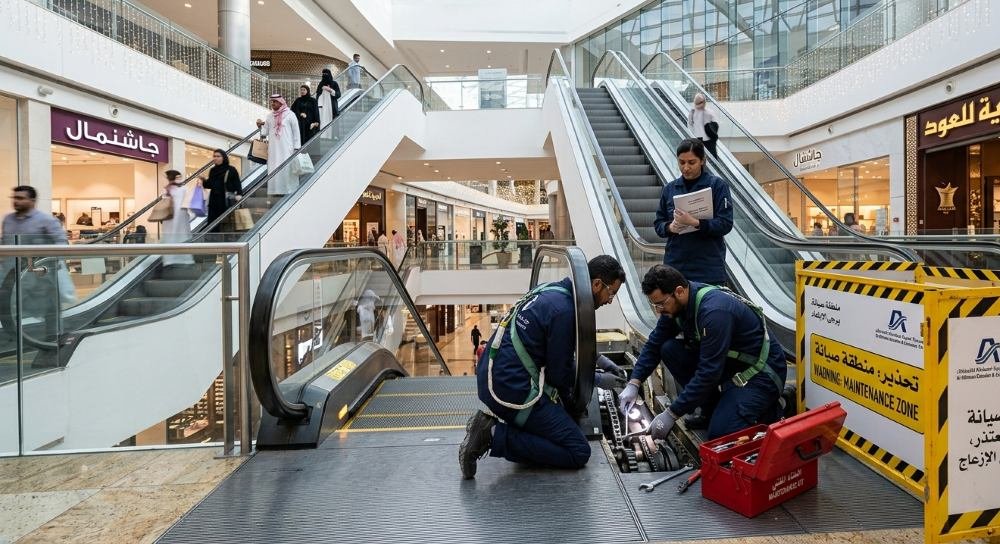
Introduction: The Most Profitable Investment a Syrian Building Owner Can Make
Two identical escalators. Same brand. Same model. Same rise height. Installed in two Syrian commercial malls on the same month. Five years later: one has had zero unplanned shutdowns and is running as smoothly as the day it was commissioned. The other has had eleven emergency callouts, one major control board replacement, a full step chain replacement, and three weeks of total downtime during peak commercial periods. The total cost difference between the two escalators? Over USD 45,000 with the lower-performing unit still costing more every month.
The single variable that explains the entire difference? Preventive maintenance. One building manager ran a structured, Syria-calibrated preventive maintenance programme from day one. The other relied on reactive service calling a technician only when something broke. Same escalator. Completely different outcomes.
This guide is the definitive preventive escalator maintenance resource for Syria’s commercial, healthcare, hospitality, and infrastructure sectors. It covers every maintenance task at every interval, every Syria-specific consideration that modifies international maintenance standards, every tool and lubricant specification, and every documentation requirement. Whether you are setting up a maintenance programme from scratch or auditing an existing one, this guide gives you the complete technical framework to do it right.
| 80% | Reduction in unplanned escalator shutdowns achievable through consistent preventive maintenance, compared to reactive-only maintenance approaches. (Source: KONE Global Service Research, 2022) |
| 3–5× | The cost differential between reactive repair and preventive maintenance for the same escalator component making preventive maintenance one of the highest-ROI investments in commercial building management. (Source: Elevator World Technical Report, 2023) |
Section 1: Why Preventive Maintenance Is Different
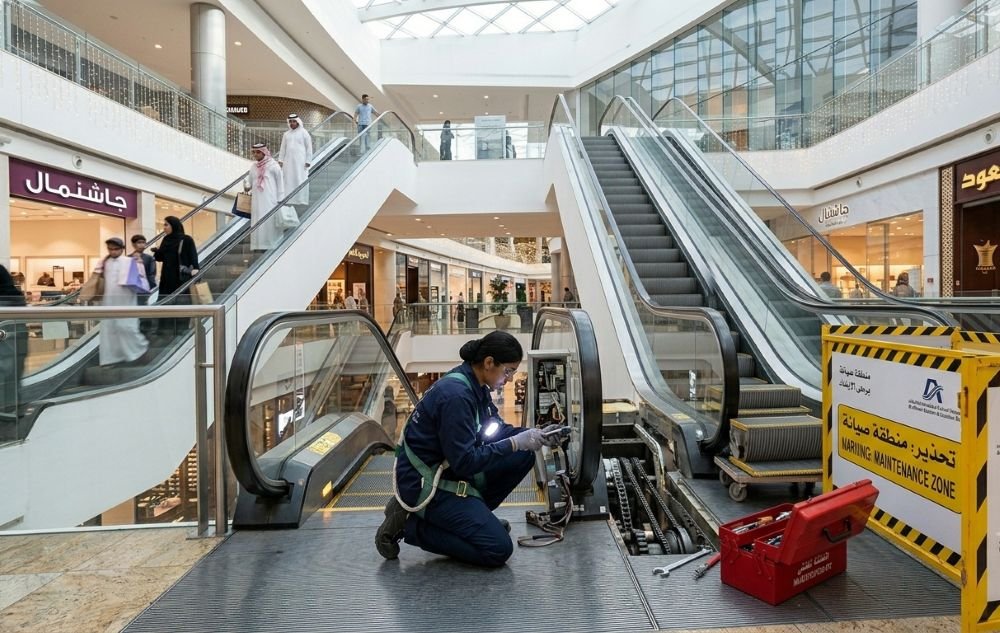
International escalator maintenance standards are written for temperate climates with stable power supplies and reliable parts chains. Syria is none of these things. Every maintenance interval, every lubrication specification, and every inspection frequency documented in a standard European or Asian manufacturer’s service manual needs to be adjusted upward for Syrian operating conditions.
The Four Syrian Escalator Stressors
Power instability is the first stressor. Syria’s commercial power grid regularly delivers voltage fluctuations of ±15–25% and periodic frequency deviations. Without protection, this accelerates control board degradation and VFD failure at 3–4× the manufacturer’s predicted rate. Preventive maintenance must include regular electrical system health checks that are simply not part of standard international schedules.
Dust and particulate loading is the second stressor. Syria’s ambient dust environment particularly in eastern cities and near construction activity introduces fine abrasive particles into step chains, bearing housings, and motor cooling systems at rates that invalidate quarterly lubrication intervals. Monthly lubrication is the Syria standard.
Temperature extremes are the third stressor. Syrian commercial spaces regularly reach 35–42°C in summer even with air conditioning running. Standard motors and gear lubricants rated for 40°C ambient operate at their design limit, not their optimal operating range, in these conditions. Thermal monitoring and high-temperature lubricant specification are Syria-specific preventive requirements.
Parts supply chain constraints are the fourth stressor. When a component reaches end-of-life in Syria, the replacement lead time particularly for non-standard brands can be 3–8 months. Preventive maintenance in Syria must therefore include proactive end-of-life assessment and advance parts ordering a discipline that European maintenance programmes simply do not need to incorporate.
| 12–18 months | Typical additional service life achieved by Syrian commercial escalators under a properly calibrated preventive maintenance programme, compared to standard international maintenance schedules applied without Syrian-specific adjustments. (Hard System field data, 2023) |
Section 2: The Five Principles of Effective Preventive Escalator Maintenance
Principle 1 — Scheduled, Not Reactive
Preventive maintenance is defined by its calendar-driven discipline. Every task has a defined interval; every interval is met regardless of whether the escalator appears to be functioning normally. The appearance of normal function is not evidence of normal component condition. Step chain elongation, bearing play accumulation, and lubricant degradation are all invisible to the casual observer — and all lead to failure if not addressed on schedule.
Principle 2 — Measured, Not Assumed
Every maintenance visit must produce documented measurements not just a record of tasks completed. Step chain elongation in millimetres. Bearing play in hundredths of a millimetre. Supply voltage at motor terminals. Motor winding insulation resistance. These measurements create a trend database that makes component failure predictable weeks or months before it occurs. Maintenance without measurement is inspection theatre it looks like maintenance but does not prevent failure.
Principle 3 — Syria-Calibrated, Not Manufacturer-Default
The manufacturer’s maintenance schedule is a starting point, not a final specification. Every interval in the manufacturer’s manual was designed for conditions that do not apply in Syria. Hard System’s Syria-calibrated maintenance schedule — documented in full in Section 4 adjusts every interval and lubricant specification to reflect Syria’s actual operating environment. Following manufacturer defaults in Syria produces failure rates that building owners then incorrectly attribute to poor equipment quality, when the real cause is inappropriate maintenance specification.
Principle 4 — Documented, Not Informal
A preventive maintenance programme that is not documented is not a programme it is a series of individual service events with no institutional continuity. Every visit must produce a written service report with task completion confirmation, measurement results, component condition ratings, and recommended actions with target dates. This documentation protects building owners legally, enables trend analysis, supports insurance compliance, and ensures that staff or supplier changes do not break the maintenance continuity.
Principle 5 — Comprehensive, Not Selective
Selective maintenance — servicing the components that are easy to access or that have recently caused problems, while deferring other tasks is one of the most common failure modes in escalator maintenance programmes. Every component system must be addressed on its defined schedule: mechanical systems, electrical systems, safety systems, and aesthetic/passenger experience components. Omitting any category creates hidden deterioration that eventually forces a reactive repair.
| Hard System’s maintenance contracts are built on all five principles. Our service reports include measurement data from every visit, our schedules are calibrated for Syrian conditions, and our contract terms define specific response time SLAs for every fault severity category. |
Section 3: The Six Component Systems That Preventive Maintenance Must Cover
A commercial escalator consists of six distinct component systems, each with its own failure modes, maintenance requirements, and service intervals. Effective preventive maintenance must address all six — not just the mechanical systems that are most visible.
System 1 — Drive System (Motor, Gearbox, Drive Chain)
The drive system converts electrical power into step movement. It consists of the main drive motor, a gearbox (worm gear or helical gear), a main drive chain connecting the gearbox output to the main drive shaft, and the main drive shaft itself. Failure of any component in this system stops the escalator completely. Drive system maintenance focuses on lubrication, thermal monitoring, chain tension management, and motor condition assessment.
System 2 — Step System (Steps, Step Chain, Step Rollers, Tracks)
The step system carries passengers from landing to landing. It consists of individual aluminium steps, the step chain that links and drives the steps, step rollers that guide each step along the incline and at the landings, and the step tracks that the rollers travel in. The step chain is the single highest-wear component in any escalator and the most common cause of unplanned shutdown. Step system maintenance is the most labour-intensive element of the preventive maintenance programme.
System 3 — Handrail System (Handrail, Drive Belt, Rollers, Guides)
The handrail system provides passenger grip support and must maintain exact speed synchronisation with the steps. It consists of the rubber handrail belt, handrail drive belt or friction wheel, handrail rollers, and handrail guide channels. Handrail speed desynchronisation where the handrail moves slower than the steps is a serious safety hazard and the most common consequence of deferred handrail system maintenance.
System 4 — Safety System (All Safety Circuits and Sensors)
The safety system consists of all sensors, switches, and circuits that monitor escalator operation and trigger emergency stops when unsafe conditions are detected. This includes comb plate impact sensors, step level monitors, handrail speed sensors, overspeed governors, anti-reversal devices, and the safety circuit board that integrates all inputs. Safety system maintenance requires functional testing of every sensor and switch at defined intervals not just visual inspection.
System 5 — Electrical System (Control Board, VFD, Power Supply, Wiring)
The electrical system controls all escalator functions and is the system most vulnerable to Syria’s power supply instability. It includes the main control board, Variable Frequency Drive (VFD), power supply filtering, emergency stop circuits, and the full wiring harness. Electrical system maintenance in Syria must include regular voltage quality logging and component health assessment that is not part of standard international maintenance programmes.
System 6 — Structural and Aesthetic System (Truss, Balustrade, Cladding, Lighting)
The structural and aesthetic system forms the escalator’s physical frame and visible appearance. It includes the steel truss structure, balustrade panels, cladding sections, landing plates, and any integrated lighting systems. While structural failures are rare in commercial escalators, corrosion, physical damage, and aesthetic deterioration require regular inspection and intervention. In Syrian commercial facilities, the appearance of escalator balustrades is a direct reflection of the facility’s overall quality standard.
Section 4: The Complete Syria-Calibrated Preventive Maintenance Schedule
The following maintenance task cards are organised by service interval, from daily facility staff checks through annual engineering inspections. Each card specifies the tasks, required tools and materials, and Syria-specific notes that modify the standard international approach.
| [DAILY] Facility Staff Visual and Operational Check |
| Maintenance Tasks: • Visual inspection of all comb plates — check for missing, bent, or broken teeth • Handrail surface check — look for tears, cracks, peeling, or exposed fabric • Step surface check — look for cracked, missing, or damaged step treads • Landing plate check — confirm no raised edges or damaged anti-slip surfaces • Listen for any new abnormal sounds during the first 5 minutes of operation • Observe handrail speed relative to step speed — they must appear synchronised • Check skirt panel gap — no visible debris accumulation in step-skirt gap • Confirm emergency stop buttons are unobstructed and clearly visible • Record any observations in the facility escalator log — even minor changes Tools & Materials Required: Facility staff daily log sheet, smartphone camera for photo-documentation of any anomaly Syria-Specific Note: In Syrian commercial facilities with high footfall (particularly post-prayer-time surges), the daily check should be performed at opening and at the midday peak, not just at opening. Shoe grit from Syria’s dusty streets enters comb plate gaps at 3× the rate of cleaner urban environments. Document and report — do not attempt any adjustment. |
| [WEEKLY] Facility Supervisor Operational and Cleanliness Check |
| Maintenance Tasks: • Clean comb plate area with appropriate non-solvent cleaner — remove accumulated grit and debris • Clean step treads with approved cleaning product — check compatibility with rubber and aluminium • Wipe handrail surface with approved handrail cleaner — never use solvent-based products • Check skirt panel brushes — confirm bristles are intact and correctly positioned • Inspect landing areas above and below for any structural damage or settlement • Check escalator interior lighting (if fitted) — replace failed lamps • Review daily logs from the week — identify any recurring observations that require investigation • Confirm emergency stop button covers are intact and buttons are unobstructed Tools & Materials Required: Approved escalator cleaning products (compatibility-confirmed list from Hard System), replacement lamps, facility log Syria-Specific Note: Critical cleaning product warning: Multiple Syrian commercial facilities have used standard industrial degreasers and alkaline floor cleaners on escalator steps and handrails. These products attack rubber handrail compound and aluminium step surfaces, causing premature degradation. Hard System provides a Syria-specific approved cleaning product list to all maintenance contract clients. Never substitute with untested products. |
| [MONTHLY] Full Preventive Engineering Service Visit |
| Maintenance Tasks: • LUBRICATION — Step chain: clean old lubricant, inspect links, apply manufacturer-specified chain oil (sealed application) • LUBRICATION — Drive chain: inspect, tension-check, apply high-pressure chain lubricant • LUBRICATION — Handrail drive belt: inspect condition, apply belt dressing if specified • LUBRICATION — All accessible roller bearings: apply manufacturer-specified bearing grease • LUBRICATION — Gearbox oil level check: record level, check for contamination or unusual colour • MEASUREMENT — Step chain tension: measure elongation across a reference section, record in trend log • MEASUREMENT — Supply voltage at motor terminals: log L1, L2, L3 voltages and frequency • MEASUREMENT — Motor operating current on all three phases: compare to nameplate FLC • SAFETY TEST — Comb plate sensors: manually activate each sensor, confirm escalator stops • SAFETY TEST — Emergency stop buttons (both landings): test and confirm function • SAFETY TEST — Handrail speed check: confirm synchronisation with step speed at load • SAFETY TEST — Anti-reversal device: confirm engagement under simulated reverse load • INSPECTION — All step treads: check for cracks, damage, and secure fixing • INSPECTION — Comb plate teeth: full count — replace any broken or missing teeth • INSPECTION — Skirt panels: check clearance from steps, no abnormal contact • INSPECTION — Balustrade: check all panel fixings, glass condition, frame integrity • INSPECTION — Motor cooling fins: clean if dust accumulation visible • INSPECTION — Control board enclosure: check ventilation, no condensation or burn marks • DOCUMENTATION — Complete service report with all measurement values and observations Tools & Materials Required: Calibrated chain tension gauge, digital clamp meter (voltage and current), calibrated tachometer (handrail speed), appropriate chain oil and chain cleaner, bearing grease (manufacturer-specified grade), comb plate replacement kit (carry stock), service report forms, camera Syria-Specific Note: Monthly service is the Syria standard — not quarterly. The combination of dust, heat, and power instability in Syria degrades lubricants and accelerates component wear at a rate that makes quarterly servicing inadequate for commercial escalators. Hard System’s field data shows a 3:1 ratio in unplanned shutdown frequency between monthly and quarterly maintenance programmes under Syrian conditions. Do not accept a quarterly maintenance offer as an equivalent. |
| [QUARTERLY] Comprehensive Mechanical and Electrical Inspection |
| Maintenance Tasks: • Full step-by-step inspection: run escalator at reduced speed and inspect every step individually at both landings • Step chain elongation survey: measure elongation across multiple reference sections and compare to previous quarter — calculate elongation rate • Drive chain full inspection: check for kinked links, uneven wear, and roller condition • Gearbox oil sample analysis: check viscosity, contamination level, and metal particle content • All step roller diameter measurement: compare to service limit — flag any roller within 15% of service limit • Handrail end-to-end inspection: check splice condition and full-length surface integrity • Control board full inspection: check all terminal connections for tightness and corrosion • VFD DC bus voltage measurement: compare to rated voltage — deviation indicates capacitor degradation • Motor winding insulation resistance test (megohm test): record and compare to previous quarter • Brake adjustment check: measure braking distance under full load • All safety circuit switch functional tests (full set, not sample) • Drainage system check (outdoor units): clear all drainage channels and sumps • Structural corrosion inspection: check all exposed steel surfaces for rust initiation • Lighting system full check: test all step-edge lights, deck lights, and newel lighting • Update component condition register with current ratings for all major components Tools & Materials Required: Megohmmeter (motor insulation tester), oil analysis kit, digital micrometer (roller measurement), DC voltage meter (VFD bus), torque wrench set (terminal connections), brake distance measurement equipment, full component condition register Syria-Specific Note: The gearbox oil sample analysis is a Syria-specific addition to the standard quarterly service. Syrian summer heat causes gear oil to reach temperatures that accelerate oxidation, leading to viscosity breakdown and increased metal wear particle content. Analysing the oil reveals gearbox condition trends that allow predictive replacement of gears or bearings before catastrophic failure. Standard European quarterly services do not include oil analysis as routine — in Syria it is essential. |
| [SEMI-ANNUAL] Major Mechanical Overhaul and Full Measurement Survey |
| Maintenance Tasks: • Full step chain replacement assessment: if elongation exceeds 1.8% of original length (lower than the international 2% limit due to Syrian dust environment), order replacement chain with 8-week lead time • All step roller replacement assessment: replace any roller within 10% of service limit • Main drive shaft bearing play measurement: if play exceeds 0.1mm, schedule bearing replacement • Gearbox oil full drain, flush, and refill with correct grade for current season (higher viscosity for summer, lower for winter at elevated sites) • All accessible wiring harness inspection: check insulation condition, connector seating, and earthing connections • Handrail full replacement assessment: if any crack or peeling is present, schedule replacement before next service • Balustrade and cladding full structural check: tighten all fixing bolts to specified torque • Landing plate inspection and re-fastening: check all countersunk screws and anti-slip surface • Anti-reversal device full mechanical inspection and test • Full AVR and surge protection system test and calibration • Emergency lighting test (if installed): confirm battery backup function • Full photo-documentation of all major components for condition record Tools & Materials Required: Full torque wrench set, bearing play gauge, micrometer set, fresh gearbox oil (correct seasonal grade), chain elongation reference gauge, photo-documentation kit, component condition report template Syria-Specific Note: The seasonal gearbox oil change (summer vs. winter viscosity grade) is a Syria-specific requirement with no European equivalent at this service level. The viscosity range required between a Syrian summer (50°C+ gearbox operating temperature) and a Syrian northern-region winter (near-freezing ambient) exceeds the performance range of a single ISO grade oil. Hard System specifies ISO VG 320 for summer (April–October) and ISO VG 220 for winter (November–March) at elevated sites. Wrong viscosity selection at the semi-annual service is a leading cause of premature gearbox wear. |
| [ANNUAL] Full Engineering Inspection, Load Test, and Certification |
| Maintenance Tasks: • Full load test: operate escalator at 100% rated passenger load for minimum 30 minutes, monitor all temperatures and parameters • Braking distance test: measure stopping distance under full load, compare to design specification • Overspeed governor test: verify activation at correct threshold • Full safety circuit audit: test every safety circuit independently with calibrated test equipment • Motor winding resistance and insulation test: compare to nameplate specification • VFD full diagnostic: read fault history, check all power module voltages, test all protection functions • Complete step chain removal and close inspection of every fifth link: look for fatigue cracking and link elongation • Main drive shaft removal and bearing inspection: measure all dimensions against drawing specification • All gearbox internal inspection (at 5-year intervals): check gear tooth contact pattern and wear • Full structural inspection with torque verification of all anchor bolts • Regulatory inspection documentation preparation: compile all records for authority submission • Produce 12-month forward maintenance plan with component replacement schedule and advance parts orders • Update asset register with current component ages and condition ratings • Client presentation of annual inspection findings and 12-month plan Tools & Materials Required: Full calibrated test equipment set, torque auditing equipment, full load test weights or passenger simulation system, regulatory documentation package, long-range camera for truss interior inspection, full parts availability check against current stock Syria-Specific Note: The annual inspection must produce a forward parts ordering plan for Syria — this is not optional. Any component that is projected to reach its service limit within the next 12–18 months must have a replacement part ordered at the time of the annual inspection. Parts that require 3–8 months to source from international suppliers must be ordered 6+ months before projected need. This advance ordering discipline is the single most effective measure a Syrian building owner can implement to prevent extended shutdown periods. |
Section 5: The Complete Lubrication Specification Guide for Syrian Conditions
Correct lubrication is the foundation of escalator preventive maintenance. Incorrect lubricant selection — using a product that is incompatible with Syria’s operating temperatures, or substituting with a lower-grade alternative — is one of the most common causes of premature component failure in Syrian escalators. This section specifies the correct lubricant for every application.
| Component | Lubricant Type | Specification (Syria) | Interval (Syria) | Quantity Per Service |
| Step chain | Chain oil, low-viscosity penetrating | ISO VG 32 chain oil, heat-stable to 80°C | Monthly | Apply to full chain run — both sides of every link |
| Drive chain (main) | High-pressure chain lubricant | ISO VG 100 chain oil with EP additive | Monthly | Apply to full chain run, roller surfaces |
| Gearbox (summer — Apr–Oct) | Gear oil, high-viscosity | ISO VG 320 GL-4 (worm) / ISO VG 220 GL-4 (helical) | Semi-annual drain & refill | Fill to sight glass mark — document quantity |
| Gearbox (winter — Nov–Mar) | Gear oil, medium-viscosity | ISO VG 220 GL-4 (worm) / ISO VG 150 GL-4 (helical) | Semi-annual drain & refill | Fill to sight glass mark — document quantity |
| Step roller bearings | Ball bearing grease | NLGI Grade 2, lithium complex, 130°C+ rating | Every 3 months | Pack to 30% fill — do not over-grease |
| Main drive shaft bearings | Ball bearing grease | NLGI Grade 2, lithium complex, 130°C+ rating | Semi-annually or as measured | Purge old grease — apply fresh to full bearing |
| Handrail drive belt/pulley | Belt dressing or dry lubricant | Non-petroleum belt conditioner only | Monthly — inspect before applying | Light surface application — no excess |
| Landing shaft bearings | Grease | NLGI Grade 2, lithium complex | Semi-annually | As specified in manufacturer datasheet |
| Skirt panel contact surfaces | Dry lubricant spray | PTFE-based dry lubricant | Quarterly | Light application — no excess on step surface |
| NEVER use automotive engine oil, WD-40, or multi-purpose spray lubricants as substitutes for specified escalator lubricants. These products attract dust (accelerating abrasive wear), break down rapidly at elevated temperatures (losing protective properties within days in Syrian summer), and leave residues that contaminate adjacent components. Hard System’s service engineers carry only specification-correct lubricants — substitution is prohibited under our quality standards. |
Section 6: The Measurement and Trend Logging System
The difference between a maintenance programme that prevents failures and one that merely visits escalators on a schedule is measurement trend logging. By recording specific numerical measurements at every service visit and tracking the trend over time, a skilled maintenance engineer can predict component failure 2–6 months before it occurs — and schedule a planned replacement during a convenient low-traffic window rather than an emergency repair during peak hours.
6.1 Step Chain Elongation Trending
Step chain elongation is the most important measurement in escalator preventive maintenance. A new step chain has a defined pitch length (typically 135mm or 133.33mm depending on manufacturer). As the chain wears, each link elongates slightly, causing the overall chain length to increase. This elongation is measured by checking the length of a fixed number of links against the new-chain reference.
The action thresholds for Syria are more conservative than international standards due to the dust environment. Hard System’s Syria-specific thresholds are: 1.0% elongation — document and increase lubrication frequency; 1.5% elongation — order replacement chain (allow 6–10 weeks for delivery); 1.8% elongation — replace immediately (international standard is 2.0%, but the higher dust environment makes 1.8% the correct Syria threshold).
| Measurement Visit | Chain Length (mm) | Elongation (%) | Action Status |
| New installation (baseline) | 10,000mm reference | 0.0% | Baseline — document as reference |
| Month 6 | 10,048mm | 0.48% | Normal — continue monthly lubrication |
| Month 12 | 10,085mm | 0.85% | Normal — continue monthly lubrication |
| Month 18 | 10,124mm | 1.24% | Elevated — increase lubrication frequency to 3-weekly |
| Month 21 | 10,156mm | 1.56% | ACTION: Order replacement chain — estimated arrival 8 weeks |
| Month 24 (at replacement) | 10,183mm | 1.83% | REPLACE: Replacement chain arrives — planned replacement during low-traffic window |
| This example shows a chain reaching the Syria replacement threshold at month 21 with replacement completed at month 24 — a planned, budgeted replacement with zero unplanned downtime. Without measurement trending, the same chain would have been run to failure at approximately month 26-28, causing an emergency shutdown during peak hours with a 3–6 week wait for emergency parts supply. |
6.2 Other Critical Measurement Parameters
| Parameter | Measurement Method | Normal Range | Syria Action Threshold |
| Supply voltage (L1-L2-L3) | Digital clamp meter at MDB | 380V ±5% | Below 350V or above 410V — install/check AVR |
| Motor running current | Clamp meter on supply cable | Within ±10% of nameplate FLC | Above 115% FLC for >30 min — investigate cause |
| Motor winding insulation | Megohmmeter test | >100 MΩ (new: >1,000 MΩ) | Below 10 MΩ — schedule motor replacement |
| Main drive shaft bearing play | Dial gauge indicator | <0.05mm | Above 0.08mm — schedule replacement |
| VFD DC bus voltage | DC voltmeter on bus terminals | Rated DC bus ±5% | Below 90% of rated — capacitor bank replacement |
| Gearbox oil temperature | Contact thermometer on housing | <75°C (worm), <65°C (helical) | Above 90°C — investigate cause, check oil level and grade |
| Handrail speed differential | Calibrated tachometer | ±0% (synchronised) | Any measurable differential — immediate handrail drive service |
| Step chain tension (sag) | Tension gauge mid-run | As per manufacturer drawing | Deviation >5% from specification — re-tension immediately |
Section 7: The Documentation System — Why What You Write Is as Important as What You Do
A preventive maintenance programme without rigorous documentation is not a preventive maintenance programme — it is a series of service events with no institutional memory. When a maintenance technician changes, when a building is sold, or when an insurance inspector requests records following an incident, documentation is the only proof that maintenance was performed correctly.
7.1 The Escalator Asset File
Every commercial escalator should have a physical and digital asset file containing: the original installation commissioning certificate, the manufacturer’s operation and maintenance manual, the full parts list with manufacturer part numbers, the installation approval and load test certificates, all warranty documentation with explicit terms and conditions, and a complete chronological service record from first commissioning.
7.2 The Service Report Standard
Each service visit must produce a formatted service report with the following mandatory fields: date, time, and duration of service; name and certification level of attending technician; tasks completed (with individual tick confirmation, not just ‘service completed’); all measurement results with units and comparison to previous visit; component condition ratings (1–5 scale for each major system); recommended actions with target completion dates; any components removed and replaced with part numbers; and technician signature.
7.3 The Fault Log
Every fault event — emergency stop activation, fault code display, abnormal noise report, or passenger complaint — must be recorded in a fault log with date, time, description of the event, the fault code if applicable, the action taken, and the resolution. The fault log is the diagnostic database that enables root cause analysis when patterns emerge. Hard System provides a standardised fault log format to all contract clients.
7.4 The Forward Maintenance Plan
The annual inspection visit produces a 12-month forward maintenance plan that documents every scheduled service visit for the coming year, every component that is projected to require replacement (with estimated replacement month and parts order lead time), and every major task planned for the year. This plan should be shared with the building owner at the annual inspection and reviewed quarterly.
| Hard System’s digital documentation system provides building owners with a real-time online portal where they can access all service reports, measurement trend charts, fault logs, and the forward maintenance plan for every escalator under our contract. Document access is available 24/7 and is retained for the full lifetime of the maintenance contract. |
Section 8: The Financial Case for Preventive Maintenance in Syria
Building owners who resist investing in comprehensive preventive maintenance often frame the decision as a cost avoidance — saving the difference between preventive and reactive maintenance costs. This framing misses the dominant cost factor: commercial revenue loss during unplanned shutdowns.
| Scenario | Annual Maintenance Cost (USD) | Unplanned Shutdowns / Year | Est. Revenue Loss / Year | Total Annual Cost |
| Reactive maintenance only (no contract) | $0 contract + $4,000–8,000 emergency calls | 8–12 per year typical | $40,000–120,000+ | $44,000–128,000+ |
| Quarterly preventive (international standard) | $1,800–2,400 / year | 4–6 per year (Syria conditions) | $20,000–60,000+ | $21,800–62,400+ |
| Monthly preventive (Syria-calibrated, Hard System) | $2,400–4,800 / year | 0–1 per year (target) | $0–12,000 | $2,400–16,800 |
The revenue loss estimates assume a mid-sized Syrian commercial mall with daily escalator-adjacent retail turnover of USD 8,000–15,000 per day. In larger malls or during peak periods, actual revenue loss per shutdown day is significantly higher. The comparison is unambiguous: a comprehensive preventive maintenance contract is not a cost — it is the most profitable operational investment a Syrian building owner can make.
| USD 45,000+ | Documented cost difference over 5 years between a Syrian commercial escalator under monthly preventive maintenance vs. reactive-only maintenance — based on Hard System case study from two comparable installations in the same city. (Hard System field data, 2023) |
Section 9: Verified External Resources
- KONE Global Service Research — Escalator Reliability & Maintenance Data (2022): kone.com/en/services
Industry benchmark research on preventive maintenance effectiveness, failure rate data by maintenance regime, and cost of ownership analysis for commercial escalators globally.
- Elevator World — Technical Knowledge Centre: elevator-world.com
The primary global trade publication for vertical transportation engineering. Essential reference for maintenance standard updates, lubrication specifications, and component life expectancy data.
- EN 115-2:2017 — Safety of Escalators and Moving Walks — Maintenance Rules: en-standard.eu
The European standard governing escalator maintenance requirements. Provides the technical foundation for the maintenance tasks and safety testing procedures referenced throughout this guide.
Frequently Asked Questions (FAQ)
Q1: How much does a comprehensive preventive maintenance contract cost for a commercial escalator in Syria?
For a standard commercial escalator (1,000mm step width, indoor, mid-range specification), a Syria-calibrated monthly preventive maintenance contract from Hard System costs USD 2,400–4,800 per year depending on the service tier. This is the all-in cost for 12 monthly visits with full measurement logging, safety system testing, and written service reports. Parts replacements required during the year are billed separately at cost. For buildings with multiple escalators, volume pricing is available contact Hard System at hard-sy.com for a facility-specific quotation.
Q2: Can I perform any preventive maintenance tasks in-house, or must everything be done by a specialist?
Daily and weekly checks and cleaning tasks described in Section 4 are designed to be performed by trained facility staff they require no specialist tools and no mechanical disassembly. Monthly, quarterly, semi-annual, and annual engineering tasks require factory-trained technicians with calibrated test equipment, correct lubricants, and access to manufacturer technical documentation. Attempting engineering-level maintenance tasks without appropriate training and tools causes more damage than it prevents and voids most manufacturer warranties.
Q3: How do I know if my current maintenance provider is actually doing what they claim?
Three specific verification measures: First, review the service report from the last visit it should contain specific numerical measurement values, not generic task confirmations. If the report says ‘chain lubricated’ but does not give the chain elongation measurement, the technician did not measure it. Second, ask to be present for one service visit per year a competent maintenance engineer will welcome the building manager’s presence as it enables them to walk through the findings in person. Third, ask for the fault log how many fault events have been recorded in the past 12 months, and how were they resolved? If the fault log is empty but your escalator has had multiple shutdowns, the documentation is not being maintained.
Q4: What is the minimum acceptable documentation I should receive from my maintenance provider?
After every service visit: a dated service report with the technician’s name, all tasks completed, all measurement values recorded, component condition ratings, and any recommended actions. After every quarterly service: an updated component condition register showing current condition ratings and projected replacement dates for all major components. After every annual inspection: a 12-month forward maintenance plan with projected parts requirements and any advance ordering recommendations. If your current provider does not supply all of these, your maintenance programme is not providing the protection your investment requires.
Q5: My escalator is only 3 years old. Do I really need comprehensive preventive maintenance already?
Yes and the first three years of operation are when the preventive maintenance programme creates the most value. This is the period when the maintenance record establishes the baseline measurements that make future trend analysis meaningful. It is also the period when installation-related issues (incorrect tension settings, incorrect lubrication grade selection, minor misalignments) become visible and are easily corrected before they cause accelerated wear. Escalators that receive comprehensive preventive maintenance from year one consistently reach 20–25 year service lives; those that begin preventive maintenance only after the first failure often show 30–40% shorter total service lives.
Q6: What is the most important single preventive maintenance task for a Syrian commercial escalator?
Monthly step chain lubrication performed correctly, with the right lubricant, applied to a clean chain at the correct interval. The step chain is the most expensive single component to replace in a commercial escalator. Its wear rate is directly controlled by lubrication quality and frequency. In Syria’s dust environment, a step chain that is lubricated monthly with the correct specification oil lasts 2–3 years longer than one lubricated quarterly with a generic substitute. Over the escalator’s 20-year life, this single task correctly performed saves USD 3,000–6,000 in step chain replacement costs per escalator.
Q7: What happens to my escalator warranty if I use a maintenance provider other than the original installer?
Most escalator manufacturer warranties specify that maintenance must be performed by an authorised service provider using manufacturer-approved parts and lubricants. Using a non-authorised provider can void the warranty leaving the building owner without recourse for defective component claims during the warranty period. Hard System is an authorised service provider for all major escalator brands we install, and our maintenance contracts maintain warranty compliance. For escalators installed by third parties, we provide written confirmation of our authorisation status before commencing service.
Q8: How should I plan for escalator maintenance during a building renovation or extended closure?
Extended closures require a formal escalator preservation procedure not simply stopping maintenance visits. A static escalator accumulates corrosion in step chain links, bearing races, and drive components if left without protective treatment for more than 4–6 weeks. The preservation procedure includes: draining and refilling lubricants with preservation-grade products, applying corrosion inhibitor to all exposed metal surfaces, covering comb plates and handrail entry points, and performing a manual rotation of all rotating components at 4-week intervals during the closure. Hard System provides escalator preservation services as part of our contract offering for buildings undergoing renovation.
Conclusion: Prevention is Not a Cost — It is a Commercial Strategy
The building owners and facility managers who achieve the lowest escalator lifecycle costs, the best passenger safety records, and the least operational disruption are not the ones who got lucky with their equipment. They are the ones who understood that preventive escalator maintenance is not a service cost to be minimised it is a commercial strategy to be executed with discipline.
In Syria’s specific operating environment with its power instability, dust loading, temperature extremes, and parts supply constraints the gap between the outcomes of preventive and reactive maintenance is wider than almost anywhere else in the world. Every deferred lubrication, every skipped safety check, and every measurement that was never taken is a step toward an avoidable failure whose cost will always exceed the prevention that was skipped.
Hard System has built its maintenance capability specifically around Syria’s operational realities. Our Syria-calibrated schedules, our in-country parts inventory, our certified technicians, and our digital documentation system combine to deliver the consistent, measurable, preventive maintenance outcomes that Syria’s commercial escalator operators deserve.
| Ready to Protect Your Escalator Investment with a Proper Preventive Maintenance Programme? Hard System offers Syria-calibrated monthly preventive maintenance contracts for all escalator brands with full measurement logging, digital documentation, and a 24/7 emergency response line. |