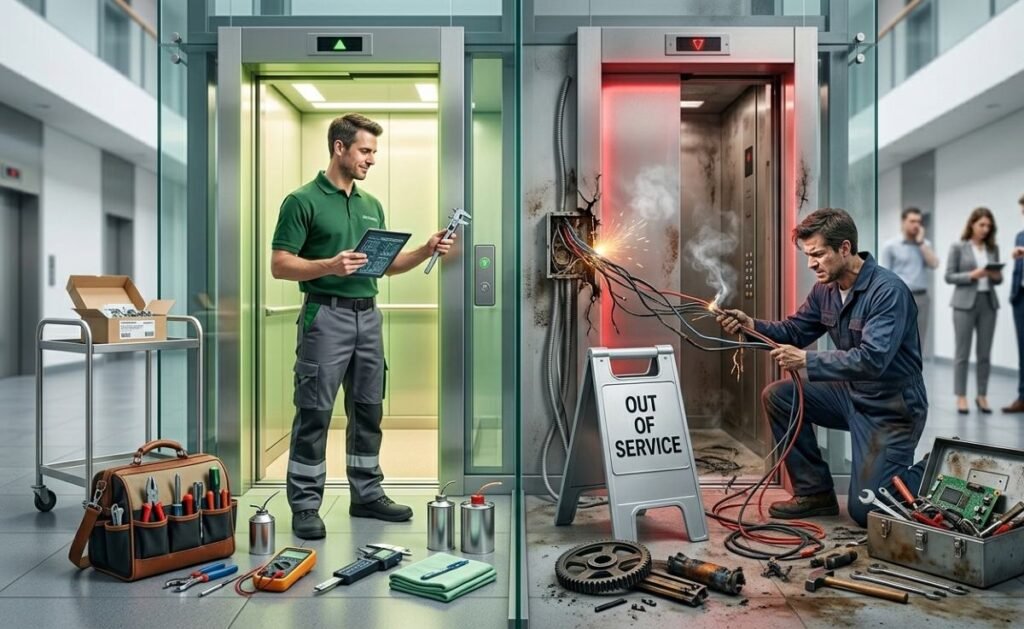
Why the Preventive vs Corrective Elevator Maintenance Debate Matters for Your Building
The financial asymmetry: Corrective maintenance after a failure costs 3–5× more than the equivalent preventive visit emergency labour rates, international parts freight to Damascus, and extended downtime all compound the total cost.
The safety asymmetry: A fault that preventive maintenance would detect at week 3 can reach catastrophic threshold by month 11 on a corrective-only approach failure risk is exponential, not linear, as degradation progresses.
Damascus operating context: Grid instability, 40°C+ summer heat, and seasonal dust storms all compress the component failure timeline for unserviced elevators corrective-only strategies carry materially higher risk in Syria’s environment than in temperate markets.
Hard System’s strategic framing: The question is not ‘preventive or corrective?’ but ‘how much preventive, and how do you manage the corrective events that occur even on best-practice programmes?’
Defining the Two Strategies What Each Type of Elevator Maintenance Actually Means
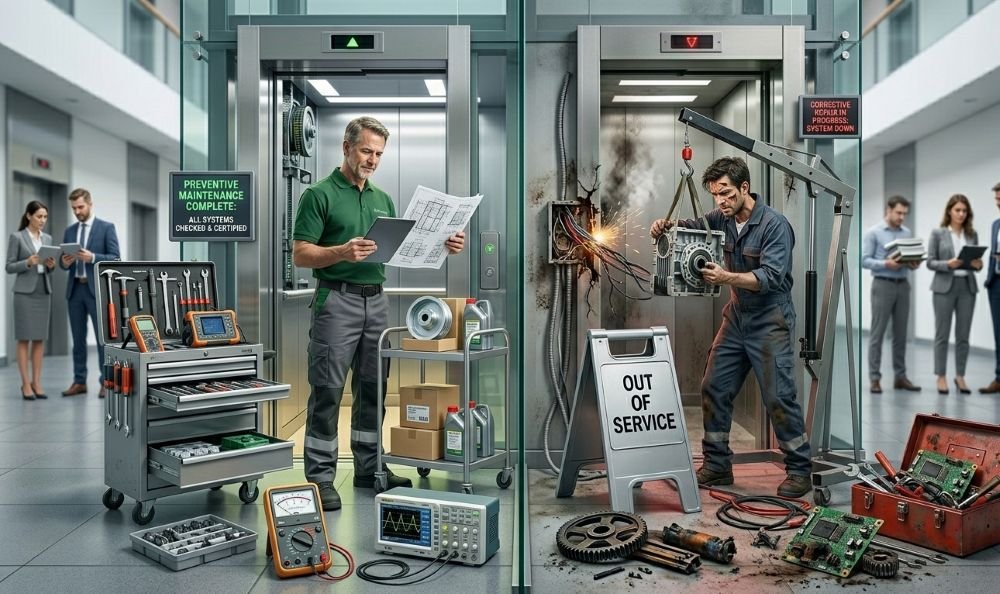
Preventive Elevator Maintenance
Definition: Scheduled, time-based or condition-based interventions performed on a functioning elevator to prevent failure lubrication, adjustment, safety device testing, and component replacement at prescribed intervals.
Sub-types: Time-based preventive (fixed calendar intervals monthly, quarterly, annual) vs. condition-based preventive (triggered by measured parameter thresholds rope wire-break count, brake pad thickness, insulation resistance value).
EN 81-20 / EN 81-50 alignment: Both standards contain explicit maintenance provisions defining minimum inspection items and test procedures preventive maintenance is the mechanism by which these obligations are discharged; compliance is not possible without it.
Hard System’s preventive protocol: 47-point digital checklist with condition-scoring per component; condition-based replacement scheduling eliminates ‘replace by calendar age’ over-spend and ‘replace after failure’ under-investment.
Corrective Elevator Maintenance
Definition: Unplanned intervention performed after a failure has occurred or a fault has been reported restoring the elevator to operational status as quickly as possible by diagnosing and resolving the fault.
Sub-types: Emergency corrective (safety-critical failure requiring immediate response trapped passengers, door interlock failure, brake anomaly) vs. deferred corrective (non-critical defect logged for repair at the next available scheduled appointment).
The unavoidability of corrective events: Even elevators on best-practice preventive programmes experience occasional corrective events the goal of preventive maintenance is to minimise their frequency and severity, not to assert that zero failures are achievable.
Hard System’s corrective response model: 2-hour on-site target for emergency corrective events for all contracted Damascus buildings; same-day response for deferred corrective items where parts are held in the local Damascus warehouse.
Predictive Elevator Maintenance — The Third Strategy
Definition: Data-driven condition monitoring using real-time IoT sensors (vibration, temperature, motor current draw, door-timing in milliseconds) to predict failure before it occurs the evolution beyond time-based preventive maintenance.
Technology enablers: Sensors on motor, door operator, and brake system feed live data to a cloud dashboard; anomaly-detection algorithms flag deviations from baseline before human observation would notice them.
Damascus applicability: Currently practical for new high-rise commercial installations and existing buildings where downtime cost justifies sensor hardware investment Hard System’s monitoring module is available as an upgrade for contracted clients.
Hybrid model recommendation: Hard System’s recommended strategy is preventive as the foundation, corrective as the backstop, and predictive as the enhancement for buildings where downtime cost justifies the additional investment.
Preventive vs Corrective Elevator Maintenance — Full Technical Comparison
Quick-Reference Comparison Table
| Dimension | Preventive Maintenance | Corrective Maintenance |
| Cost Predictability | Fixed & budgetable | Unpredictable spikes |
| 5-Year TCO (mid-rise) | 35–50% lower overall | Higher when all costs included |
| Safety Device Coverage | Verified every visit | Checked only at failure / annual |
| Fault Detection Window | Days to weeks | Weeks to 12 months |
| MTBF (failure interval) | 5–8× longer | Baseline (no improvement) |
| Regulatory Compliance | Complete log — strongest position | Sparse log — risk exposure |
| Insurance Position | Full audit trail | May be challenged by insurers |
| Downtime Frequency | Low / predictable | High / unpredictable |
| Emergency Call-Out Risk | Minimal | High — at premium rates |
| Damascus Climate Fit | Adapted protocol — optimal | Sub-optimal — risk amplified |
Read our Guide about monthly vs yearly elevator maintenance
Cost Structure — The True Financial Comparison
Preventive cost profile: Fixed, predictable, and distributed contract fee paid on schedule, consumables included in comprehensive plans, no unplanned expenditure spikes; cash-flow-friendly for building managers.
Corrective cost profile: Unpredictable spikes emergency call-out rate typically 2–3× the standard rate; international parts procurement adds 7–21 days lead time and a significant freight premium to Damascus; extended downtime generates compounding tenant costs.
5-year TCO analysis for a typical Damascus mid-rise: Preventive maintenance contracts (quarterly or monthly) deliver 35–50% lower total maintenance expenditure than corrective-only approaches when all cost categories are modelled not just the contract fee line.
Hard System’s free TCO calculator: Building owners input floor count, elevator type, and usage level to receive a 5-year cost projection comparing preventive contract tiers against a corrective-only cost model.
The Risk Profile Comparison
Preventive safety profile: Every visit verifies the full safety chain overspeed governor, door interlocks, brake system, buffer condition, ARD operation before any device approaches failure threshold; no safety-critical component degrades undetected for more than 30–90 days.
Corrective safety profile: Safety devices are inspected only when a fault is reported or at the mandatory annual statutory inspection failure can develop and persist at hazardous levels for up to 12 months between detection events.
Statistical evidence: Industry data shows elevators on structured preventive programmes experience 70–80% fewer safety-related incidents than those maintained correctively the gap widens further in high-wear environments such as Damascus.
Liability implication: A documented preventive maintenance history provides a robust legal defence in the event of an elevator-related personal injury claim; a corrective-only history implies the fault was knowable and preventable a legally and regulatorily dangerous position for the building owner.
Operational Reliability — Availability & MTBF
Preventive reliability profile: MTBF for preventively maintained elevators is 5–8× longer; when issues arise, they are detected early, parts are pre-available, and repair is planned not reactive and dependent on international freight.
Corrective reliability profile: Failures occur without warning; elevator unavailability is unpredictable; for commercial buildings with tenant SLA obligations, this unpredictability has direct contractual and financial consequences.
Damascus-specific consequence: An elevator outage in a Damascus residential tower during summer (when internal stairwells reach 45°C) is not merely an inconvenience it presents a genuine health and safety risk for elderly and mobility-impaired residents.
Hard System availability data point: Buildings on monthly preventive contracts in the Damascus portfolio average 99.1% elevator availability; uncontracted buildings average 91.3% an 8-percentage-point gap with direct quality-of-life and commercial impact.
Regulatory & Insurance Compliance
Preventive compliance strength: 12 (monthly) or 4 (quarterly) maintenance log entries per year create a continuous audit trail the strongest possible evidence of operator due diligence for Ministry of Housing inspections and elevator-related insurance claims.
Corrective compliance weakness: A maintenance log with gap periods invites scrutiny; a corrective event with no prior maintenance record implies the fault was knowable and preventable legally and regulatorily a very poor position for the building owner.
Insurance implications in Syria: Property insurers increasingly require evidence of a structured preventive maintenance programme as a condition of elevator-related liability coverage a corrective-only history may result in partial or full claim rejection.
Hard System’s documentation standard: All maintenance activities logged in a cloud-accessible client portal with timestamps, engineer signatures, and photographic evidence available within seconds for any Ministry of Housing inspection or insurance claim event.
When Corrective Maintenance Is Unavoidable — Managing It Effectively
Corrective Events That Occur Even on Best-Practice Preventive Programmes
Random failure events: Electronic component failures (capacitors, relays, PLC modules) have statistically random failure modes that time-based preventive maintenance cannot always predict or prevent these are inherent in any complex electromechanical system.
External damage events: Vandalism to landing door panels, water ingress during adjacent construction activity, or power surge damage to control boards fall outside the preventive maintenance scope entirely.
Consumable depletion between visits: A door contact that was borderline at the last quarterly visit may fail before the next one the 90-day detection window carries residual corrective risk that monthly plans reduce but cannot eliminate to zero.
Hard System’s transparent position: Preventive maintenance minimises corrective events significantly, but building owners should budget for 1–3 minor corrective events per year per elevator even on a well-maintained installation and should have a rapid-response plan confirmed in advance.
Hard System’s Corrective Maintenance Response Framework
Priority 1 — Emergency corrective: Passenger entrapment, brake fault, door safety failure: 2-hour on-site target in Damascus; engineer dispatched with diagnostic kit and most common emergency parts; Hard System’s 24/7 operations centre active and tracking.
Priority 2 — Urgent corrective: Elevator out of service, no trapped passengers: same-day response target; building manager receives real-time status updates and an estimated restoration time; temporary out-of-service signage provided.
Priority 3 — Deferred corrective: Elevator operational with a noted defect: scheduled within 5 working days or at the next planned visit; parts ordered from Damascus warehouse stock or from the international supply chain depending on local availability.
Post-corrective quality protocol: Every Priority 1 and Priority 2 event triggers a written root-cause report from Hard System identifying whether the event was truly random or potentially preventable by programme adjustment; used as a quality-improvement data point.
Damascus-Specific Factors That Shift the Preventive vs Corrective Balance
Grid Instability — The Corrective Driver That Preventive Must Offset
Syria’s load-shedding regime means Damascus elevators experience 3–5× more power interruption events per year than regional market averages each event stresses the ARD system, control board power supply circuitry, and VFD capacitor bank.
Power surge corrective events: Voltage spikes during grid restoration after outages cause capacitor and relay failures in elevator control electronics a properly specified surge-protection and UPS system (preventive investment) reduces these corrective events by an estimated 75–80%.
ARD battery corrective replacement: On corrective-only programmes, ARD batteries are replaced after they fail a rescue operation on Hard System’s preventive programme, battery capacity is measured at every visit and batteries are replaced before capacity drops below the safe rescue threshold.
Hard System’s grid-offset preventive package: Surge-protection modules, quality UPS specification, and ARD battery capacity check at every visit this combination reduces grid-related corrective events to near-zero in Damascus installations based on portfolio performance data.
Climate Extremes — Heat, Dust & the Accelerated Wear Cycle
Damascus summer heat (40°C+) causes lubricant viscosity degradation, motor winding insulation ageing, and hydraulic fluid additive breakdown at rates that compress the preventive-to-corrective transition timeline far below European norms what holds at annual service intervals in the UK does not hold in Damascus.
Dust infiltration corrective events: Without monthly dust clearance of door mechanisms and control board cooling vents, Damascus elevators develop door operator faults and PCB contamination failures at rates that create a corrective maintenance burden easily and cheaply offset by more frequent preventive cleaning visits.
Thermal expansion corrective events: Rail bracket fastener loosening due to temperature cycling (−2°C winter to 40°C summer) causes ride quality deterioration and alignment drift preventable by including fastener torque verification in the annual preventive inspection; without it, the consequence is a corrective call-out.
Hard System’s climate-adapted preventive protocol: All Damascus maintenance programmes include additional heat-response lubrication steps, dust-clearance procedures, and thermal fastener checks beyond the European EN 81 baseline a proprietary adaptation developed and refined over 15+ years of Syrian market operation.
Building Age & Electrical Infrastructure Quality in Damascus
Older Damascus buildings (pre-2000): Non-standard shaft construction, ageing electrical infrastructure, and original elevator equipment approaching end-of-life create environments where the baseline corrective event rate is structurally higher making the ROI of preventive maintenance proportionally greater, not less.
Electrical infrastructure quality: Unstable earthing, undersized supply cables, and absent surge protection in older Damascus buildings create recurring control board faults addressable by a one-time infrastructure upgrade (corrective) combined with preventive monitoring to prevent recurrence.
New-build standard: Hard System specifies surge protection, quality UPS, and fully EN 81-compliant shaft construction as prerequisites for all new Damascus installations removing the most common corrective event drivers from the building’s maintenance profile from day one of operation.
Building the Right Hybrid Maintenance Strategy — Hard System’s Recommended Approach
The Preventive Foundation — Non-Negotiable Elements
- Monthly or quarterly scheduled visits as the baseline: Frequency calibrated to building type, floor count, usage level, and Damascus environmental factors not defaulted to the cheapest interval available.
- Condition-based replacement scheduling: Suspension rope assessment on measured wire-break count per metre, brake pad replacement on measured lining thickness, lubricant replenishment on viscosity check not on calendar age alone, and never after failure.
- Mandatory safety device verification at every visit: Overspeed governor, door interlocks, safety gear, ARD battery capacity, and brake holding force checked regardless of contract tier zero-compromise items in Hard System’s protocol for every Damascus installation.
- Documentation as a preventive asset: Every visit generates a timestamped, engineer-signed digital record; the maintenance log is not a compliance exercise it is a liability-management tool, a predictive maintenance data source, and a property asset register entry.
The Corrective Backstop — What Every Building Owner Needs in Place
- Emergency response contract confirmed in writing: Priority call-out provision should be a contractual right, not an arrangement made during a passenger entrapment event when negotiating leverage is zero.
- Local spare parts availability verified: Confirm whether your maintenance provider stocks common corrective parts in-country or relies on international procurement the difference between a 4-hour repair and a 4-week repair in Damascus is often just one phone call.
- Corrective budget reserve established: Even Full-Inclusive contract holders should maintain a minor contingency for major components not covered by standard contract terms Hard System’s account engineers advise on appropriate reserve levels for each building’s equipment profile.
The Predictive Enhancement — When the Investment Is Justified
Appropriate for: High-rise commercial buildings, hospitals, hotels, and residential towers where the cost of a single day of downtime or a safety incident significantly exceeds the annual cost of sensor hardware and monitoring subscription.
Hard System’s IoT monitoring module: Sensors on motor current, door cycle timing, and cabin vibration feed a cloud dashboard; anomaly-detection algorithms flag deviations before they manifest as faults visible to building users or detected during a periodic visit.
ROI-based recommendation: Hard System’s account engineers assess whether predictive investment is justified by the building’s downtime cost profile recommended transparently and honestly rather than sold to all clients regardless of whether the economics support it.
Hard System’s Elevator Maintenance Services — Preventive, Corrective & Predictive
Contract Tier Summary
Basic (Annual / Semi-Annual): Scheduled preventive visits, statutory log completion, advisory defect notices designed for private villas and genuinely low-use single-occupancy buildings only.
Comprehensive (Quarterly): Full preventive programme + consumables + priority corrective call-out at contracted rates + digital condition reports the standard recommended tier for Damascus mid-rise residential buildings.
Full-Inclusive Monthly: Complete preventive programme + all corrective labour and standard parts + predictive monitoring option + Ministry of Housing certification management the premium tier for commercial and high-rise buildings.
Portfolio bespoke contracts: Available for property management companies with multiple Damascus buildings onsolidated reporting, single dedicated account engineer, volume pricing, and a unified maintenance strategy across the entire portfolio.
Hard System’s Damascus-Specific Differentiators
- 15+ years of Syrian market operation: The only elevator maintenance provider with a service protocol specifically adapted for Damascus’s grid environment, climate extremes, and building stock characteristics not a European programme applied without modification.
- Local spare parts warehouse in Damascus: Eliminates international freight dependency for the most common corrective components faster repair, lower emergency cost, better availability, and predictable response times for contracted buildings.
- Bilingual Arabic/English documentation: All maintenance logs, condition reports, and corrective event summaries available in both languages supports building owners dealing with international insurers, investors, or multi-national tenants.
- Full regulatory cycle management: Ministry of Housing permit coordination, installation certification, annual inspection attendance, and Certificate of Conformity renewal end-to-end compliance managed by Hard System so building owners focus on their core business.
Frequently Asked Questions — Preventive vs Corrective Elevator Maintenance
| Which is cheaper — preventive or corrective elevator maintenance? | Preventive is cheaper over 5 years; corrective has a lower contract fee but higher total cost when emergency labour rates, international parts freight, and downtime losses are all included in the model. |
| Can I rely on corrective maintenance only for my Damascus building? | Only viable for private villas with genuinely minimal usage; not recommended for any multi-tenant or commercial building Damascus’s climate and grid environment amplify corrective event frequency and cost significantly. |
| What does Hard System’s preventive maintenance programme include? | 47-point digital checklist covering mechanical, electrical, safety chain, door system, ARD battery, and documentation performed 12×/year (monthly) or 4×/year (quarterly) with condition-scored reports delivered within 24 hours. |
| How quickly does Hard System respond to corrective emergencies in Damascus? | 2-hour on-site target for Priority 1 events (passenger entrapment, safety device failure) for all contracted buildings; Hard System’s 24/7 operations centre tracks all emergency dispatches. |
| Does preventive maintenance eliminate all corrective events? | No — preventive maintenance reduces corrective frequency by 70–80% and severity significantly; even best-practice programmes experience 1–3 minor corrective events per elevator per year; budget and planning accordingly. |
| What is predictive elevator maintenance and do I need it? | Real-time IoT sensor monitoring that predicts failure before it occurs recommended for high-rise commercial buildings where downtime cost justifies the investment; Hard System assesses fit case-by-case before recommending. |
| How does my maintenance strategy affect elevator insurance in Syria? | A comprehensive preventive maintenance log is the strongest position for insurance claims and Ministry of Housing inspections; a corrective-only history may be challenged by insurers as evidence of inadequate operator due diligence. |
Build Your Elevator Maintenance Strategy with Hard System — Start Today
You now have the full framework preventive as the non-negotiable foundation, corrective as the managed backstop, predictive as the ROI-justified enhancement. Hard System’s role is to calibrate the right balance for your specific building.