A freight elevator that fails a safety inspection can shut down a loading dock overnight. One that fails in operation can injure a worker or destroy a shipment. Safety standards exist to prevent both outcomes, but only when a facility actually understands and follows them, and works with a partner who applies them correctly.
This guide is written for facility managers, safety officers, and plant owners responsible for freight elevator compliance. It covers the major codes that apply, what inspectors look for, and the practices that keep a facility both compliant and safe between inspections, with input from the engineering team at Hard System.
Why Safety Standards Exist for Freight Elevators
Freight elevators move heavier, less predictable loads than passenger elevators, often operated by different people on every shift. A pallet loaded off center, a forklift driven onto the platform, or a door held open under load creates risks that passenger elevator design does not anticipate.
Safety codes translate decades of incident data into concrete requirements: rated capacity limits, interlocks that prevent movement with a door open, safety gears that stop a falling car, and inspection intervals that catch wear before it causes failure. Following them is not paperwork for its own sake. It is the accumulated record of what actually prevents injuries and equipment loss, and it is the standard Hard System designs every freight elevator to meet.
Key Codes and Standards That Apply
Requirements vary by country and sometimes by local authority, so the specific code that governs your facility depends on location. The frameworks below are the ones most commonly referenced internationally.
- ASME A17.1 / CSA B44 (Safety Code for Elevators and Escalators): The primary code in the United States and Canada, covering design, construction, installation, and maintenance of elevators including freight units.
- ASME A17.2: Guide for inspection of elevators, escalators, and related equipment, used alongside A17.1 during periodic testing.
- ASME B20.1: Governs vertical reciprocating conveyors (VRCs), a distinct category from freight elevators under most codes, with its own safety requirements.
- EN 81 series: The European standard family for lift safety, with EN 81-31 addressing lifts for goods only, and other parts covering electric and hydraulic lifts more broadly.
- Local and municipal authorities having jurisdiction (AHJ): Most regions, including Syria, require registration and periodic inspection, often built on international codes such as A17.1 or the EN 81 series with local adaptations.
Hard System designs and installs freight elevators to align with these internationally recognized frameworks, then adapts installation and documentation to whatever local authority governs your site in Damascus.
Core Safety Requirements Under These Standards
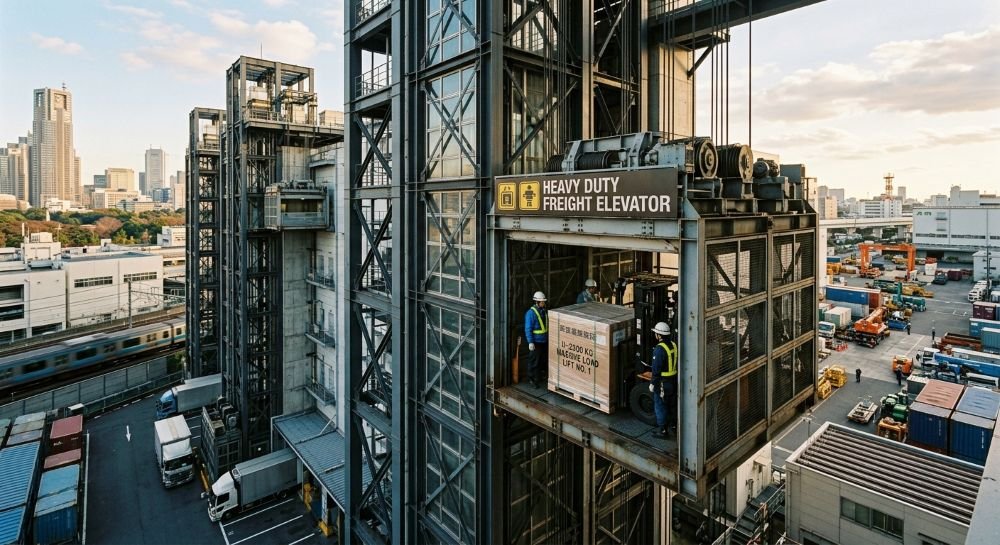
While the details differ by code, most frameworks converge on the same core protections for freight elevators. These are the requirements Hard System builds into every project from the design stage, not added afterward.
Load Rating and Signage
Every freight elevator must display its rated capacity clearly inside the car, and that rating must never be exceeded. Codes typically require the rating to account for the heaviest anticipated load, including any vehicle such as a forklift that will enter the car. Hard System calculates this with a safety margin of at least 20% above the heaviest expected load.
Door Interlocks and Gates
Interlocks must prevent the car from moving unless all landing doors and the car gate are fully closed, and must prevent doors from opening unless the car is at the landing within a defined tolerance. This is one of the most heavily enforced requirements because door-related incidents are among the most common serious injuries.
Safety Gears and Governors
Traction elevators require a governor-activated safety gear that grips the guide rails and stops the car if it exceeds a set overspeed. Hydraulic elevators require pressure relief and, in many codes, rupture valves that stop descent if a hydraulic line fails. Hard System tests both systems before handover, not just at the manufacturer’s factory.
Emergency Communication and Signaling
Freight elevators typically require a two-way communication device or alarm reachable from inside the car, along with signals indicating car position where operators need that information.
Pit and Overhead Clearances
Codes specify minimum pit depth and overhead clearance to give personnel a safe refuge space during maintenance. These clearances are frequently cited in inspection failures on older installations, which is why Hard System verifies them during the initial site survey, before any equipment is ordered.
Periodic Testing
Most codes require scheduled testing of safeties, governors, and pressure relief systems at defined intervals. Hard System documents every test in a maintenance file the client keeps, so compliance history is never a guessing game at inspection time.
What Inspectors Typically Check
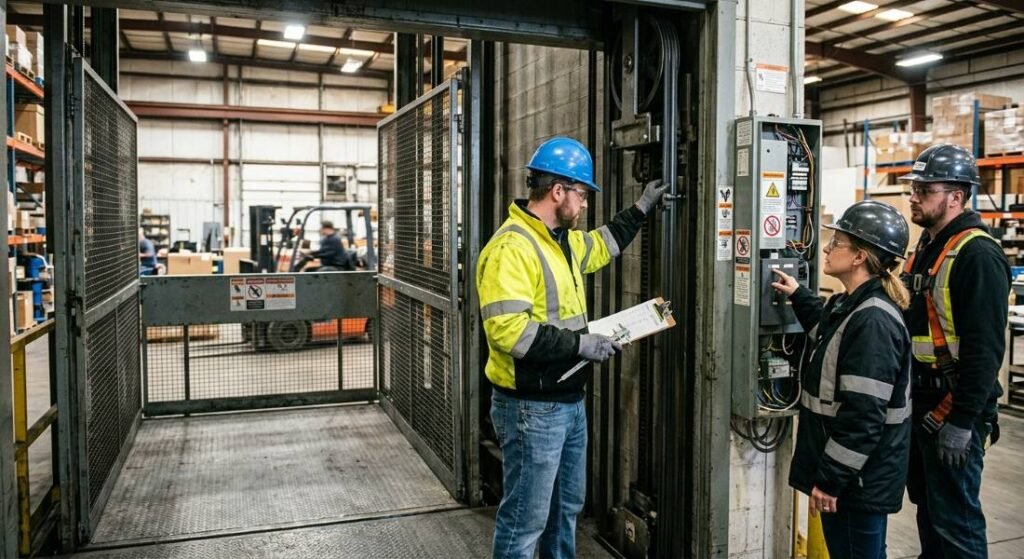
Inspections generally follow a standard sequence, though specifics vary by jurisdiction and equipment type.
- Documentation review: Permits, prior inspection reports, maintenance logs, and any outstanding violations.
- Machine room and equipment review: Condition of the motor or pump, controller, wiring, and housekeeping around the equipment.
- Hoistway and pit inspection: Guide rails, buffers, ropes or hydraulic cylinder, clearances, and general condition.
- Car and door inspection: Interlocks, gates, load signage, emergency communication, and car condition.
- Functional and safety testing: Governor and safety gear tests, pressure relief valve tests, and door reopening device tests.
- Findings and corrective action: A written report noting violations, required repairs, and re-inspection deadlines.
Facilities that keep organized maintenance records and address minor issues promptly move through this process with far fewer surprises. Clients on a Hard System maintenance contract receive this documentation automatically after every visit.
Compliance Requirements by Frequency
| Requirement | Typical Frequency | Who Performs It | Common Focus |
|---|---|---|---|
| Routine operational check | Daily to weekly | Facility staff or operator | Unusual noise, door function, visible damage |
| Preventive maintenance service | Monthly to quarterly | Qualified elevator technician | Lubrication, adjustment, component wear |
| Periodic safety test | Annually (varies by code) | Certified technician or inspector | Interlocks, brakes, alarm, general safety devices |
| Full load and safety gear test | Every 3 to 5 years (varies by code) | Certified inspector with technician support | Governor, safety gear, full load test, buffers |
| Local jurisdictional inspection | Per local requirement | Authority having jurisdiction | Code compliance, permit renewal |
| Maintenance record audit | Ongoing | Facility safety officer | Documentation completeness, trend review |
Confirm exact intervals with your local authority, since requirements can be stricter than the base international code. Hard System builds its maintenance contracts around these intervals so clients are never caught unprepared.
Best Practices for Staying Compliant Between Inspections
Maintain a Complete, Accessible Record
Keep maintenance logs, prior inspection reports, permits, and repair records in one place. Inspectors ask for this first, and a complete record signals a well-managed facility. Hard System maintains a parallel digital record for every client, so nothing is lost if paperwork goes missing on site.
Train Operators, Not Just Technicians
Anyone who loads or operates a freight elevator should understand rated capacity, proper loading, and what to do if something seems wrong. Many serious incidents involve operator error rather than equipment failure. Hard System includes operator briefing as part of every handover.
Do Not Defer Minor Repairs
A door that closes roughly, a car that levels slightly off, or an occasional unusual noise are often early indicators of a developing safety issue. Addressing them immediately is far cheaper than an unplanned shutdown or a failed inspection.
Use a Qualified, Code-Aware Service Provider
Confirm that your maintenance provider is certified for your equipment type and familiar with the codes enforced in your area. A provider unfamiliar with local requirements can leave you non-compliant without realizing it. This is the core of what Hard System offers Damascus facilities: engineering that already accounts for local code and local conditions.
Never Bypass a Safety Device
Interlocks, governors, and safety gears must never be disabled or bypassed to keep an elevator running, even temporarily. This is both a serious code violation and one of the most common causes of catastrophic failure.
Plan for Power Instability
Facilities with unreliable power should treat it as a safety issue, not just an operational one. Sudden outages during operation can strand loads mid-shaft or stress braking and safety systems if backup power and rescue devices are not in place. Hard System addresses this directly with automatic rescue devices, inverter-backed power, and voltage protection built into every installation, a response to the power conditions common across Damascus and the wider Syrian grid.
Frequently Asked Questions
Which code applies to my freight elevator in Damascus?
Local authorities generally build their requirements on internationally recognized frameworks such as ASME A17.1 or the EN 81 series, adapted with local permitting rules. Hard System confirms the exact applicable requirements for your site during the initial survey.
Are vertical reciprocating conveyors held to the same standard as freight elevators?
No. VRCs are typically classified separately, most often under ASME B20.1 internationally, and carry different design and safety requirements since they move goods rather than people.
How often does a freight elevator need a full safety inspection?
Most codes call for annual safety testing, with more extensive load and safety-gear testing every three to five years. Hard System sets the exact schedule for your equipment as part of its maintenance contract.
What happens if a freight elevator fails an inspection?
The inspector issues a report listing violations and a deadline for correction, and the elevator may need to be taken out of service until repairs are verified. Hard System’s maintenance clients receive priority scheduling to resolve findings quickly and get the equipment back in service.
Conclusion: Compliance Is a Continuous Process, Not an Event
Freight elevator safety standards are not a box to check once a year. They describe an ongoing standard of care that depends on trained operators, disciplined maintenance, and prompt attention to warning signs between formal inspections. Facilities that treat compliance this way rarely face surprise violations or unplanned downtime.
Hard System builds this standard of care into every freight elevator it designs, installs, and maintains in Damascus, from the first site survey to every scheduled service visit afterward. If you are uncertain whether your freight elevator currently meets the applicable code, or your last full inspection is more than a year old, our engineering team can review it with you.
Request a compliance review or a free site assessment from Hard System today, and get a clear picture of where your elevator stands before an inspector tells you
Pingback: Freight Elevator Cost Guide | Hard System
Pingback: Freight Elevators vs. Passenger Elevators | Hard System