
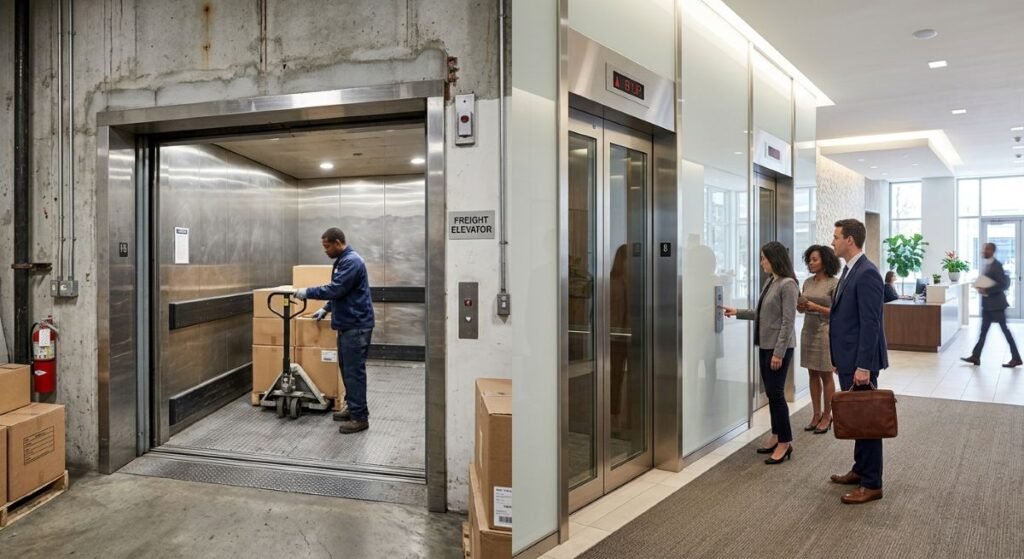
Freight Elevators vs. Passenger Elevators
Confusing a freight elevator with a heavy-duty passenger elevator is one of the most expensive mistakes a facility can make. The two are built to different codes, different structural standards, and different assumptions about what will be inside the car. Choosing the wrong category can mean a failed inspection, a damaged elevator, or worse, an injury.
This guide explains exactly how freight and passenger elevators differ, which one your facility actually needs, and how Hard System applies these requirements in every installation in Damascus.
The Core Distinction: What Each One Is Designed to Carry
A passenger elevator is engineered around people: evenly distributed weight, gentle acceleration, quiet operation, and a finished interior. A freight elevator is engineered around cargo: concentrated point loads, impact resistance, and a structure built to survive daily contact with forklifts, pallet jacks, and loaded carts.
This difference in purpose drives every other distinction on this list. You cannot simply install a passenger elevator and use it for freight, even if the rated capacity looks sufficient on paper.
Key Differences at a Glance
| Factor | Freight Elevator | Passenger Elevator |
|---|---|---|
| Primary purpose | Moving goods, equipment, and material handling vehicles | Moving people safely and comfortably |
| Load distribution | Concentrated, uneven loads (pallets, carts, forklifts) | Evenly distributed body weight |
| Typical capacity | 500 kg to 5,000+ kg | Usually 320 kg to 1,600 kg |
| Car floor | Reinforced steel, impact-resistant | Finished flooring, not built for impact |
| Door type | Vertical bi-parting or heavy mesh gates | Horizontal sliding, automatic |
| Interior finish | Utilitarian, protective wall panels | Decorative finishes, mirrors, lighting |
| Speed | Slower, prioritizing load stability | Faster, prioritizing passenger convenience |
| Governing standard | Freight-specific provisions within elevator codes, or VRC codes for goods-only lifts | Standard passenger elevator codes |
| Structural design | Reinforced frame, guide rails rated for impact loading | Standard structural rating for distributed weight |
| Typical use case | Warehouses, factories, back-of-store stockrooms, loading docks | Offices, retail floors, residential buildings |
Structural and Safety Requirements Unique to Freight Elevators
Reinforced Car Construction
Freight elevator cars are built with heavier gauge steel floors and walls specifically to withstand impact from equipment. A passenger car’s finished floor and thin wall panels are not designed for a forklift bumping against them repeatedly.
Different Load Calculations
Freight elevator capacity must account for concentrated point loads, not just total weight spread evenly across the floor. A 2,000 kg pallet sitting on a small footprint stresses the floor structure very differently than 2,000 kg of evenly spread passengers, so freight elevators require different structural engineering even at similar rated capacities.
Door and Gate Requirements
Freight elevators commonly use vertical bi-parting doors or mesh gates rather than the horizontal sliding doors typical of passenger elevators. These door types accommodate wider, taller openings for pallets and equipment, and they are built to tolerate impact rather than only smooth, careful use.
Operator-Controlled vs. Automatic Operation
Many freight elevators use operator-dependent controls, sometimes requiring a person to hold a button for continuous movement, rather than the fully automatic call-and-go operation passengers expect. This is a deliberate safety feature that keeps an operator actively engaged during loading and unloading.
Signage and Load Limits
Codes typically require freight elevators to post the rated capacity prominently, along with a statement restricting or prohibiting passenger use unless the elevator is specifically rated and certified for both. Passenger elevators have no equivalent industrial load signage requirement.
Can a Freight Elevator Carry Passengers?
Generally, no, unless the elevator is specifically designed, tested, and certified for combined freight and passenger use. Most freight elevators lack the finished interior, speed control, and passenger-specific safety features required for that certification, and using one to carry people without that certification is a code violation as well as a safety risk.
Some facilities do install combination freight and passenger elevators, which meet passenger-grade safety and finish requirements while retaining reinforced flooring for occasional cargo use. This is a specific design category, not something achieved by simply allowing people to ride a standard freight unit.
How to Choose the Right Type for Your Facility
Choose a Freight Elevator When You Need To:
- Move pallets, crates, or bulk inventory between floors or between a stockroom and sales floor.
- Transport forklifts, pallet jacks, or other material handling equipment.
- Support continuous industrial use in a factory, warehouse, or distribution center.
- Move heavy, irregularly shaped loads that would not fit standard passenger elevator dimensions.
Choose a Passenger Elevator When You Need To:
- Move employees, customers, or visitors between floors.
- Meet accessibility requirements for people with disabilities.
- Provide a finished, comfortable experience in a retail, office, or residential setting.
Consider a Combination Unit When:
- Your facility genuinely needs both functions in one shaft due to space constraints.
- Usage patterns justify the higher cost of passenger-grade finishes and safety systems combined with freight-grade structural reinforcement.
Common Mistakes Facilities Make
- Installing a passenger elevator for occasional freight use, then damaging the floor and walls within months of heavy daily loading.
- Assuming a freight elevator can double as a passenger elevator without the required certification, creating both a safety hazard and a compliance violation.
- Underestimating point-load stress by sizing a freight elevator based on total weight alone, without accounting for how that weight is distributed on the floor.
- Choosing door type by cost alone, without considering how frequently the door will be struck by equipment during daily operation.
How Hard System Determines the Right Category for Your Project
- Site and use-case assessment: We ask what will actually move through the elevator, day to day, not just the theoretical maximum load.
- Load and distribution analysis: We calculate both total capacity and how that load will be distributed across the car floor.
- Code classification: We confirm whether your application falls under freight elevator provisions, a vertical reciprocating conveyor, or a passenger-certified combination unit.
- Structural and door specification: We size the frame, floor, and door type to match actual impact and load conditions, not a generic template.
- Compliance documentation: We provide the signage, rated capacity documentation, and certification your local authority requires for the category you install.
Frequently Asked Questions
Is a freight elevator cheaper than a passenger elevator?
Not necessarily. Freight elevators often cost less in interior finishing but more in structural reinforcement, and the final price depends heavily on capacity, door type, and travel height in both categories. A site-specific quote is the only reliable way to compare.
Can I convert a passenger elevator into a freight elevator?
Generally no, not without significant structural modification to the floor, frame, and doors, and recertification under freight elevator provisions. In most cases, installing a purpose-built freight elevator is more practical and safer than converting an existing passenger unit.
Do freight elevators require the same inspection frequency as passenger elevators?
Freight elevators are typically inspected under the same general code framework as passenger elevators, though specific testing points differ to reflect freight-specific safety devices. Confirm exact intervals with your local elevator authority.
What is a vertical reciprocating conveyor, and is it the same as a freight elevator?
No. A vertical reciprocating conveyor (VRC) moves goods only, never people, and is governed by separate standards such as ASME B20.1 in North America. VRCs are generally simpler and less costly than a certified freight elevator but cannot be used if personnel need to ride with the load.
Conclusion: Match the Elevator to the Job, Not the Other Way Around
Freight and passenger elevators solve different problems, and treating them as interchangeable creates cost, compliance, and safety risks that surface only after installation. The right choice starts with an honest look at what actually needs to move through your building, and how.
Hard System evaluates your real use case before recommending equipment, so you get a freight elevator, a passenger elevator, or a certified combination unit, whichever your facility genuinely needs.
Request a free site assessment from Hard System and get a clear, code-compliant recommendation for your building in Damascus.