
Introduction: The Most Expensive Dumbwaiter Decision Is the One Made Twice
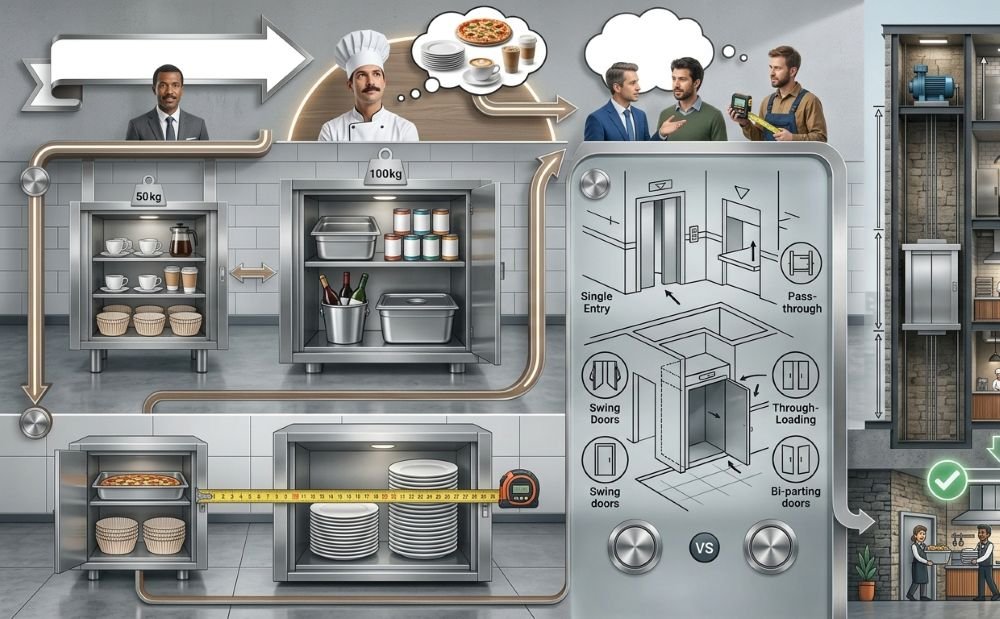
A restaurant in Damascus orders a compact 50 kg dumbwaiter to connect its ground-floor kitchen to its first-floor dining room. Six months after installation, the head chef introduces a new weekend brunch menu served on large sharing platters stacked on a single tray. The first time a waiter loads the brunch tray into the dumbwaiter, the overload sensor trips. The unit stops. The tray has to come back out. The order is sent up by hand. It happens again on the second Saturday. And the third.
By month eight, the dumbwaiter is effectively unused during the restaurant’s most profitable service of the week. The owner, having bought a 50 kg unit to save money over a 100 kg alternative, has spent the price difference ten times over in lost efficiency and staff frustration all because the dumbwaiter size was chosen based on current menu load, not maximum possible load.
Choosing the right dumbwaiter size for a restaurant is one of the most consequential operational decisions a Syrian restaurant owner, hotelier, or building developer makes. Get it right and the system serves quietly for 20 years. Get it wrong and it becomes a daily friction point that every service staff member knows about and works around.
This guide covers every dimension of dumbwaiter sizing for Syrian restaurant operations from the basic vocabulary of car dimensions and capacity, through the step-by-step calculation methodology, to the complete size-by-restaurant-type reference tables that let you arrive at the right specification before you ever speak to a supplier
Section 1: The Four Dimensions of Dumbwaiter Size — What Each Measurement Means
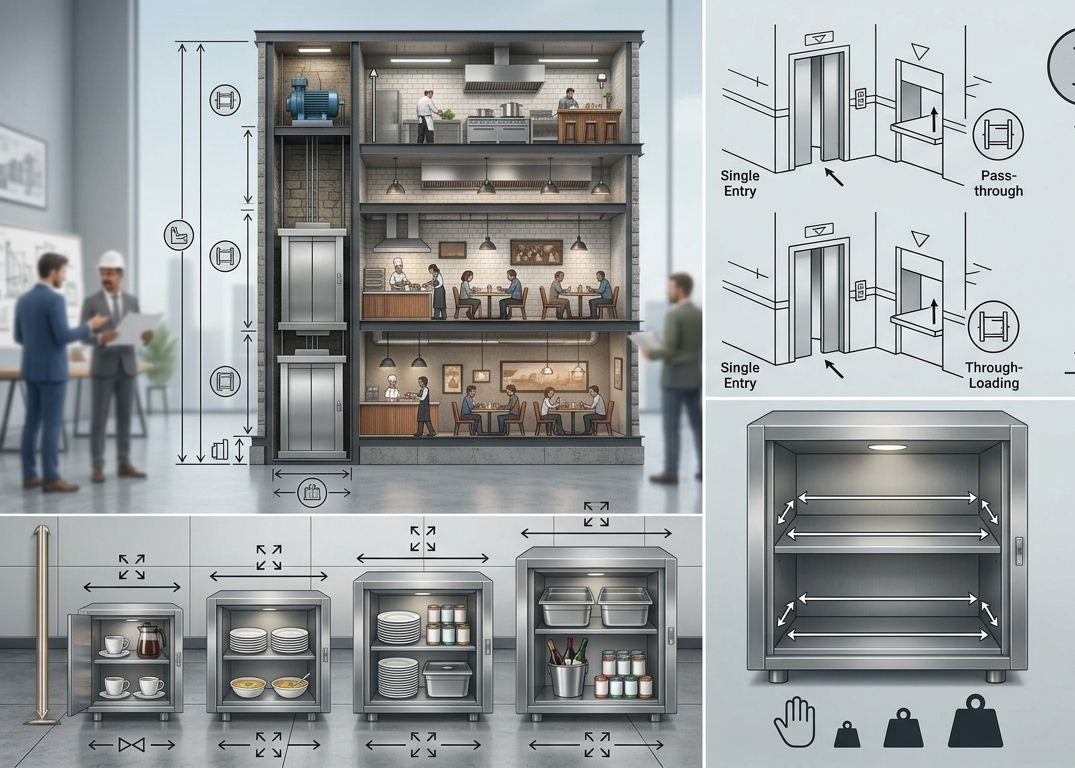
When restaurant owners and managers talk about dumbwaiter ‘size’, they are often using a single word to describe four distinct specifications each of which is an independent constraint on what the unit can carry and how it can be used. Understanding each dimension separately is the foundation for making the right sizing decision.
Dimension 1 — Car Width (the horizontal measurement left-to-right at the door opening)
Car width determines what fits through the door opening. This is the measurement that most directly limits the size of trays, platters, and equipment that can be loaded into the dumbwaiter. A car that is 500mm wide accepts a standard 460mm restaurant tray with room for hand clearance. A car that is 700mm wide accepts two standard trays side by side. A car that is 900mm+ accommodates a small service trolley.
The minimum practical car width for a Syrian restaurant dumbwaiter is 500mm enough for a single large restaurant tray. For operations that send multiple items per trip (two trays, a tray plus a bottle, a covered plate plus a side dish), 650–700mm is the appropriate minimum width specification.
Dimension 2 — Car Depth (the horizontal measurement front-to-back, away from the door)
Car depth determines how far into the car a load can extend. For tray-based loading (where the tray slides in from the front), depth must exceed the tray length plus hand clearance. A standard 530mm × 325mm rectangular restaurant tray requires a minimum car depth of 550mm. Circular trays of 460mm diameter require 480mm minimum depth. Serving carts require depth equal to the cart length plus 50mm clearance minimum.
Car depth is the dimension most frequently misspecified in Syrian restaurant dumbwaiter installations. A 500mm × 450mm car which appears adequate from the width is too shallow for a standard rectangular restaurant tray if the tray must be loaded lengthways. Always verify that the car depth accommodates your largest standard item when loaded in its natural orientation.
Dimension 3 — Car Height (the vertical internal clear dimension)
Car height determines how tall the items inside can be. For single-layer tray service (one tray per trip), 400–500mm of car height is typically adequate. For covered plate service (cloche covers add 200–280mm), a minimum car height of 600mm is required. For stacked tray systems (multiple tray shelves inside the car), car height must accommodate the full stack height plus clearance. For any service involving open bottles or tall items, 700mm+ is required.
Car height is the dimension that catches out the most Syrian restaurant operators specifying dumbwaiters for the first time. A car with adequate width and depth but insufficient height forces staff to remove cloche covers before loading defeating the purpose of keeping food covered during transit and risking spills and temperature loss.
Dimension 4 — Capacity (the maximum weight the car can carry safely)
Capacity is the maximum load in kilograms that the dumbwaiter is rated to carry safely per trip. This rating covers the combined weight of everything inside the car: food, plates, trays, covers, bottles, and any other items. The capacity rating is enforced by an overload sensor that prevents the unit from operating when the load exceeds the rated maximum which is why under-specifying capacity directly impacts operations during peak service.
Capacity specification in Syria should always be set at 130% of the maximum load you anticipate sending in a single trip. This 30% safety margin accounts for: estimating errors in load weight calculation, future menu changes that may increase load weight, the tendency for busy service staff to overload rather than make an additional trip, and the degradation of overload sensor calibration accuracy over time in high-cycle environments.
Section 2: The Step-by-Step Dumbwaiter Sizing Calculation for Syrian Restaurants
Every correct dumbwaiter size specification begins with a structured calculation based on the restaurant’s actual service items, loads, and operational patterns. Follow these four steps to arrive at the minimum correct specification for your operation before consulting any supplier or reviewing any catalogue.
Step 1 — Identify Your Heaviest Single-Trip Load
List every item type you will send through the dumbwaiter in a single trip. For each possible combination, calculate the total weight. Your heaviest likely single-trip combination is your reference load. Common Syrian restaurant reference loads include: full breakfast setup for two (2 large plates, 2 side plates, 2 glasses, coffee press, juice, bread basket) typically 8–12 kg; full mezze service for a table of 8 (8 cold mezze plates, bread, condiments on two trays) typically 15–22 kg; wedding service tray (large serving platters, 6–8 items) typically 20–35 kg.
Step 2 — Apply the 130% Safety Margin
Multiply your heaviest single-trip load by 1.3. This is your minimum capacity specification. For a heaviest load of 22 kg, your minimum specified capacity is 22 × 1.3 = 28.6 kg meaning a 30 kg or 50 kg capacity unit is appropriate. For a heaviest load of 35 kg, your minimum specified capacity is 35 × 1.3 = 45.5 kg meaning a 50 kg unit at minimum. For a unit serving future banquet or event loads up to 60 kg, minimum specified capacity is 78 kg meaning a 100 kg unit.
Step 3 — Measure Your Largest Single Item
Identify the largest single item (by physical dimension) that must fit inside the car. Measure its maximum width, depth, and height in operating orientation the position in which it will be loaded. Add 50mm to each dimension for hand clearance. The resulting measurements are your minimum car interior dimensions. For a 530mm × 325mm × 280mm (with cloche) covered plate: minimum car is 580mm wide × 375mm deep × 330mm high. For a full mezze tray 600mm × 400mm: minimum car is 650mm wide × 450mm deep.
Step 4 — Calculate Cycle Rate Requirement
Estimate the number of trips per hour you need during your peak service period. Divide 60 minutes by the round-trip cycle time at the specified speed (calculate as: [rise height in metres ÷ speed in m/s] × 2 + 30 seconds loading/unloading, expressed in minutes). If the result is less than your required trips per hour, you need either a higher speed specification or a second unit. For most Syrian restaurant applications with a rise height of 3–5 metres and a 0.3 m/s speed, round-trip cycle time is approximately 35–45 seconds giving capacity for 80–100 trips per hour, which exceeds all but the most intensive service operations.
Section 3: The Five Dumbwaiter Size Categories for Syrian Restaurants
Syrian restaurant dumbwaiter applications fall into five practical size categories, each corresponding to a specific range of restaurant types, service volumes, and operational requirements. The following profile cards document each size category with its physical specifications, suitable applications, and Syria-specific notes.
| SIZE 1 | Compact — Single Tray Service |
| Car Dimensions (W × D × H): 450–550mm (W) × 400–480mm (D) × 400–550mm (H) Capacity: 25–50 kg Speed: 0.2–0.4 m/s Best For: Small cafés (under 30 covers), family-run restaurants with limited floor-to-floor service volume, pharmacy supply between 2 floors, private residence with single-floor dumbwaiter, small office pantry service Syria Consideration: The compact size is the most commonly over-relied-upon specification in Syrian restaurant projects. It is appropriate only for operations where the maximum single-trip load will never exceed 32 kg (50 kg capacity × 0.65 practical loading factor) and where only one tray at a time is required. Any Syrian restaurant with more than 40 covers at peak service should evaluate Size 2 as the minimum specification. |
| SIZE 2 | Standard — Single Tray Plus Items |
| Car Dimensions (W × D × H): 550–700mm (W) × 480–600mm (D) × 550–700mm (H) Capacity: 50–100 kg Speed: 0.3–0.5 m/s Best For: Standard Syrian restaurants (40–80 covers), café-restaurants with table service, hotel room service (light load), small banquet hall service, institutional canteen with standard service volumes, hospital nutrition for 1–2 ward floors Syria Consideration: Size 2 is the most appropriate standard specification for the majority of Syrian commercial restaurants. The 550–700mm width accommodates two standard restaurant trays side by side or one tray plus a bottle rack. The 50–100 kg capacity handles all standard Syrian restaurant single-trip loads with appropriate margin. This size range represents the best balance of capability and cost for the Syrian commercial restaurant sector. |
| SIZE 3 | Mid-Range — Double Tray Service |
| Car Dimensions (W × D × H): 700–900mm (W) × 600–750mm (D) × 700–900mm (H) Capacity: 100–150 kg Speed: 0.4–0.6 m/s Best For: Busy Syrian restaurants (80–150 covers), multi-outlet hotel F&B service, wedding hall with integrated kitchen service, hospital central kitchen serving 3–5 ward floors, large office canteen, commercial catering operation with multi-floor service Syria Consideration: Size 3 becomes necessary when two full trays side by side must be sent simultaneously a common requirement in Syrian restaurants serving large tables during Eid and family dining periods when multiple mezze dishes and main courses are dispatched together. The higher capacity (100–150 kg) and larger car volume significantly reduce the number of trips required during peak service, directly improving table turn time. |
| SIZE 4 | Commercial — Small Trolley Access |
| Car Dimensions (W × D × H): 800–1,000mm (W) × 750–900mm (D) × 900–1,200mm (H) Capacity: 150–250 kg Speed: 0.4–0.6 m/s Best For: Large Syrian restaurants (150+ covers), hotel room service with trolley dispatch, large banquet operations, hospital meal distribution with trolley system, multi-floor food hall or commercial dining complex Syria Consideration: Size 4 represents the transition from tray-based to trolley-based service. A standard Syrian room service trolley (typically 550mm wide × 700mm deep × 900mm high) requires a Size 4 car to enter with appropriate clearance. For any Syrian hotel or large restaurant operation where service trolleys are part of the workflow, Size 4 is the minimum correct specification and under-specifying to Size 3 forces staff to unload trolleys at the dumbwaiter, re-load trays individually, and rebuild the service arrangement at the destination floor. |
| SIZE 5 | Industrial — Full Trolley, High Volume |
| Car Dimensions (W × D × H): 1,000–1,400mm (W) × 900–1,200mm (D) × 1,400–1,800mm (H) Capacity: 250–500 kg Speed: 0.3–0.5 m/s Best For: Five-star hotel room service (double-trolley dispatch), large banquet complex (300+ guests), hospital central nutrition department serving 8+ ward floors, large commercial catering commissary, multi-brand food court with centralised kitchen Syria Consideration: Size 5 industrial food lifts represent the upper range of restaurant and hotel food service transport. These are purpose-engineered industrial systems rather than standard catalogue dumbwaiters designed for the highest volume Syrian hospitality and healthcare applications. The car dimensions allow two full service trolleys to enter side by side, the 250–500 kg capacity handles simultaneous multi-course service dispatch, and the industrial drive system handles the continuous high-cycle-rate service typical of large Syrian hospitality operations. |
Section 4: Recommended Dumbwaiter Size by Syrian Restaurant Type
The following reference table maps Syrian restaurant and food service operation types to their recommended dumbwaiter size category, based on Hard System’s installation experience across Syria’s commercial hospitality sector.
| Restaurant / Operation Type | Covers / Volume | Recommended Size | Capacity | Car Min. W×D (mm) | Notes |
| Family restaurant Syrian cuisine | 30–50 covers | Size 1–2 | 50–100 kg | 550×480 | Mezze service requires wide tray clearance |
| Mid-range restaurant | 50–80 covers | Size 2 | 100 kg | 650×550 | Standard for most Damascus commercial restaurants |
| Busy city restaurant | 80–120 covers | Size 2–3 | 100–150 kg | 700×600 | Peak-hour double-tray dispatch recommended |
| Large restaurant / dining hall | 120–200 covers | Size 3 | 150 kg | 800×700 | Wedding season peak load must be calculated |
| Wedding hall / banquet | 200–500 guests | Size 3–4 | 150–250 kg | 900×800 | Event-burst load drives specification, not average |
| Rooftop restaurant | 40–100 covers | Size 2–3 | 100–150 kg | 700×600 | Rise height may require higher-speed specification |
| Hotel room service (light) | Up to 80 rooms | Size 2–3 | 100–150 kg | 700×600 | Tray-based service single trolley not needed |
| Hotel room service (standard) | 80–150 rooms | Size 3–4 | 150–200 kg | 900×800 | Trolley access required for efficient service |
| Hotel room service (premium) | 150+ rooms | Size 4–5 | 200–400 kg | 1,100×900 | Double-trolley specification for peak efficiency |
| Hospital cafeteria / canteen | Up to 200 meals/service | Size 2–3 | 100–150 kg | 700×600 | Healthcare hygiene spec required on car interior |
| Hospital nutrition (ward service) | 3–5 floors | Size 3–4 | 150–250 kg | 900×800 | Trolley system; consider dedicated shaft per wing |
| Café / coffee shop | Under 40 covers | Size 1 | 25–50 kg | 500×450 | Light loads; compact specification appropriate |
| Pharmacy — supply between 2 floors | N/A | Size 1 | 25–50 kg | 450×450 | Access control; clinical hygiene spec required |
| Private residence — luxury | N/A | Size 1–2 | 50–100 kg | 600×500 | Quiet drive spec; aesthetic integration options |
Section 5: The Six Most Common Dumbwaiter Sizing Mistakes in Syrian Restaurants
Hard System’s installation and maintenance experience across Syrian commercial restaurant and hospitality projects has identified six recurring sizing mistakes that cause operational problems within the first year. Each is preventable with the correct specification methodology.
Mistake 1 — Specifying for Average Load, Not Maximum Load
The most common mistake in Syrian restaurant dumbwaiter sizing is calculating the typical trip load (one tray, standard dishes) rather than the maximum conceivable trip load (two full platters, a bottle, condiments, bread basket). During normal weekday service, the average load specification works fine. During Friday family dining, Eid service, or a wedding celebration, the actual load exceeds specification and the overload sensor activates. Specify for maximum load, not average load.
Mistake 2 — Not Accounting for Future Menu Development
A Syrian restaurant that opens with a focused 12-dish menu and specifies its dumbwaiter accordingly will if successful expand that menu within 18 months. Larger menus mean more items per service, larger serving formats, and heavier individual trips. The cost of upgrading a dumbwaiter specification at installation from 50 kg to 100 kg is typically USD 400–600. The cost of replacing a unit that is too small after installation is USD 3,000–6,000 including dismantling, new unit, and reconfiguration.
Mistake 3 — Ignoring Car Height When Specifying Covered Plate Service
A dumbwaiter car that is 500mm wide × 450mm deep × 450mm high appears adequate for restaurant tray service. But a covered plate (with cloche) is typically 280–320mm tall. A tray with two covered plates cannot fit in a 450mm high car. The restaurant owner then faces a choice: remove cloches before loading (losing the temperature protection and presentation integrity the cover provides) or make individual trips for each plate (losing all efficiency gain from the dumbwaiter). Car height must always be specified to accommodate the tallest loaded item in operating configuration with a minimum 50mm clearance above.
Mistake 4 — Confusing Car Width with Door Opening Width
Some dumbwaiter specifications list the door opening width rather than the internal car width and these are different measurements. The door frame, door mechanism, and structural elements reduce the clear opening width by 40–100mm compared to the car’s interior dimension. A dumbwaiter with a 600mm internal car width may have a 520–540mm clear door opening. If the tray is 530mm wide, it will not pass through a 520mm door opening. Always confirm both the internal car dimension and the clear door opening dimension before purchasing.
Mistake 5 — Not Specifying for the Type of Loading (Tray vs. Trolley)
The loading method — whether items are carried in by hand on trays, slid in on a shelf, or rolled in on a trolley determines the minimum car depth as much as the item dimensions do. Trolley-loaded items require the car depth to accommodate the trolley’s total length plus clearance for the wheels to enter and exit. If a trolley is 700mm long, the car must be at least 750–780mm deep. Specifying a 600mm deep car for a trolley-based loading operation guarantees the trolley will not fit requiring manual transfer that negates the efficiency of the system.
Mistake 6 — Selecting Size Based on Shaft Availability Rather Than Service Requirement
In Syrian restaurants where the shaft space is limited by building constraints, it is tempting to specify the largest dumbwaiter that fits in the available shaft rather than the smallest dumbwaiter that meets the service requirement. The reverse trap is equally common: specifying a smaller car than required because the shaft is tight, and accepting the operational compromise. The correct approach is to determine the service requirement first, derive the minimum car size, and then design (or modify) the shaft to accommodate the correct car not to let the shaft dictate the car size.
| CRITICAL SIZING WARNING FOR SYRIAN RESTAURANTS: Do not specify a dumbwaiter size based on your current menu and current covers alone. A restaurant that is correctly sized for its opening configuration and grows by 30% in the first 18 months will find its dumbwaiter is the operational constraint that limits further growth. Specify for the restaurant you intend to be in 5 years, not the restaurant you are today. |
Section 6: Shaft Dimensions Required for Each Dumbwaiter Size
The dumbwaiter car size determines the shaft dimensions required. This relationship is critical for restaurant developers and architects in Syria who must design the shaft before equipment is procured. The shaft must be built to the correct dimensions too small and the equipment will not fit; too large and the structural cost is unnecessarily high.
| Size Category | Car W×D (mm) | Min. Shaft Width (mm) | Min. Shaft Depth (mm) | Min. Pit Depth (mm) | Min. Headroom (mm) |
| Size 1 — Compact | 450–550 × 400–480 | 620–700 | 580–650 | 300 | 500 |
| Size 2 — Standard | 550–700 × 480–600 | 720–870 | 660–780 | 350 | 550 |
| Size 3 — Mid-Range | 700–900 × 600–750 | 870–1,070 | 780–930 | 400 | 600 |
| Size 4 — Commercial | 800–1,000 × 750–900 | 970–1,170 | 930–1,080 | 450 | 700 |
| Size 5 — Industrial | 1,000–1,400 × 900–1,200 | 1,170–1,570 | 1,080–1,380 | 500 | 800 |
| Shaft dimensions must be confirmed by Hard System’s engineering team before construction begins. The values above represent general guidance actual shaft dimensions depend on the specific dumbwaiter brand and model selected, which determines the guide rail positions, counterweight location, and landing door frame dimensions. Building the shaft before confirming with the equipment supplier is one of the most common causes of costly installation complications in Syrian restaurant projects. |
Frequently Asked Questions (FAQ)
Q1: What is the standard dumbwaiter size for a Syrian restaurant with 60 covers?
For a standard Syrian restaurant with 60 covers serving traditional Syrian cuisine with mezze service, the appropriate dumbwaiter specification is a Size 2 unit with 100 kg capacity and a car of approximately 650mm wide × 550mm deep × 650mm high. This size accommodates two standard restaurant trays side by side, handles covered plate service with adequate height clearance, and provides capacity for the heavier loads typical of Syrian family mezze service. If the restaurant serves large family groups of 10+ people regularly, Size 3 at 150 kg should be considered.
Q2: Can I use a residential dumbwaiter in a commercial restaurant?
A residential dumbwaiter (typically rated for 25–50 kg and designed for 10–20 cycles per day) is not appropriate for commercial restaurant use. Commercial restaurants require a unit rated for 50–100+ cycles per day with a continuous-duty motor specification, commercial-grade safety systems, and stainless steel interiors. Using a residential dumbwaiter in a commercial restaurant application voids the manufacturer’s warranty, accelerates mechanical wear to the point of failure within 1–2 years, and may not meet the safety requirements for a commercially operated food service environment. Hard System specifies commercial-grade units for all restaurant applications.
Q3: How do I know if my dumbwaiter is the wrong size?
The four clearest warning signs are: the overload sensor activates regularly during peak service (capacity too low), staff remove dishes from covers or split loads to fit in the car (car dimensions too small), the unit takes too many trips per service to keep pace with demand (too small for the service volume), or the car cannot accommodate your largest serving items without awkward positioning (car geometry mismatch with your serving equipment). Any of these signs indicate a sizing mismatch that Hard System can assess and advise on during a free consultation.
Q4: What happens if I over-specify the dumbwaiter size for my restaurant?
Over-specification (choosing a larger size than strictly necessary) has two costs: higher initial purchase and installation price, and a larger shaft requirement that uses more floor area. However, over-specification never causes operational problems a larger car and higher capacity dumbwaiter always works for smaller loads. In contrast, under-specification causes daily operational friction. Given the relatively small cost difference between size categories (typically USD 400–900 per step up), Hard System’s general recommendation is to err one size category above the calculated minimum rather than at the minimum.
Q5: Does the floor-to-floor height affect the dumbwaiter size I need?
Floor-to-floor height does not affect the car size specification the car dimensions and capacity are determined by the load and the items being transported. However, floor-to-floor height affects the speed specification and the motor rating. Greater height means a longer transit time at the same speed, which affects the trips-per-hour capacity calculation. For restaurants where transit time is a service quality concern (hot food cooling during a long transit), higher speed specification compensates for greater height. Hard System’s sizing consultation includes a transit time calculation for the specified height and speed.
Q6: Can the dumbwaiter size be upgraded after installation if my restaurant grows?
In most cases, upgrading to a larger car size after installation is not practical without rebuilding the shaft because the shaft is constructed to the dimensions of the original car, and a larger car requires a larger shaft. The most cost-effective approach is to specify correctly at the outset, or to design the shaft with 10–15% additional dimensional allowance to accommodate one size category upgrade in the future. Hard System explicitly discusses this future-proofing option with every restaurant client at the specification stage.
Q7: How much does dumbwaiter size affect the price?
Dumbwaiter price increases with size and capacity, but not proportionally. Moving from a 50 kg unit to a 100 kg unit typically adds 20–35% to the unit cost. Moving from a 100 kg to a 150 kg unit adds another 25–40%. The civil works (shaft construction) cost increases more steeply with size a Size 3 shaft requires approximately 25–40% more civil works investment than a Size 1 shaft. Hard System provides comparative pricing for all size options as part of the consultation so clients can make an informed trade-off decision based on real numbers rather than estimates.
Q8: What is the difference between dumbwaiter capacity and safe working load?
The capacity rating and the Safe Working Load (SWL) are the same value the maximum load the unit is designed to carry safely per trip, as determined by the manufacturer’s engineering calculations and verified by the overload protection system. Some Syrian suppliers quote ‘maximum load’ figures that exceed the certified SWL by 10–20% to make their units appear more capable but operating a dumbwaiter above its certified SWL invalidates the warranty and may compromise the structural integrity of the drive system over time. Always verify that the capacity specification matches the certified SWL on the manufacturer’s technical documentation.
Conclusion: Size It Right Once — and Let It Work for 20 Years
The right dumbwaiter size for a Syrian restaurant is the one that handles every trip your busiest service will ever demand with enough margin that it never becomes the constraint that slows your kitchen team down. Getting there requires one disciplined calculation, one honest look at your maximum service scenario, and one conversation with an experienced vertical transportation specialist who understands the specific demands of Syrian restaurant operation.
The calculation is straightforward. The consequences of skipping it are expensive. And the solution a correctly sized dumbwaiter installed with the right motor specification, the right car dimensions, and the right capacity for your operation will serve your restaurant quietly and reliably for the next 20 years.
Hard System has sized, installed, and maintained dumbwaiters for Syrian restaurants, hotels, hospitals, and commercial food service operations across the country. Our sizing consultation is free, our specification methodology is Syria-calibrated, and our installation team delivers systems that perform from the first day of service to the last.
| Ready to Size the Right Dumbwaiter for Your Syrian Restaurant? Send Hard System your restaurant type, number of covers, floor-to-floor height, and your peak service load details and our engineering team will deliver a free, personalised size recommendation and specification within 24 hours. Visit hard-sy.com | Get Your Free Dumbwaiter Size Consultation Syria’s Most Trusted Food Lift & Vertical Transportation Partne |