Industrial Food Lifts for Hotels
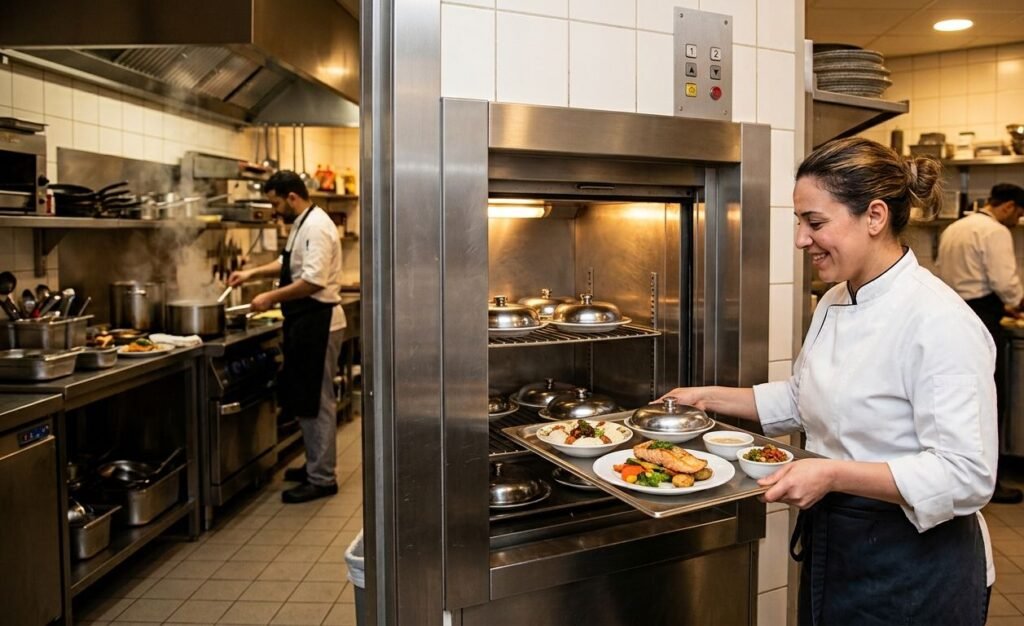
At 7:30 AM in a five-star Damascus hotel, 180 breakfast orders are being dispatched simultaneously. Trolleys loaded with covered plates, coffee pots, juice jugs, and fruit bowls move from the ground-floor kitchen to rooms on floors 3 through 12. At the same moment, the banquet kitchen on floor 2 is sending 400 buffet items up to the rooftop ballroom for a wedding breakfast. And in the basement laundry, clean linens are being sent to the housekeeping pantry on every floor.
Every one of these movements depends on one piece of infrastructure that most hotel guests never see and most hotel developers never fully plan for: the industrial food lift system. Get it right, and the hotel operates like a precision machine — food arrives hot, service is seamless, and staff efficiency is maximised. Get it wrong, and the consequences compound with every service: cold room service, slow banquet setups, overwhelmed staff elevators, guest complaints, and a kitchen team that spends as much time waiting for lifts as cooking.
This guide is the definitive technical and commercial reference for industrial food lift specification in Syrian hotels. It covers every system type used in hotel operations, the specific engineering requirements that distinguish industrial hotel food lifts from standard commercial dumbwaiters, the full cost picture, and the Syria-specific considerations that determine whether your installation performs at five-star standard for the next 20 years.
Hard System has designed, installed, and maintained industrial food lift systems in hotels across Syria — from boutique properties with 40 rooms to large hospitality complexes with multi-floor F&B operations. This guide reflects that experience directly.
Section 1: Why Hotels Need Industrial Food Lifts — Not Standard Dumbwaiters
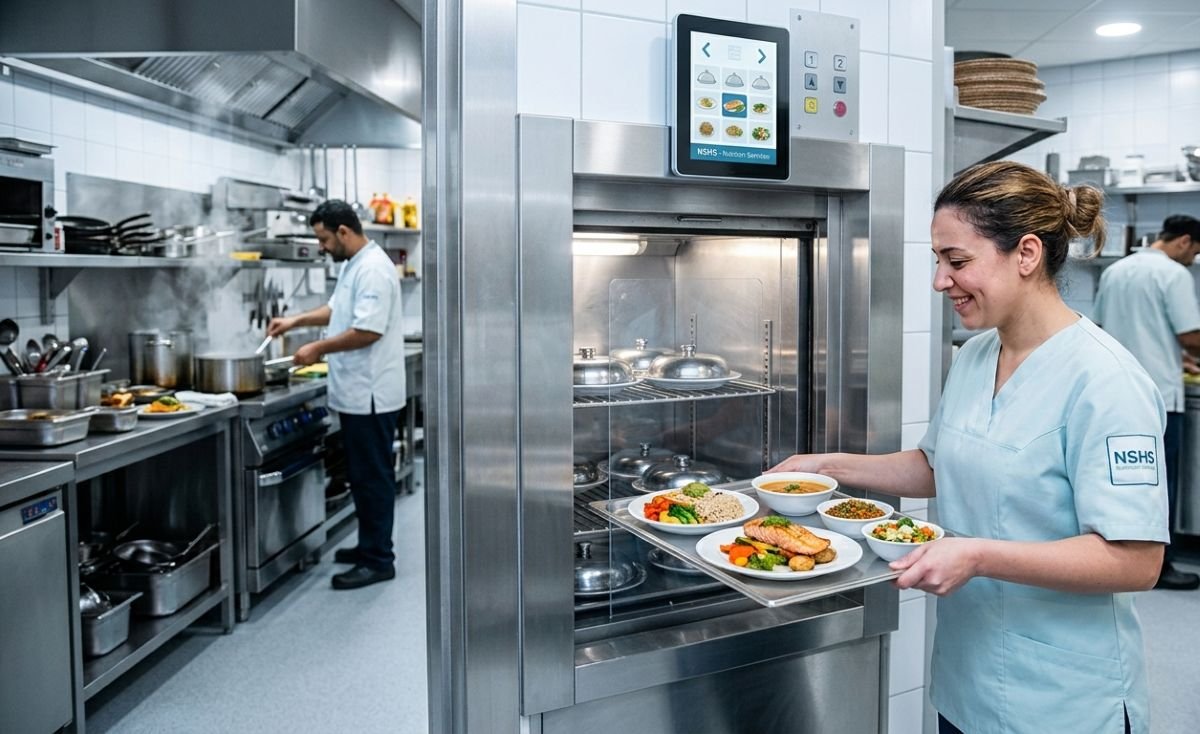
The word ‘industrial’ in industrial food lift is not marketing language — it is a precise engineering classification that distinguishes hotel-grade service lift systems from the light-duty dumbwaiters appropriate for small restaurants and residential applications. Understanding this distinction is the starting point for every hotel food lift specification decision.
1.1 The Five Dimensions of Industrial Grade
Cycle rate is the first dimension. A standard commercial dumbwaiter is designed for 20–40 cycles per day. An industrial food lift in a 150-room hotel room service operation runs 80–150 cycles per day. This 4–5× difference in daily cycle rate requires fundamentally different motor sizing (continuous duty rating rather than intermittent), drive chain specification (heavy-duty roller chain rather than standard lift chain), bearing specification (rated for continuous operation at elevated temperature), and control board thermal management.
Capacity is the second dimension. Standard dumbwaiters top out at 100–150 kg for heavy-duty catalogue units. Industrial hotel food lifts for room service trolley transport require 200–300 kg capacity. Banquet service lifts for multi-trolley dispatch require 400–600 kg. Linen lifts in large hotels move full hampers weighing 250–400 kg. None of these capacities are achievable with standard commercial dumbwaiter specifications — they require industrial drive motors, heavy-gauge structural steel car frames, and guide rail systems rated for the corresponding point loads.
Car dimensions are the third dimension. A hotel room service trolley is typically 550mm wide × 700mm deep × 1,400mm tall. Two trolleys side-by-side — the standard configuration for efficient room service dispatch — require a car of 1,200mm × 800mm × 1,500mm clear internal dimension. No standard catalogue food lift provides these dimensions. Industrial hotel food lifts are designed and manufactured to accommodate actual hotel trolley specifications, not catalogue approximations.
Duty cycle rating is the fourth dimension. Industrial motors are rated for S3 or S6 duty cycles (intermittent with defined on/off periods and continuous duty respectively). Standard commercial dumbwaiter motors are typically S2 rated (short-time duty). Running an S2-rated motor at the cycle rates required by a busy hotel room service operation causes motor winding temperature to accumulate beyond the insulation class rating, leading to premature insulation breakdown and motor failure within 2–3 years of heavy service.
Hygiene and maintenance specification is the fifth dimension. Hotel industrial food lifts are cleaned multiple times daily with commercial hygiene products. Car interiors must be Grade 304 or 316 stainless steel with fully welded seams (no exposed fixings that trap food residue), floor drains for washdown cleaning, and exterior surfaces that resist commercial cleaning chemicals without surface degradation. Standard dumbwaiters are not designed for this cleaning intensity.
| 3–4× | Higher annual maintenance cost for a standard commercial dumbwaiter operated at hotel service volumes versus an industrial-rated food lift system of equivalent capacity — driven by accelerated motor, bearing, and drive chain wear from continuous-duty operation. (Elevator World Technical Report, 2023) |
Section 2: The Seven Hotel Food Lift Applications — System by System
A large hotel is not a single food lift application — it is multiple parallel service flows, each with its own operational requirements, trolley dimensions, capacity needs, and cycle rate. Specifying a single generic food lift system for all hotel applications is a common and costly mistake. The following seven application cards document each hotel food lift use case and its specific system requirements.
| ROOM SERVICE Room Service Trolley Lift |
| Specification: Capacity: 200–300 kg per trip | Car: 650mm × 900mm min. (single trolley) or 1,200mm × 900mm (double) | Speed: 0.5–0.8 m/s | Floors: All guest floors | Cycle rate: 80–200 cycles/day | Drive: Industrial traction with S6 motor Key Feature: Speed is the primary room service KPI — every additional minute between kitchen completion and guest delivery is a guest satisfaction risk. Specify the highest speed achievable within the structural constraints of the shaft, with VFD soft-start/stop to protect plated food presentation during acceleration and deceleration phases. Syria Consideration: Syrian hotel room service peak hours (7:00–9:30 AM breakfast and 12:00–14:00 lunch) create burst demand that can exceed 25 cycles per hour. The industrial motor specification must account for this burst pattern — not just the daily average. Hard System’s room service lift specifications include a thermal margin calculation at peak burst load. |
| BANQUET Banquet and Ballroom Service Lift |
| Specification: Capacity: 400–600 kg per trip | Car: 1,400mm × 1,200mm × 1,800mm (trolley-height access) | Speed: 0.3–0.5 m/s | Floors: Kitchen to banquet/ballroom floors | Cycle rate: Intermittent high-burst (event-driven) | Drive: Heavy-duty hydraulic or high-capacity traction Key Feature: Banquet service lifts experience extreme burst demand during event setup — 30–50 cycles in a 90-minute window before service — followed by extended idle periods. The drive system must handle this burst pattern without overheating. Hydraulic systems with large-capacity oil reservoirs are well-suited to this intermittent high-load profile. Syria Consideration: Syrian wedding and banquet events routinely serve 300–600 guests, creating single-event dispatch loads that exceed the daily room service lift demand. Banquet lift specification must be based on the peak single-event load, not the average daily load. Hard System designs banquet lift systems with 25% capacity headroom above the client’s largest planned event specification. |
| LAUNDRY Linen and Laundry Lift |
| Specification: Capacity: 250–400 kg per trip | Car: 1,000mm × 800mm × 1,600mm | Speed: 0.3–0.5 m/s | Floors: Guest floors to laundry (basement or dedicated floor) | Cycle rate: 60–120 cycles/day | Drive: Industrial traction, washdown-rated interior Key Feature: Linen lifts carry wet, heavy loads — full laundry hampers can reach 120 kg for a single hamper. The car floor must be rated for the point load of hamper wheel contacts under maximum load, and the car interior must withstand continuous moisture exposure from damp linen. Stainless steel with floor drainage is mandatory. Syria Consideration: In Syrian hotels where laundry is processed in-house (increasingly common as outsourcing costs rise), the linen lift is a 24-hour operation — clean linen goes up to housekeeping pantries on night shifts, soiled linen comes down throughout the day. The motor must be rated for 24-hour S6 duty cycle, not the standard commercial 16-hour assumption. |
| MINIBAR Minibar and Room Supply Lift |
| Specification: Capacity: 80–150 kg per trip | Car: 600mm × 600mm × 900mm | Speed: 0.5–0.8 m/s | Floors: Storeroom/receiving to all floors | Cycle rate: 30–60 cycles/day | Drive: Standard industrial traction Key Feature: Minibar lifts handle small, fragile loads — bottled beverages, snacks, and amenity items that are easily damaged by vibration. The VFD smooth-start specification is important to prevent bottle contact and breakage. Car interior cushioning or rubber floor matting reduces vibration transmission to fragile items. Syria Consideration: Syrian hotel minibar operations have expanded significantly with the growth of international brand properties in Damascus, Latakia, and coastal resort areas. Minibar lift systems that were not included in the original hotel specification are increasingly being retrofitted — a more expensive and operationally disruptive option than including them in the original design. Hard System advises all new hotel projects to include minibar lift provision in the original specification even if immediate operation is not planned. |
| KITCHEN Multi-Kitchen Vertical Delivery System |
| Specification: Capacity: 150–300 kg per trip | Car: 800mm × 800mm × 1,400mm | Speed: 0.5–0.8 m/s | Floors: Main kitchen to satellite kitchens / service pantries | Cycle rate: 100–250 cycles/day (highest intensity application) | Drive: Continuous-duty industrial traction Key Feature: Multi-kitchen systems — where a main production kitchen sends prepared items to satellite service kitchens or floor pantries — are the highest-intensity food lift application in hotel operations. The continuous-duty motor specification, heavy-duty drive chain, and industrial control board thermal management are all critical. These systems must be designed to never create a bottleneck in kitchen workflow. Syria Consideration: In Syrian luxury hotels with multi-outlet F&B operations (main restaurant, pool bar, rooftop lounge, in-room dining, and events catering running simultaneously), the vertical delivery system between the main kitchen and the outlet service points is a single point of failure that affects all revenue lines simultaneously. Hard System designs multi-kitchen delivery systems with a redundancy provision — either dual shafts or a maintenance-priority service arrangement that guarantees maximum 4-hour response on any fault. |
| PHARMACY Hotel Clinic and Pharmacy Supply Lift |
| Specification: Capacity: 50–100 kg per trip | Car: 500mm × 500mm × 800mm | Speed: 0.3–0.5 m/s | Floors: Pharmacy/clinic storage to treatment areas | Cycle rate: 20–40 cycles/day | Drive: Precision traction, access-controlled Key Feature: Hotel clinic and pharmacy supply lifts require access control (key or card reader at each landing) to restrict access to authorised personnel. The car interior must meet clinical hygiene standards — Grade 316 stainless steel with fully welded seams and no exposed fasteners. Some applications require temperature-controlled car interiors for medication storage during transit. Syria Consideration: Syrian hotels with integrated medical clinic facilities (increasingly common in resort and business hotel developments) must comply with health authority equipment specifications for pharmacy supply lifts. Hard System provides regulatory compliance documentation for clinical supply lift installations in Syria. |
| POOL/SPA Pool and Spa Towel and Supply Lift |
| Specification: Capacity: 100–200 kg per trip | Car: 700mm × 700mm × 1,200mm | Speed: 0.5 m/s | Floors: Laundry to pool/spa levels | Cycle rate: 40–80 cycles/day | Drive: Industrial traction, sealed for humidity Key Feature: Pool and spa environments are among the most aggressive operating conditions for food lift mechanical and electrical components — high ambient humidity, chlorine in the air, and frequent cleaning with aggressive chemical products. All electrical enclosures must be IP55 minimum rated, and guide rail lubrication must use moisture-resistant specification grease rather than standard products. Syria Consideration: Syrian resort hotels in Latakia, Tartus, and coastal areas face additional salinity in the ambient air that accelerates corrosion of standard steel components in pool/spa environments. Hard System specifies marine-grade fasteners, stainless steel structural components, and IP65-rated electrical enclosures for coastal Syrian hotel spa lift applications. |
Section 3: Industrial Food Lift Technology Options for Hotels — Head-to-Head Comparison
Hotel industrial food lift systems are available in three primary drive technologies, each with distinct performance characteristics, maintenance requirements, and suitability profiles for different hotel applications. Understanding the trade-offs is essential to selecting the right technology for each use case.
| TECHNOLOGY 1: Industrial Traction (Counterweight) System — The Hotel Standard | |
| ADVANTAGES • Highest speed capability (0.5–1.0 m/s) — ideal for room service time-sensitivity • Most energy-efficient technology at high cycle rates • Smooth, consistent movement under varying loads • Best performance at high rise heights (10+ floors) • Widest range of capacity options (100–600 kg) • Industry-standard technology — widest parts availability in Syria | LIMITATIONS • Requires counterweight space — either beside or above the car • Machine room required (or machine-room-less configuration at premium cost) • Higher installation complexity than hydraulic systems • Guide rail installation requires precise alignment over full height |
| TECHNOLOGY 2: Industrial Hydraulic System — The Banquet Specialist | |
| ADVANTAGES • Smoothest movement profile — minimal vibration ideal for plated food • No counterweight required — simpler shaft structure • Excellent load-bearing capacity at lower speeds • Self-locking — no brake required for stationary holding • Ideal for banquet burst-load applications with intermittent high demand • Lower installation cost for short-rise applications (up to 8m) | LIMITATIONS • Slower maximum speed (0.15–0.3 m/s) — less suitable for time-critical room service • Requires hydraulic power unit in accessible machine room • Hydraulic oil viscosity affected by Syrian summer temperatures — seasonal oil grade change required • Limited to ~8m rise per hydraulic stage (tandem for greater heights) • Higher maintenance cost than traction at high cycle rates |
| TECHNOLOGY 3: Industrial Chain/Belt Drive — The Compact Solution | |
| ADVANTAGES • Most compact installation footprint — ideal for retrofit in existing buildings • Lower installation cost than traction for short-rise applications • No separate machine room required for belt-drive systems • Good capacity range (up to 300 kg for industrial chain) • Fast installation timeline | LIMITATIONS • Higher vibration level than traction or hydraulic — less suitable for plated food • Lower maximum capacity than traction (typically 300 kg maximum for hotel applications) • Chain systems require more frequent lubrication than traction in Syrian dust environment • Less suitable for high rise heights (best below 10m) • Higher noise emission than traction — relevant for guest-adjacent applications |
Section 4: Industrial Hotel Food Lift — Complete Price Guide for Syria
Hotel industrial food lift pricing in Syria encompasses a wider range than standard commercial food lifts due to the higher capacity, industrial-grade components, and complex multi-floor configurations typical of hotel installations. The following pricing framework reflects current Syrian market conditions including import logistics, customs, and installation.
5.1 System Price by Application and Specification Tier
| Application | Mid-Range Specification (USD Installed) | Premium Specification (USD Installed) | Notes |
| Room service lift (single trolley, 6 floors) | $12,000–$20,000 | $20,000–$38,000 | Includes 6 landing doors, AVR, UPS |
| Room service lift (double trolley, 10 floors) | $22,000–$35,000 | $35,000–$60,000 | Includes VFD, thermal insulation option |
| Banquet service lift (2–3 floors) | $15,000–$28,000 | $28,000–$50,000 | Hydraulic or heavy traction, wide car |
| Linen lift (6 floors, double hamper) | $18,000–$30,000 | $30,000–$52,000 | Washdown interior, S6 motor |
| Minibar supply lift (6 floors) | $6,000–$12,000 | $12,000–$22,000 | Smaller car, lighter specification |
| Multi-kitchen delivery (8 floors) | $18,000–$32,000 | $32,000–$55,000 | Highest cycle rate spec, dual motor option |
| Pool/spa towel lift (4 floors) | $8,000–$16,000 | $16,000–$28,000 | IP55, moisture-resistant lubrication |
| Pharmacy/clinical lift (4 floors) | $7,000–$14,000 | $14,000–$25,000 | Access control, SS316, clinical spec |
| Complete hotel system (4+ lifts, 10 floors) | $75,000–$160,000 | $160,000–$320,000 | Full hotel fit-out, Hard System package |
| These price ranges reflect complete installed costs including civil works, electrical installation, all landing doors, AVR, UPS emergency lowering, commissioning, and a 12-month installation warranty. Unit-only prices — which exclude civil works, electrical, doors, and protection systems — are typically 40–55% lower than these installed figures and are frequently used in misleading competitor quotations. Always compare on a like-for-like installed basis. |
5.2 Hidden Costs Syrian Hotel Developers Must Account For
- Machine room or machine-room-less premium: MRL (Machine Room Less) traction systems cost 15–25% more than machine-room configurations but recover floor area that can be used for additional guest rooms — typically a worthwhile trade-off in multi-floor Syrian hotels
- AVR and UPS for each shaft: USD 600–1,500 per lift — non-negotiable for Syria
- Civil works for multiple shafts: each shaft requires independent structural design, with costs of USD 2,500–8,000 per shaft depending on construction type
- Fire-rated landing doors where shafts cross fire compartment boundaries: USD 800–2,000 per door premium over standard landing doors
- Access control integration for restricted applications: USD 1,200–3,500 per system
- Hotel management system (PMS) integration for automated room service tracking: USD 2,000–6,000
- Preventive maintenance contracts: USD 1,800–4,500 per lift per year — budget from day one, not as an afterthought
Section 5: Syria-Specific Engineering Requirements for Hotel Food Lift Systems
6.1 Power Infrastructure Planning
A full hotel industrial food lift system — room service, banquet, linen, minibar, and kitchen delivery lifts combined — represents a significant electrical load. A 10-floor hotel with four industrial food lifts may draw 15–25 kW continuously during peak service, with starting current surges of 6–8× rated current when multiple motors start simultaneously. The hotel’s electrical switchboard, cable sizing, and generator capacity must be designed to accommodate this load — which must be included in the MEP (Mechanical, Electrical, and Plumbing) design at the earliest stage.
Syria’s power supply instability requires voltage regulation for every hotel industrial food lift motor. AVR units for three-phase hotel applications cost USD 800–2,500 per lift and should be treated as mandatory specifications, not optional add-ons. Hotels that operate without AVR protection face motor failure rates in Syria that are 3–4× the manufacturer’s predicted MTBF.
6.2 Generator Integration
Syrian hotels routinely operate on generator power for extended periods. Every industrial food lift system must be tested on generator power as part of commissioning — verifying that the generator’s voltage regulation and frequency stability meet the food lift control board’s operating parameters. Some generators, particularly older models common in Syrian commercial buildings, produce transient voltage spikes during load switching that can damage food lift control boards even when AVR protection is present. Hard System’s commissioning process includes generator compatibility testing and, where necessary, additional transient protection.
6.3 Multi-System Coordination in Hotel Fit-Out
A hotel fit-out involves multiple contractors — civil, MEP, interior design, kitchen equipment, and vertical transportation — all working within the same building simultaneously. Industrial food lift installation must be coordinated with kitchen equipment suppliers (to verify trolley dimensions fit the car specification), MEP contractors (to confirm electrical supply and shaft penetration coordination), interior designers (to verify landing door finishes integrate with corridor design), and fire safety engineers (to confirm shaft fire compartmentation compliance).
Hard System’s project management approach for hotel installations includes a formal multi-contractor coordination meeting at the start of the installation phase — bringing together all relevant contractors to resolve interface conflicts before they become site issues. This meeting, taking 2–3 hours, prevents the most common causes of hotel vertical transportation installation delays.
6.4 Parts and Service Strategy for Hotels
A hotel cannot afford a 3-month parts wait for a room service lift failure during peak season. Hard System’s hotel industrial food lift service strategy includes: maintaining a minimum stock of critical parts (control board, motor contactor set, drive chain section, and landing door mechanism components) for every hotel system under our maintenance contract; a 4-hour emergency response SLA for all hotel contracts; and a documented escalation procedure for failures that cannot be resolved on the first visit.
For hotels with multiple food lift systems of the same specification, Hard System recommends a cross-system spare parts strategy where one unit’s critical spare can serve as the temporary replacement for another — reducing the effective stock investment while maintaining service continuity across all systems.
Section 6: Planning Industrial Food Lift Systems into a Syrian Hotel — The Developer’s Timeline
The most expensive food lift decisions in Syrian hotel development are the ones made too late — after the shaft locations are fixed, after the electrical switchboard is specified, or after the kitchen equipment layout is finalised. This planning timeline documents when each food lift decision must be made in the hotel development programme.
| Development Stage | Food Lift Decision Required | Consequence of Delay | Who Decides |
| Concept design | Number and location of lift shafts | Structural rework cost: $15,000–50,000+ | Developer + architect |
| Concept design | Shaft sizes (car dimension drives shaft size) | Cannot accommodate correct car size | Developer + F&B operator |
| Schematic design | Drive technology selection (traction vs. hydraulic) | Machine room provision may be missed | MEP engineer + Hard System |
| Schematic design | Electrical load calculation for all lifts | Generator and switchboard undersized | MEP engineer |
| Design development | Car interior finish specification | Finishes cannot integrate with design | Interior designer + operator |
| Design development | Landing door specification and finish | Door size/finish conflicts with corridor design | Interior designer |
| Construction docs | Civil works specification for shafts/pits | Contractor builds incorrect shaft | Hard System + civil engineer |
| Construction | Shaft verification visits (3 minimum) | Dimensional errors built in permanently | Hard System site team |
| Fit-out | Kitchen trolley dimension verification | Car too small for actual trolleys | F&B operator + Hard System |
| Pre-opening | Generator compatibility testing | Control board failure on generator | Hard System + MEP contractor |
| Opening | Maintenance contract activation | No service coverage from day 1 | Hotel GM + Hard System |
| Hard System recommends engagement at the concept design stage for all hotel industrial food lift projects. Early engagement costs nothing — it is a consultation service that Hard System provides without charge. Late engagement, after structural decisions are made, costs USD 15,000–80,000 in rework and programme delay on a typical Syrian hotel project. |
Frequently Asked Questions (FAQ)
Q1: How is an industrial food lift different from a standard hotel service elevator?
An industrial food lift (dumbwaiter) carries service items only — food, linen, supplies — with no passengers permitted. A service elevator is a passenger-rated lift that can also carry trolleys and equipment, but is subject to full passenger lift regulations, has a larger footprint, costs 5–10× more, and runs at passenger lift speeds that are higher than food service requirements. Industrial food lifts are the economically appropriate solution for food and linen transport; service elevators are appropriate where staff must accompany trolleys between floors or where items exceed food lift capacity limits.
Q2: What is the minimum number of industrial food lifts for a 100-room Syrian hotel?
For a 100-room hotel with standard service requirements (room service, linen, minibar) across 8 floors, Hard System recommends a minimum of two dedicated lift shafts: one room service/minibar lift and one dedicated linen lift. Combining room service and linen in a single shaft creates hygiene cross-contamination risk and creates a service bottleneck during peak hours when both demands are high simultaneously. A hotel with multi-outlet F&B (pool restaurant, rooftop dining, main restaurant, events) requires a third shaft for kitchen-to-outlet delivery. This three-shaft minimum is the baseline specification for a 100-room Syrian hotel operating to international service standards.
Q3: How long does industrial food lift installation take in a hotel that is already operating?
Industrial food lift installation in an operating hotel requires careful phasing to minimise guest impact. Shaft construction (the noisiest and most disruptive phase) typically takes 2–3 weeks and should be scheduled during low-occupancy periods or confined to daytime hours if adjacent rooms are occupied. The lift installation itself takes 5–10 days per shaft. Hard System’s hotel retrofit installation programme includes a phasing plan that sequences shaft-by-shaft construction to maintain some service capability throughout the installation period. Total programme for a three-shaft hotel retrofit: 8–14 weeks from programme start to full commissioning.
Q4: What hygiene certification does the car interior need for food transport in Syrian hotels?
Syrian hotel food lift car interiors should comply with international food safety equipment standards requiring food-contact surfaces to be of a material that is non-absorbent, non-porous, non-corrosive, and cleanable with commercial cleaning products. Grade 304 stainless steel with fully welded seams and no exposed fasteners meets these requirements for standard food service applications. For hotels operating under international brand standards or targeting food safety certification, Grade 316 stainless steel with an electropolished finish provides additional corrosion resistance and is specified by several international hotel brand technical standards. Hard System provides material certification documentation for all car interior specifications.
Q5: Can industrial food lifts be integrated with the hotel’s room service ordering system?
Yes — and this integration delivers measurable operational benefits for Syrian hotels operating room service at scale. Integration between the PMS (Property Management System) room service order workflow and the food lift control system enables automatic lift dispatch when a room service order is marked ‘ready’ in the kitchen, floor-level indicator lights in staff pantries showing the lift is en route, and delivery time logging for service standard monitoring. This integration requires a compatible control board with BMS/API interface capability — a specification that must be requested at the time of system design, not attempted as a retrofit. Hard System’s premium hotel food lift package includes PMS integration capability as a standard option.
Q6: What preventive maintenance schedule should a Syrian hotel plan for its industrial food lift systems?
Syrian hotels should plan for monthly preventive maintenance visits for every industrial food lift in service — not the quarterly schedule that international manufacturers specify for their design climate. Monthly maintenance for hotel industrial food lifts includes full lubrication service (step chain, drive chain, bearing housings), safety system functional testing, motor thermal check, control board inspection, and all landing door mechanism verification. The annual cost of a monthly maintenance contract for a hotel’s full food lift system (3–4 lifts) is USD 8,000–18,000 — approximately 4–6% of the initial system installation cost. This is the most profitable maintenance investment a Syrian hotel can make.
Q7: What is the weight limit for room service trolleys in a standard industrial hotel food lift?
The maximum load per trip in a hotel room service food lift should be specified at 130% of the heaviest trolley load the hotel will ever dispatch. For a Syrian five-star hotel dispatching double-trolley room service for premium suites (two full breakfast setups including coffee press, juice, fruit, bread basket, and hot items), the maximum double-trolley load including the trolley weight is typically 180–220 kg. The food lift should therefore be specified at 250–300 kg capacity minimum. Under-specifying capacity — a common cost-cutting decision — results in overload sensor activation during peak service, forcing staff to split loads and double the number of trips.
Q8: Does Hard System provide the complete hotel food lift system — design, supply, install, and maintenance?
Yes — Hard System provides the complete end-to-end service for hotel industrial food lift systems in Syria. Our hotel service package includes initial consultation and service flow analysis at the concept design stage, full engineering design and specification, equipment import and logistics management, civil works coordination and shaft verification, mechanical and electrical installation, commissioning and load testing, staff training, regulatory documentation, and structured preventive maintenance contracts. We are the single point of accountability for the entire system — eliminating the coordination risk between multiple suppliers that affects many Syrian hotel projects. Contact Hard System at hard-sy.com to discuss your hotel’s specific requirements.
Conclusion: Industrial Food Lifts Are Hotel Infrastructure — Plan Them Like It
Every Syrian hotel that operates multi-floor food and beverage service faces a simple operational reality: the speed, temperature, and presentation of food delivered to guests is directly limited by the capacity and performance of the vertical transport system between the kitchen and the service point. Industrial food lifts are not an amenity or a convenience item — they are core operational infrastructure, as critical to hotel service delivery as the kitchen equipment itself.
Specifying industrial hotel food lifts correctly means understanding the specific service flows of each application, selecting the right technology and capacity for each use case, planning the systems into the hotel design at the concept stage rather than retrofitting them later, and ensuring that the Syria-specific power, climate, and parts availability realities are addressed in every specification decision.
Hard System brings to every Syrian hotel food lift project the engineering depth, the hospitality sector experience, the in-country parts infrastructure, and the structured maintenance capability that hotel-grade industrial food lift systems demand. From boutique Damascus properties to large coastal resort complexes, our team delivers systems that perform at five-star standard throughout their operational life.
| Ready to Specify Industrial Food Lifts for Your Syrian Hotel? Hard System offers free concept-stage consultations for Syrian hotel food lift projects — including service flow analysis, shaft location guidance, and preliminary specification. No obligation. No cost. Just engineering expertise that protects your investment. |