
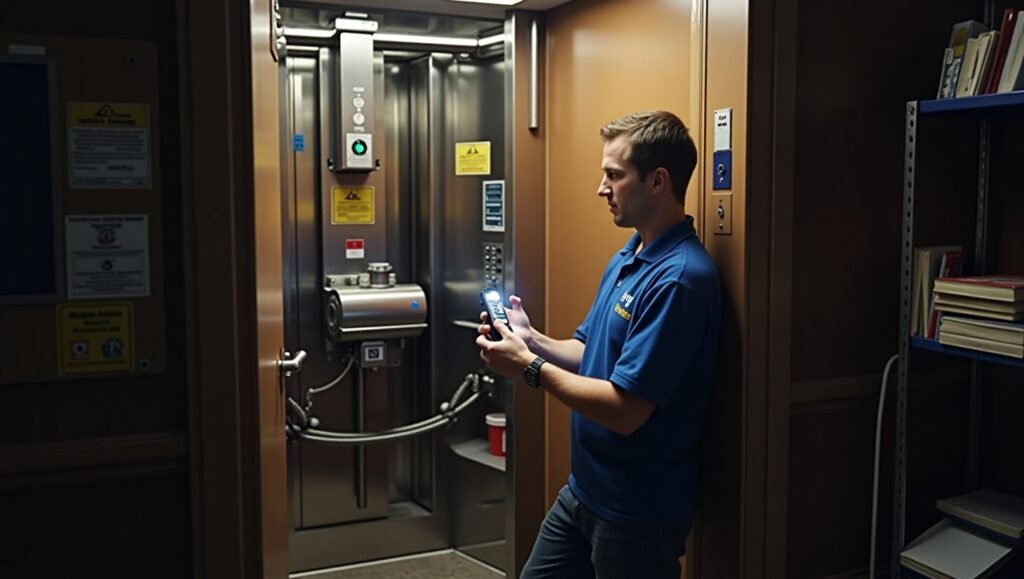
Monthly vs Yearly Elevator Maintenance
Most building owners approach elevator maintenance the same way they approach car insurance: find the lowest compliant price and move on. That instinct is understandable and, in this case, genuinely costly. The annual-only contract appears cheaper on paper. In practice, it shifts risk to the building, to the residents, and ultimately to the owner’s liability position.
The stakes are concrete. A 12-month gap between inspections allows door interlocks, brake pad thickness, and suspension rope condition to deteriorate below safe thresholds without any detection. Each of these represents a direct life-safety risk, not a theoretical one. In Syria’s operating environment specifically, standard European service interval guidelines do not translate without adjustment.
Damascus adds its own amplifiers: chronic grid instability, 40°C+ summer temperatures, and seasonal khamseen dust storms all compress component wear timelines beyond temperate-climate assumptions. An elevator that would safely reach twelve months between services in a Stuttgart apartment building may reach a hazardous condition in eight months in a Damascus high-rise.
Hard System’s position is this: the right maintenance plan is not the cheapest or the most frequent. It is the one matched precisely to the building’s actual usage level, occupancy type, elevator specification, and local environmental conditions. This article gives you the technical and financial framework to make that match correctly.
Understanding What Each Elevator Maintenance Plan Actually Covers
Before the head-to-head comparison, it is worth being precise about what each service frequency actually delivers. The label “monthly” or “annual” refers to visit frequency, not necessarily to the scope of each visit. Understanding both dimensions is how you evaluate a contract rather than just a price.
What a Monthly Elevator Maintenance Plan Includes
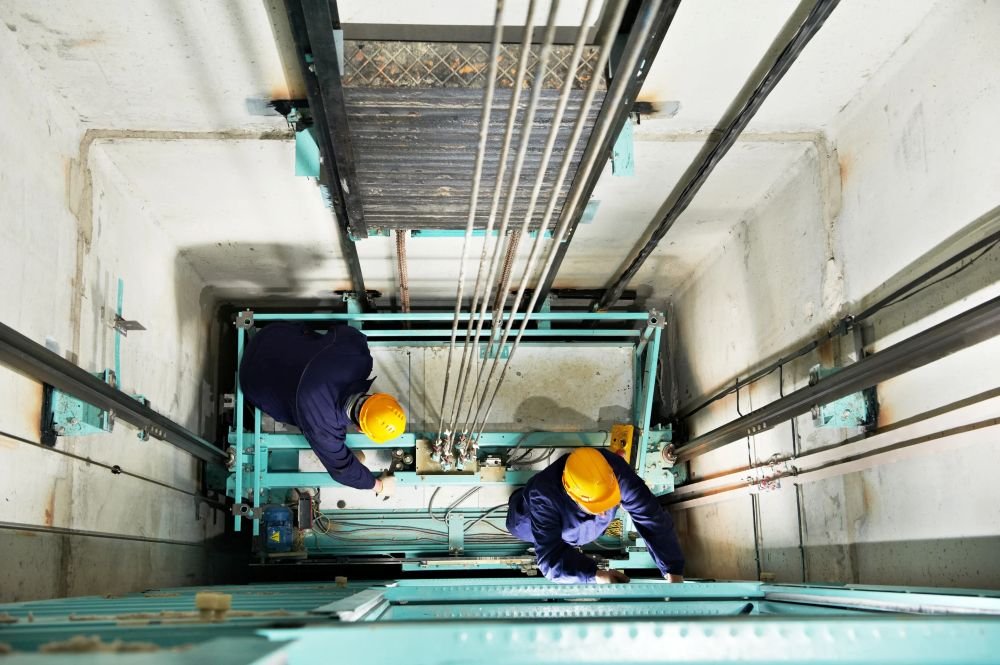
A monthly plan delivers twelve engineer visits per year. At each visit, a competent monthly protocol covers: guide rail lubrication, rope and sheave groove inspection, door timing and closing-force measurement, safety circuit spot-check, ARD battery capacity test, cabin lighting verification, and emergency intercom function confirmation.
The core advantage is the fault detection window. With monthly visits, no defect can develop undetected for longer than thirty days. For a high-traffic commercial building or a hospital, a single day of elevator downtime has a measurable, sometimes severe, financial impact. Catching a developing door interlock fault in week three of the month rather than in month eleven is the difference between a planned component swap and an emergency shutdown.
Documentation is the second major output. Twelve signed maintenance log entries per year represent the maximum evidentiary record available for any regulatory inspection, insurance claim, or tenant liability dispute in Syria. Hard System’s monthly protocol uses a standardised 47-point digital checklist with per-component condition scoring. Automated trend alerts flag any component moving from green to amber status between client reporting cycles, giving building managers advance notice rather than retrospective reporting.
What a Quarterly Elevator Maintenance Plan Includes
Quarterly servicing delivers four visits per year. Each quarterly visit covers all monthly items, plus deeper mechanical checks: torque verification on rail brackets and buffer fixings, brake lining thickness measurement, control board diagnostic read-out, and full pit and overhead equipment inspection. The scope is wider at each visit because the interval is longer.
The quarterly plan is the EN 81-20-aligned standard for most mid-use residential buildings and represents the practical balance between cost efficiency and a 90-day maximum fault detection window. It is not a compromise position for the right building profile, quarterly servicing is the correct specification.
Hard System’s quarterly protocol adds two elements not found in standard European programmes: a mandatory ARD battery test and a full dust-clearance procedure, both specifically engineered for Syria’s operating environment. Between scheduled visits, Hard System issues advisory notices for any observed defects requiring owner awareness before the next planned service.
What an Annual Elevator Maintenance Plan Includes
An annual plan delivers one comprehensive inspection per year: mechanical, electrical, full safety-chain verification, load test, complete documentation review, and regulatory log update. It is a thorough snapshot of the elevator’s condition on a single day, with no monitoring between that day and the same day twelve months later.
Annual servicing is genuinely appropriate in one narrow context: a private villa home elevator used by one or two residents with verifiably minimal daily trip counts. Hard System offers a Basic plan designed precisely for this use case, with full transparency about its limitations. For any other building type in Damascus multi-tenant residential, commercial, medical, hospitality Hard System does not recommend annual-only servicing.
The regulatory position is important to state clearly. Annual-only plans may satisfy the minimum inspection frequency required by Syrian authorities. They do not satisfy Hard System’s professional standard of care for any building with multiple regular occupants. There is a meaningful gap between the regulatory minimum and competent professional practice, and building owners should understand which standard their chosen contract meets.
Monthly vs Yearly Elevator Maintenance Head-to-Head Technical Comparison
Quick-Reference Comparison Table
This table is designed as a decision anchor. Print it, share it with your board or property manager, and use it as the framework for any conversation with a maintenance contractor.
| Aspect | Monthly Plan | Annual Plan |
| Fault Detection Window | Max 30 days | Monthly wins — up to 365 days on annual |
| Safety Device Checks / Year | 12 | Monthly wins — only 1 on annual |
| Maintenance Log Entries / Year | 12 | Monthly wins — only 1 on annual |
| Lubrication Continuity | Maintained year-round | Annual risk — possible 10-month starvation |
| ARD Battery Checks / Year | 12 | Monthly wins — only 1 on annual |
| Dust Clearance (Damascus) | Monthly removal | Annual risk — 12 months accumulation |
| Emergency Call-Out Risk | Low (early detection) | Monthly wins — high risk on annual |
| 5-Year Total Cost of Ownership | Lower when all costs included | Monthly wins — higher when fully costed |
| Recommended For | High-rise, commercial, medical, hotels | Annual: private villas (low-use only) |
Safety Device Integrity
The monthly plan’s safety device advantage is direct: door interlock wear is detected within thirty days; overspeed governor lubrication is maintained continuously; brake pad measurement establishes a trend baseline across twelve annual data points. No safety device degrades undetected for more than one month.
The annual plan’s exposure is the inverse. An interlock failure can develop, worsen, and approach a hazardous condition for up to twelve months before detection. There is no trend baseline because each annual visit is an isolated snapshot rather than a point in a data series. The inspector sees the condition on the day; they have no visibility of the trajectory that produced it.
Damascus amplifies this risk materially. Dust infiltration into door mechanism contacts accelerates interlock wear rates to levels that make twelve-month detection intervals unsafe for any multi-tenant building. EN 81-20 §14 states that the safety circuit must be verified at every maintenance visit. A single annual visit satisfies the technical minimum. It does not satisfy Hard System’s duty-of-care interpretation for any occupied building with regular use.
Component Lifespan and Wear Management
Continuous lubrication under a monthly plan keeps lubricant film intact on guide rails and sheave grooves year-round. Suspension rope wire-break count is monitored monthly, enabling condition-based replacement at planned rates. Bearing temperatures are trended across twelve readings per year, making thermal anomalies visible long before they produce failure.
Under an annual plan, lubricant starvation is possible for ten months or more between visits. Rope wire breaks accumulate between EN 81 replacement thresholds without detection. Bearing failure, when it comes, is more likely to be abrupt than predicted because there is no trend data to give advance warning.
The replacement cost differential is significant. A rope replaced on condition at month nine of a monthly-serviced elevator is a planned maintenance cost: scheduled, budgeted, and managed. The same rope replaced after failure on an annual-plan elevator is an emergency procurement event typically 40–60% more expensive once emergency labour rates and international freight to Damascus are included.
Hard System’s monthly contracts generate a per-component data series across twelve readings per year. This enables predictive replacement scheduling and accurate multi-year maintenance budget forecasting capabilities that building owners and property managers increasingly treat as a governance requirement rather than an optional extra.
Regulatory Compliance and Documentation Strength
Twelve signed maintenance log entries per year create a complete, year-round audit trail. This is the strongest defensible position in any Ministry of Housing inspection or elevator-related insurance claim. The log demonstrates continuous operator engagement, not periodic compliance theatre.
An annual plan produces one log entry per year. That single entry is technically compliant with the minimum threshold. It leaves an eleven-month documentation gap that insurers and inspectors may legitimately challenge as evidence of inadequate operator diligence regardless of the elevator’s physical condition on the day of inspection.
Syrian regulatory context matters here. Ministry of Housing inspectors treat the maintenance logbook as the primary evidence of operator diligence. A sparse log reflects on the building owner’s risk management posture regardless of what the inspector finds when they look at the equipment. The log is not a technicality; it is the legal record.
Hard System’s digital log platform stores all visit records in a cloud-accessible client portal, time-stamped and engineer-signed. Any record is retrievable within seconds during an unannounced inspection or claims event. This is not a paperwork exercise; it is an operational risk management tool.
Five-Year Total Cost of Ownership The True Financial Picture
The monthly plan carries a higher scheduled contract fee, distributed evenly across the year with no large unplanned expenditure events. Emergency call-outs are largely eliminated because developing faults are caught and resolved during scheduled visits. Components are replaced at planned rates, enabling accurate budget forecasting across a multi-year horizon.
The annual plan has a lower contract fee and a less predictable total cost. Emergency call-outs, when they occur, are billed at standard un-contracted rates. Unplanned parts procurement via international freight commands a premium. Tenant downtime losses in commercial or hospitality buildings are real financial costs, even when they do not appear in the maintenance ledger.
Hard System’s internal TCO analysis for a typical Damascus mid-rise shows that monthly and quarterly contracts deliver lower total five-year expenditure than annual contracts in 85% of modelled scenarios, once all costs including downtime, emergency labour, and expedited parts are included in the model. The annual plan is cheaper on paper. It is rarely cheaper in practice.
Damascus-Specific Factors That Determine the Optimal Maintenance Plan Frequency
Generic elevator maintenance guidelines are written for temperate, stable-grid markets. Damascus is neither. The three environmental factors below are the primary reasons why Hard System’s Damascus recommendations diverge from standard European service interval guidance and why building owners in Syria should be skeptical of contractors who apply European templates without local calibration.
Power Grid Instability and ARD Battery Degradation
Syria’s load-shedding schedule means Damascus elevators trigger significantly more ARD activations per year than regional benchmarks. Each activation draws down battery capacity and stresses ARD mechanical components beyond standard wear assumptions. An ARD battery that would last three years in a stable-grid environment may degrade to below safe rescue capacity in eighteen months in Damascus.
Under a monthly plan, ARD battery capacity is tested every thirty days. A degrading battery is caught and replaced before it reaches the unsafe threshold. Under an annual plan, the same battery may operate below safe rescue capacity for months silently, without any trigger that would alert the building manager. In Damascus, this is not a theoretical scenario. It is a documented occurrence in buildings managed on annual-only contracts.
UPS charging circuit efficiency adds another layer. A degraded charging circuit silently reduces battery charge level without producing any fault signal or alarm. Detection requires measurement which means it only happens at a service visit. Hard System treats ARD battery capacity test and UPS output voltage measurement as non-negotiable safety items at every visit on every contract tier, regardless of the scheduled service frequency.
Summer Heat (40°C+) and Lubricant Performance
Damascus peak summer temperatures cause lubricant viscosity to fall below the minimum effective film-strength threshold for sheave groove and guide-rail protection. The consequence is accelerated metal-to-metal wear at the highest-load contact points of the elevator system. This is not a marginal degradation it is a fundamentally different wear regime that standard annual-service assumptions do not account for.
Monthly lubrication replenishment prevents starvation entirely. The technician checks and replenishes at every visit, maintaining film continuity through the summer peak. An annual plan leaves lubricant potentially fully depleted from July onward, with no replenishment until the following year’s scheduled visit four to five months of metal-on-metal contact at the system’s most critical load interfaces.
Motor winding insulation ageing is a related risk. Thermal degradation of winding insulation accelerates exponentially above 40°C. Monthly insulation resistance spot-checks detect degradation before it produces a fault. Annual plans provide no interim thermal monitoring, which means the first indication of insulation failure may be the failure itself rather than a trend that could have prompted a planned winding replacement.
Dust and Particulate Infiltration
Damascus’s seasonal khamseen dust storms deposit fine conductive and abrasive particulate throughout elevator mechanisms at rates well above European reference conditions. The affected areas include door mechanism grooves, control board cooling vents, rope sheave grooves, and guide-shoe liners. The consequence is not cosmetic; it is functional and progressive.
Door mechanism contamination is the most immediately consequential. Twelve months of particulate accumulation can jam door operators and wear electrical contacts beyond cost-effective repair. Monthly cleaning and re-adjustment prevents accumulation from reaching the threshold at which it becomes a defect. Annual servicing typically finds contamination it does not prevent it.
Control board contamination carries a different risk profile. Conductive dust deposits on PCB surfaces cause intermittent faults that are difficult to diagnose and eventually produce board failure. Monthly compressed-air purging of control cabinet vents prevents this at negligible cost per visit. Board replacement is not. Guide rail contamination causes accelerated guide-shoe wear and measurable increase in car vibration; monthly lubrication flushes contaminants, while annual servicing finds worn shoes that could have been preserved.
Building Type and Usage Profile Damascus Market Segmentation
Hard System’s plan recommendations are calibrated to building type and usage profile rather than applied uniformly. The following segmentation reflects our operational experience across the Damascus portfolio.
- High-rise residential (10+ floors): Monthly plan is Hard System’s mandatory recommendation. High daily trip cycles, the large number of simultaneously affected residents on any given failure, and the regulatory visibility of high-rise buildings all require the tightest possible service frequency.
- Mid-rise residential (4–9 floors): Quarterly plan minimum; monthly plan strongly recommended for any building with ground-floor retail, a medical clinic, or commercial tenants who cannot tolerate unplanned elevator downtime.
- Commercial, retail, hospitality, and medical: Monthly plan required. Tenant SLA obligations, public liability exposure, and brand or operational reputation make any service interval longer than 30 days commercially and legally unacceptable for these building types.
- Private villa and home elevators: Semi-annual or annual plan acceptable only for genuinely single-occupancy, low-use installations. Hard System conducts ARD and door interlock checks at every visit regardless of the frequency tier contracted.
Hard System’s Elevator Maintenance Plan Tiers for Damascus Buildings
The following plan descriptions are structured so that a building owner or property manager can match their specific building profile to the correct tier directly. Each plan is designed for a defined use case, with transparent limitations where applicable.
Basic Plan Annual or Semi-Annual
Designed for private villas, home elevators, and genuinely low-use single-occupancy buildings where annual service meets both regulatory and practical requirements. The Basic plan includes a scheduled visit or visits, the full 47-point safety inspection, a statutory maintenance log entry, and written advisory notices for any observed defects with recommended action timelines.
Hard System does not recommend this plan for multi-tenant residential or any commercial installation in Damascus. That limitation is stated explicitly in every Basic plan proposal so that clients make an informed choice. The Basic plan is not a lesser service it is the correctly specified service for its intended building type, applied to the wrong building type by owners who should be on a higher tier.
For clients who start on the Basic plan and whose building occupancy or usage subsequently increases, Hard System’s account team proactively recommends an upgrade when the building’s profile moves beyond Basic-plan criteria. The goal is to match the plan to the building at all times, not to sell the highest-priced contract.
Comprehensive Plan Quarterly
Designed for mid-rise residential buildings of four to nine floors, mixed-use buildings, and owners seeking EN 81-aligned service at an efficient cost point. The Comprehensive plan includes four full visits per year, all consumables (lubricants, door seals, minor electrical contacts), priority two-hour emergency call-out response, and digital condition reports with traffic-light component grading.
Hard System’s quarterly protocol adds the Damascus-specific calibration described above: mandatory ARD battery testing, dust-clearance steps, and summer heat lubrication checks at every visit, beyond what standard European quarterly programmes include. The documentation package covers four maintenance log entries per year, annual safety audit submission management, and Ministry of Housing inspection coordination and attendance.
The Comprehensive plan’s two-hour emergency response guarantee is a contractual right, not a best-effort commitment. For mid-rise buildings where elevator failure affects a significant number of residents simultaneously, response time is a practical service quality measure with direct impact on tenant satisfaction and owner liability exposure.
Full-Inclusive Monthly Plan
Designed for high-rise residential buildings of ten or more floors, all commercial buildings, hospitals, hotels, and any building where unplanned downtime has direct financial, operational, or safety consequences. The Full-Inclusive plan includes twelve visits per year, all consumables, all parts replacement excluding major structural components, priority emergency response, monthly trend reports, annual certification management, and Ministry of Housing inspection support.
The exclusive benefit of this plan tier is the component condition trending dashboard, accessible by the building manager in real time. Proactive replacement scheduling eliminates budget surprises: when a component’s trend line indicates approaching replacement, the building manager knows months in advance, not at the moment of failure. Dedicated account engineer support is provided for Damascus-portfolio clients with multiple buildings or high-complexity elevator configurations.
Hard System’s performance record on the Full-Inclusive Monthly Plan is the strongest client guarantee we can offer: no building in our Damascus portfolio on this plan has received an unresolved Ministry of Housing compliance notice. The plan is not simply a maintenance contract. It is a managed compliance programme with the building owner’s regulatory and legal position as the primary output.
| PLAN COMPARISON OVERVIEW |
| Basic (Annual/Semi-Annual): Private villas, low-use single-occupancy | 1–2 visits/yr | 47-point inspection + log |
| Comprehensive (Quarterly): Mid-rise residential, mixed-use | 4 visits/yr | All consumables + 2hr emergency response |
| Full-Inclusive (Monthly): High-rise, commercial, medical, hotels | 12 visits/yr | All parts + trending dashboard + full compliance management |
Frequently Asked Questions Monthly vs Yearly Elevator Maintenance
Is monthly elevator maintenance really necessary in Damascus?
Yes, for multi-tenant and commercial buildings. Damascus’s heat, dust, and grid instability accelerate component wear beyond what annual-plan detection windows can safely monitor. Hard System’s operational data shows five to eight times lower breakdown frequency on monthly contracts compared to annual contracts across comparable building types in the Damascus portfolio.
Does Syrian law require a specific maintenance plan frequency?
The Ministry of Housing mandates annual inspection as the regulatory minimum. Hard System recommends quarterly servicing as the professional minimum for any occupied building, and monthly servicing for high-rise and commercial properties. The gap between the regulatory minimum and competent professional practice is meaningful, and building owners bear the consequences of operating in that gap if an incident occurs.
Can I switch from an annual to a monthly plan mid-contract with Hard System?
Yes. Plan upgrades are available at any point in the contract cycle. Hard System performs a full condition audit at the point of transition to re-establish a component baseline and bring the maintenance log current. The transition process is managed entirely by Hard System with no disruption to normal elevator operation during the changeover.
What is the true cost difference between monthly and annual plans?
Annual plans carry a lower contract fee and a higher total five-year cost when emergency call-outs, unplanned parts procurement, and downtime losses are included in the calculation. Hard System provides a free, building-specific five-year TCO comparison worksheet to any prospective client the inputs are building type, floor count, elevator specification, and expected daily trip volume. Request it at hard-sy.com/en/contact.
Does a monthly plan guarantee no breakdowns?
No maintenance plan eliminates all failures. Elevators are mechanical systems and unexpected faults occur regardless of service frequency. Monthly-serviced elevators experience five to eight times longer mean time between failures than annual-plan elevators. When faults do occur on a monthly plan, they are detected and resolved within thirty days rather than up to twelve months. The difference is the severity and cost of the outcome, not the theoretical elimination of failure.
What happens during a breakdown if I am on an annual plan?
Emergency call-outs for annual-plan clients are available but billed at standard un-contracted rates, which are higher than contracted emergency response rates. Clients on Hard System’s Comprehensive and Full-Inclusive plans have priority two-hour emergency response as a contractual right. For commercial and high-rise buildings where downtime has direct financial consequences, the emergency response contract right is a significant operational protection.
Which plan does Hard System recommend for a brand-new elevator installation?
Hard System’s recommendation for all new installations is the Comprehensive (quarterly) plan as the minimum, with the Full-Inclusive Monthly plan for any high-rise, commercial, or mixed-use building from the first day of operation. Establishing a component condition baseline and trend data from the beginning of the elevator’s service life maximises the value of predictive maintenance and provides the strongest possible regulatory documentation position from the outset.
Get the Right Elevator Maintenance Plan for Your Building
You now have the technical and financial framework to evaluate any elevator maintenance proposal against your building’s specific profile. The decision is not complicated once the right inputs are in place: building type, floor count, elevator specification, daily trip volume, and the full cost picture rather than the contract fee alone.
Hard System’s next step is to take those inputs from you, match them against our Damascus operational experience, and give you a specific plan recommendation with the five-year cost model to support it. There is no obligation attached to the recommendation, and no cost for the consultation or the TCO worksheet.
Hard System’s engineers will match the right plan to your specific building profile at no cost or obligation.