Introduction: The Number Everyone Wants — And Why It Is More Complex Than You Think
You are planning a commercial mall, a hospital expansion, or a premium residential tower in Syria. You have the architectural drawings, the structural calculations, and the investor backing. Then comes the question that stops every project in its tracks: how much does an escalator actually cost to install in Syria?
The honest answer is: it depends but “it depends” is not good enough when you are budgeting millions of Syrian pounds or tens of thousands of US dollars. You need real numbers, real cost drivers, and the real picture of what escalator installation in Syria’s specific market conditions actually looks like in 2025.
This guide delivers exactly that. From entry-level commercial units to high-end spiral escalators, from the unit price to the hidden costs that most suppliers never mention, you will find here the most comprehensive escalator pricing breakdown available for the Syrian market written by the engineers and project managers at Hard System who have delivered these installations.
| Important note: All USD price ranges in this guide reflect 2024–2025 market conditions. Syrian pound equivalents vary with exchange rates and are best confirmed directly with Hard System at the time of quotation. Visit hard-sy.com for current pricing guidance. |
Section 1: The Global Context — Why Escalator Prices Are What They Are
Before examining Syrian market pricing, it is worth understanding the global cost structure that underlies every escalator quotation you will receive. Escalators are precision-engineered industrial machines with thousands of components and their price reflects that reality.
| $16.3B | Global escalator & moving walkway market value in 2022 projected to reach USD 24.1 billion by 2030 (Source: Grand View Research, 2023). |
| 70–75% | of a commercial escalator’s total cost of ownership occurs after installation in maintenance, energy, and eventual part replacement making the purchase price only the beginning. |
The largest cost components in any escalator are the drive motor and gearbox assembly (20–25% of unit cost), the step chain and step system (15–20%), the electronic control board and safety system (15–18%), the structural truss (10–15%), and installation labour (10–15%). Each of these components is imported into Syria, making them subject to customs duties, currency exchange rates, freight costs, and availability constraints.
This is why two escalator quotations for the same rise height and step width can differ by 30–40%: the difference almost always comes down to component country of origin, manufacturer brand tier, and the supplier’s local cost base. Understanding this structure empowers you to evaluate quotations intelligently rather than simply choosing the cheapest option.
For authoritative global market data, see: Grand View Research — Escalator & Moving Walkway Market Report
Section 2: Escalator Installation Cost in Syria — Price Ranges by Type
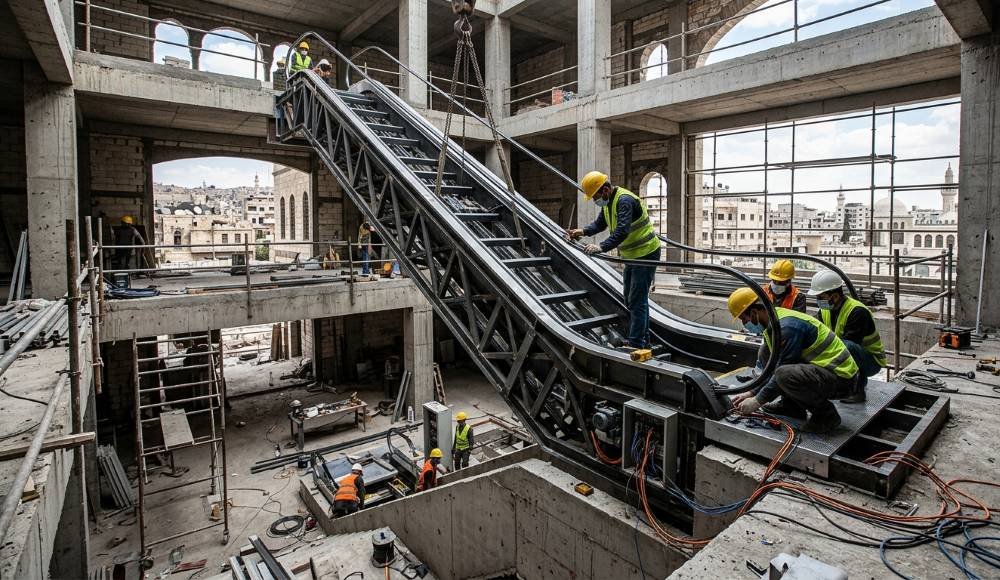
The following price ranges reflect complete installed costs meaning the escalator unit, all associated civil works, electrical connections, commissioning, and a standard 12-month installation warranty. They are expressed in USD as the reference currency for equipment procurement in Syria.
2.1 Standard Parallel Commercial Escalator
The parallel escalator is the workhorse of Syrian commercial buildings the most common type seen in malls, retail complexes, and commercial towers. A standard unit with a 1,000mm step width, 0.5 m/s speed, and a rise height of 3.0–4.5 metres represents the baseline commercial specification.
| Specification / Variable | Installed Cost Range (USD) |
| Entry-level (Asian manufacture, 3–4m rise, 800mm) | $18,000 – $28,000 |
| Mid-range (European spec, 3–4m rise, 1,000mm) | $32,000 – $48,000 |
| Premium (top-tier brand, 4–6m rise, 1,000mm) | $50,000 – $70,000 |
| Per additional metre of rise height (approx.) | + $3,500 – $6,000 |
| Civil works (pit, truss support, landing plates) | $4,000 – $9,000 |
| Electrical installation & switchboard work | $2,000 – $4,500 |
| Hard System insight: In the Syrian market, the sweet spot for commercial mall escalators is the mid-range European-specification tier at USD 35,000–45,000 installed. This tier offers the best balance of initial cost, parts availability, and operational longevity for Syrian conditions. |
2.2 Crisscross (Scissor) Escalators
Crisscross configurations involve two escalators positioned to cross in the middle one going up, one going down saving significant floor space compared to parallel layouts. The structural complexity of the crossing configuration adds a cost premium of 15–25% over equivalent parallel units.
| Configuration | Installed Cost Range (USD) per pair |
| Entry-level crisscross pair (Asian, 800mm) | $42,000 – $58,000 |
| Mid-range crisscross pair (European spec, 1,000mm) | $68,000 – $95,000 |
| Premium crisscross pair (top-tier brand) | $100,000 – $140,000 |
2.3 Cascade (Multiple Parallel) Escalators
Cascade configurations three or more escalators in a row including a reversible centre unit are specified for the highest-traffic commercial environments in Syria. The reversible centre unit carries a control system premium.
| Configuration | Installed Cost Range (USD) |
| 3-unit cascade (mid-range, 1,000mm) | $105,000 – $150,000 |
| 3-unit cascade (premium, 1,000mm) | $155,000 – $210,000 |
| Reversible control system premium (per unit) | + $4,000 – $8,000 |
2.4 Moving Walkways (Travelators)
Moving walkways are priced per linear metre of horizontal travel distance, making them fundamentally different in cost structure from inclined escalators. They are commonly used in Syrian airport expansions, large hospital corridors, and major commercial complexes.
| Type & Specification | Installed Cost Range (USD) |
| Flat walkway — per linear metre (800mm wide) | $2,800 – $4,200/m |
| Flat walkway — per linear metre (1,000mm wide) | $3,500 – $5,500/m |
| Inclined walkway (up to 12°) — per linear metre | $4,200 – $6,800/m |
| Typical airport corridor installation (20–30m) | $65,000 – $180,000 |
2.5 Curved (Spiral) Escalators
Curved or spiral escalators are the most complex and prestigious escalator type available. They require precision custom manufacturing and are specification items for landmark commercial, luxury hotel, and flagship retail projects in Syria. Lead times from order to delivery are typically 16–24 weeks for these units.
| Specification | Installed Cost Range (USD) |
| Standard curved escalator (single unit, installed) | $150,000 – $280,000 |
| Premium curved escalator (flagship brand) | $280,000 – $450,000+ |
| Note: Civil and structural premium | + $20,000 – $50,000 |
Section 3: The 8 Major Cost Drivers in Syrian Escalator Installations
A quotation is only as useful as your ability to understand what is driving the number. These are the eight variables that most significantly affect the final installed cost of an escalator in Syria and what you can do to manage each one.
3.1 Rise Height
Rise height is the single most impactful specification on unit price. Every additional metre of vertical travel requires a longer truss, more steps, more handrail, a more powerful motor, and a longer structural steelwork section. In Syria, the cost increase per additional metre of rise is approximately USD 3,500–6,000 depending on the base unit tier.
The implication for developers: accurately measuring and specifying rise height before issuing a procurement tender is essential. Under-specifying and then requesting a change order mid-project typically costs 20–35% more than the original specification change would have.
3.2 Step Width
Moving from 800mm to 1,000mm step width increases unit cost by approximately 12–18% while increasing passenger capacity by roughly 33%. For any Syrian commercial building expecting peak footfall above 3,000 persons per hour (essentially any mall or major hospital), the 1,000mm specification is both safety-appropriate and cost-effective when evaluated on a cost-per-passenger-per-hour basis.
3.3 Brand and Country of Origin
Escalator brand and manufacturing origin is perhaps the most consequential decision affecting both price and long-term total cost. The market broadly divides into three tiers relevant to Syria.
| Brand Tier | Typical Cost Premium / Discount vs. Mid-Range |
| Tier 1 — European / Japanese (KONE, Thyssenkrupp, Schindler, Otis, Mitsubishi) | + 35–60% |
| Tier 2 — Mid-range Asian (established Korean/Chinese brands) | Baseline (0%) |
| Tier 3 — Entry-level Asian (generic OEM) | – 25–40% |
Hard System’s recommendation for Syria: Tier 2 from established manufacturers with documented Syrian market parts availability offers the optimal total cost of ownership. Tier 3 units may appear attractive at purchase but frequently face 3–8 month parts delays for non-standard components, making them high-risk for commercial applications.
3.4 Civil and Structural Works
The structural works required to receive an escalator including the concrete pit, structural steel supports, truss anchoring, and landing area finishes typically add USD 4,000–15,000 to the installed cost depending on the building type and condition. In new-build projects where the civil works are designed to receive the escalator from the start, costs are at the lower end. In retrofit projects in existing buildings, core drilling, structural reinforcement, and access constraints can push civil costs to the upper range or beyond.
3.5 Electrical Works and Power Infrastructure
A standard commercial 1,000mm escalator requires a dedicated three-phase 380V feed, a disconnect switch, appropriate cabling, and typically a UPS braking system for the Syrian market. Electrical works add USD 2,000–6,000 per unit depending on the distance from the nearest appropriate switchboard and whether power conditioning equipment (AVR) is specified.
In Syrian commercial buildings with documented power quality issues, adding an Automatic Voltage Regulator (AVR) typically USD 1,200–2,500 per unit is a cost that pays for itself within the first avoided repair call.
3.6 Customs Duties and Import Logistics
All escalator components are imported into Syria. The customs duty and import tax structure applicable to mechanical and electrical equipment affects the landed cost of every unit. Current Syrian customs regulations apply varying duty rates depending on the equipment’s Harmonized System (HS) classification, country of origin, and declared value.
Hard System manages the full import process on behalf of clients, including accurate HS classification, customs documentation, and bonded warehouse management. Our established import channel typically achieves 15–20% lower landed costs than ad-hoc import arrangements due to volume freight rates and pre-cleared supplier relationships.
3.7 Installation Complexity and Site Conditions
A ground-floor installation in a new commercial building with direct crane access is the lowest-cost installation scenario. A mid-building installation in a partially occupied mall, requiring night-time working, confined space access, and protection of adjacent tenants, can add 25–40% to the labour component of installation cost.
Site condition assessment is a mandatory first step in any Hard System quotation process. We conduct a formal pre-installation survey before issuing a binding price proposal protecting both parties from cost surprises during execution.
3.8 Maintenance Contract and Warranty Terms
A standard 12-month installation warranty is the baseline that any credible installer should include. Beyond this, the structure of the ongoing maintenance contract significantly affects the true annual cost of escalator ownership. In Syria, the monthly preventive maintenance cost for a standard commercial escalator ranges from USD 180–350 per unit depending on the service tier.
| 70% | of premature escalator failures in commercial buildings are directly attributable to inadequate or skipped preventive maintenance making maintenance contract quality a major cost risk factor. (Source: KONE Elevator Global Service Research) |
Section 4: Hidden Costs That Most Escalator Quotations in Syria Do Not Include
The single most common cause of escalator project budget overruns in Syria is not price inflation or currency fluctuation it is hidden costs that were never included in the initial quotation. Here is the definitive list of costs to verify are included before signing any installation contract.
- Pit and landing plate civil works: Often quoted separately or excluded entirely. Always confirm whether the quotation includes concrete pit construction, structural steel support fabrication, and landing plate installation.
- Electrical supply infrastructure: The cable run from the main switchboard to the escalator disconnect switch is frequently excluded. In large buildings, this cable run can add USD 1,500–4,000 per unit.
- Automatic Voltage Regulator (AVR): Essential for Syrian power conditions but routinely excluded from entry-level quotations. Budget USD 1,200–2,500 per unit.
- UPS braking system: Mandatory for safety in power interruption scenarios. Confirm it is included or budget USD 800–1,800 per unit if not.
- Balustrade and cladding: The glass, stainless steel, or painted steel panels that form the escalator’s visual exterior. Specification and finish grade significantly affect cost and are sometimes quoted at a basic level with premium finishes treated as upgrades.
- Commissioning and testing fees: Factory acceptance testing, site commissioning, and load testing documentation. These are engineering services that should be included but are sometimes billed separately.
- Training for facility maintenance staff: Hard System includes basic operator training as standard. Not all installers do.
- First-year maintenance contract: Some quotations include the first 12 months of preventive maintenance; others do not. The annual maintenance cost of USD 2,000–4,000 per unit is a real operational cost that should be in your budget from day one.
- Permits and regulatory inspection fees: Building permits, occupancy inspection fees, and safety certification costs vary by governorate and building type in Syria. Confirm who is responsible for obtaining and funding these.
| Hard System provides fully itemised quotations that explicitly list every cost component civil works, electrical, AVR, UPS, commissioning, training, and first-year maintenance. We believe transparent pricing builds long-term relationships. Request your detailed quotation at hard-sy.com. |
Section 5: Total Cost of Ownership The Number That Actually Matters
The purchase and installation price is only the beginning of the financial relationship between a building owner and their escalator. For commercial buildings in Syria with a 20-year operational horizon, the total cost of ownership (TCO) typically looks like this for a mid-range 1,000mm commercial escalator:
| Cost Category | 20-Year TCO Estimate (USD per unit) |
| Initial purchase & installation | $35,000 – $50,000 |
| Preventive maintenance (20 years) | $48,000 – $84,000 |
| Wear parts replacement (steps, chains, bearings) | $18,000 – $35,000 |
| Energy consumption (0.5 m/s, 16hrs/day) | $12,000 – $22,000 |
| Major overhaul (Year 12–15) | $8,000 – $18,000 |
| Estimated 20-Year TCO per unit | $121,000 – $209,000 |
The practical implication: saving USD 8,000 on purchase price by choosing an entry-level unit over a mid-range specification can cost USD 25,000–40,000 more over 20 years due to higher maintenance frequency, more frequent part replacement, and shorter major overhaul intervals.
This is the calculation that Hard System’s project consultants walk every client through before finalising a specification recommendation. The cheapest unit at purchase is rarely the cheapest unit over its operational life.
For global benchmarking data on elevator and escalator maintenance costs, see: Elevator World Industry Resource Centre
Section 6: Syria-Specific Factors That Affect Your Final Installation Cost
6.1 Currency Exchange Rate Exposure
Escalator equipment is priced globally in USD or EUR. In Syria, this creates real cost exposure for projects with extended procurement timelines. Between project approval and equipment arrival, exchange rate movements can significantly affect the Syrian pound cost of the same USD-quoted equipment.
Hard System mitigates this risk for clients through forward purchase agreements on equipment at order placement locking in the equipment cost at the prevailing rate at the time of commitment. This protects project budgets from exchange rate deterioration during manufacturing and shipping lead times of 10–18 weeks.
6.2 Power Infrastructure Upgrade Costs
Syrian commercial buildings vary widely in the quality of their existing electrical infrastructure. Buildings constructed before 2010 often have switchboard capacities, cable gauges, and earthing systems that are inadequate for the inrush current demands of modern escalator installations. Electrical infrastructure upgrades can add USD 3,000–12,000 per escalator installation in older buildings a cost that must be budgeted before procurement rather than discovered during installation.
6.3 Freight and Port Logistics
Escalator equipment arrives in Syria primarily through Latakia port. Port clearance timelines, storage fees, and inland freight costs to project sites vary significantly depending on shipment size, origin country, and seasonal port congestion. Hard System’s established freight relationships and bonded storage capabilities provide cost certainty and timeline reliability that ad-hoc importers cannot match.
6.4 Skilled Labour Availability and Cost
Factory-trained escalator installation engineers are a limited resource in Syria. The availability and cost of qualified installation teams directly affects both installation timeline and quality. Hard System maintains a permanent team of certified installation engineers eliminating the risk of project delays from unavailable subcontract labour that affects many smaller operators.
| 12–18 wks | Typical timeline from escalator purchase order to operational commissioning in Syria, including manufacturing, shipping, customs clearance, and installation. Budget projects accordingly. |
Frequently Asked Questions (FAQ)
Q1: What is the minimum budget I should plan for a single commercial escalator installation in Syria?
For a basic but commercially viable installation entry-level Asian manufacture, 800mm step width, 3–4 metres rise, including civil and electrical works a realistic minimum budget is USD 22,000–28,000 installed. Below this threshold, you are typically looking at equipment that will face significant parts availability challenges in the Syrian market. For a mid-range specification appropriate for a mainstream commercial mall, plan for USD 38,000–52,000 per unit installed.
Q2: Is it cheaper to buy an escalator from abroad directly rather than through a local company?
In the short term, direct import appears cheaper typically 15–25% below a local installer’s quoted price. However, direct importers face challenges with customs classification, port clearance delays, lack of in-country technical support, and no local warranty service. When these risks materialise as they frequently do the apparent savings are eliminated and often reversed. Hard System’s pricing reflects the full service package including import logistics, installation, commissioning, training, and warranty costs that direct importers bear separately and unpredictably.
Q3: How long does an escalator installation take from order to operation?
The typical timeline from purchase order to operational commissioning in Syria is 12–18 weeks: 8–12 weeks for manufacturing and shipping, 2–4 weeks for customs clearance and freight to site, and 3–5 weeks for installation and commissioning. Projects requiring civil works preparation in advance of equipment arrival should begin civil works at the time of equipment order placement to avoid timeline delays.
Q4: Does escalator installation require a building permit in Syria?
Yes. Escalator installations in commercial buildings require building permit documentation and are subject to inspection by the relevant municipal or governorate engineering authority prior to occupancy. The specific requirements vary by location and building classification. Hard System manages the full permitting process on behalf of commercial clients, including preparing the required technical documentation and coordinating inspections.
Q5: What maintenance cost should I budget annually per escalator?
For a mid-range commercial escalator in Syrian operating conditions, budget USD 2,400–4,800 per year per unit for a comprehensive preventive maintenance contract. This covers monthly service visits, lubrication, tension adjustments, safety system checks, and minor wear part replacement. Major components such as drive chains, step chains, and handrail drives are typically billed separately when replacement is required budget an additional USD 800–1,500 per year as a wear parts reserve fund.
Q6: Can I get financing for escalator installation through Hard System?
Hard System works with clients to structure payment terms appropriate for project cash flows. Standard commercial projects typically proceed on a 40% deposit at order placement, 40% at equipment arrival in Syria, and 20% at commissioning. For large multi-unit projects, phased payment structures are available. Contact our commercial team at hard-sy.com to discuss project-specific financing structures.
Q7: What is the difference in cost between indoor and outdoor escalator installations?
Outdoor escalators require weatherproof specification: stainless steel or aluminium structural components, sealed bearings, waterproof control enclosures, and corrosion-resistant surface treatments. This specification adds 20–35% to the base unit cost compared to an equivalent indoor installation. In Syrian coastal environments (Latakia, Tartus), the corrosion specification requirement is significant marine-grade components add a further 10–15% premium but are essential for acceptable service life.
Q8: How do I compare two escalator quotations fairly?
The only valid comparison is a like-for-like scope comparison. Ensure both quotations include: identical step width and rise height, identical speed specification, civil and structural works, electrical installation and switchboard connection, AVR and UPS braking system, balustrade and cladding specification, commissioning and testing, operator training, and 12-month installation warranty. A quotation that excludes any of these items will appear cheaper but will not be cheaper at completion.
Conclusion: Getting the Right Escalator at the Right Cost
The question “how much does an escalator installation cost in Syria?” does not have a single answer but it now has a framework that lets you find your answer with confidence. From USD 22,000 for an entry-level commercial unit to USD 450,000+ for a flagship curved installation, the numbers are real and the cost drivers are knowable.
What separates a well-executed escalator investment from a costly mistake is not the size of the budget it is the quality of the specification, the depth of the supplier’s in-country knowledge, and the robustness of the after-sales service structure. In Syria’s specific operating environment, these factors matter more than in almost any other market.
Hard System has delivered escalator, elevator, and moving walkway installations across Syria’s commercial, healthcare, hospitality, and residential sectors. Our team combines factory-trained installation engineering, an in-country spare parts inventory, a transparent costing methodology, and a preventive maintenance programme designed specifically for Syrian conditions. We do not offer the cheapest initial price we offer the best total value over the life of your installation.
Visit hard-sy.com | Request Your Free Cost Assessment