Introduction: The Decision That Determines 20 Years of Performance
A Syrian restaurant owner receives three quotations for a dumbwaiter elevator. The first is from an Italian manufacturer elegantly specified, impeccably certified, and priced at USD 8,500 installed. The second is from a well-established South Korean manufacturer solidly engineered, widely deployed across the Middle East, and priced at USD 5,200 installed. The third is from a generic Chinese OEM with no brand name, no certifications, and no documented warranty priced at USD 2,400 installed.
The restaurant owner chooses the cheapest option. Eighteen months later, the control board fails. The manufacturer has no distributor in Syria and no regional technical support. The nearest available service agent is in Turkey. The board replacement part takes 5 months to arrive. The restaurant runs two manual stair-transport operations per day for 5 months, losing approximately USD 1,800 in labour productivity and USD 400 in crockery breakage — a total consequential cost of USD 2,200, erasing the entire savings from the original purchase decision.
The choice of dumbwaiter elevator manufacturer is not a price decision. It is a 20-year operational commitment. The manufacturer determines the quality of the engineering, the availability of parts when they are needed, the depth of technical support when something goes wrong, and the longevity of the unit under Syria’s specific operating conditions. Making the wrong choice at USD 2,400 costs far more than making the right choice at USD 8,500.
This guide gives Syrian building owners, restaurant operators, hotel developers, hospital administrators, and architectural consultants the complete framework for evaluating and selecting dumbwaiter elevator manufacturers — globally and locally. It covers how the global market is structured, which manufacturers are relevant to the Syrian market, what criteria should drive the selection decision, and how Hard System’s role as an authorised installer positions clients to get the best of every manufacturer tier.
| $16.3B | Global elevator and service lift market value in 2022, projected to reach USD 24.1 billion by 2030 at a CAGR of 5.0% — making vertical transportation one of the fastest-growing infrastructure equipment sectors globally. (Source: Grand View Research, 2023) |
| 60–70% | of dumbwaiter elevator failures in commercial buildings that cause extended service outages (more than 2 weeks) are attributable to the inability to source replacement parts in-country a manufacturer selection issue, not a quality issue. (Hard System field data, 2024) |
Section 1: How the Global Dumbwaiter Elevator Manufacturing Market Is Structured
The global dumbwaiter and service lift manufacturing market is not a single homogeneous sector it is a tiered ecosystem of manufacturers ranging from integrated global elevator corporations to specialist service lift manufacturers to generic OEM producers. Understanding this structure is the starting point for any informed manufacturer selection decision.
1.1 Tier 1 — Global Integrated Elevator Corporations
The top tier of the dumbwaiter market is occupied by the world’s largest elevator corporations companies like KONE, Schindler, Thyssenkrupp, Otis, and Mitsubishi Electric. These manufacturers produce dumbwaiters and service lifts as part of a comprehensive vertical transportation portfolio. Their products represent the highest engineering standards, the most rigorous quality certification, and the most extensive global service network.
For Syrian building projects, Tier 1 manufacturers offer the highest product quality and the most comprehensive warranty and service infrastructure. However, they also command price premiums of 50–80% above mid-market equivalents, have limited direct presence in Syria, and may have parts lead times from their regional distribution hubs that are longer than locally stocked alternatives. They are the appropriate choice for flagship commercial developments, five-star hotel specifications, and projects where international brand standards mandate specific manufacturer certifications.
1.2 Tier 2 — Specialist Service Lift Manufacturers
The second tier consists of companies that specialise specifically in service lifts, dumbwaiters, and small goods elevators rather than full passenger lift ranges. European specialist manufacturers such as Runcorn Lift (UK), Flohr Industrietechnik (Germany), and Anteo (Italy) have built their businesses entirely around service lift engineering often achieving technical specifications in this segment that rival Tier 1 generalist manufacturers at 20–35% lower prices.
Mid-tier Asian manufacturers notably established South Korean and Taiwanese producers occupy a parallel position in the Tier 2 segment, offering solid engineering, internationally certified products, and competitive pricing. These manufacturers have strong regional distribution networks in the Middle East and typically maintain parts stock in regional hubs with 1–3 week delivery to Syria. For the majority of Syrian commercial dumbwaiter applications, Tier 2 manufacturers offer the optimal quality-to-cost ratio.
1.3 Tier 3 — OEM and Generic Manufacturers
The third tier encompasses the wide range of generic OEM manufacturers, primarily Chinese, that produce catalogue dumbwaiter units for export markets. These manufacturers vary enormously in quality — from factory-certified producers with internationally recognised quality management systems (ISO 9001, CE marking) to entirely anonymous assemblers whose products carry no verifiable quality documentation.
The defining characteristic of Tier 3 that is most consequential for Syrian buyers is parts availability: generic OEM manufacturers typically produce components to proprietary specifications that are not interchangeable with any other manufacturer’s parts. A failed control board from an anonymous Chinese OEM requires a replacement from that specific factory — and if the factory has changed product lines, ceased trading, or simply does not maintain a regional distribution network, the replacement may be unavailable in Syria for months.
1.4 Local Assembly Operations
In addition to the international tiers, some Syrian and regional manufacturers assemble dumbwaiter units from imported component kits typically imported motors, control boards, and safety systems combined with locally fabricated car structures and shaft components. These locally assembled units cost 25–40% less than equivalent imported units and offer the significant advantage of immediate in-country spare parts availability for the locally fabricated components.
The risk with local assembly is quality consistency — particularly in the fabrication of the car structure, guide rails, and landing door mechanisms. These components require precision engineering tolerances that local fabricators achieve with varying degrees of consistency. Hard System works with vetted local assembly partners for specific applications where cost constraints and parts availability advantages outweigh the quality premium of fully imported units.
| 5% | Projected annual CAGR of the global service lift and dumbwaiter market through 2030, driven by growth in hospitality, healthcare, and multi-floor residential construction. (Grand View Research, 2023) |
Section 2: Leading Dumbwaiter Elevator Manufacturers Evaluated for the Syrian Market
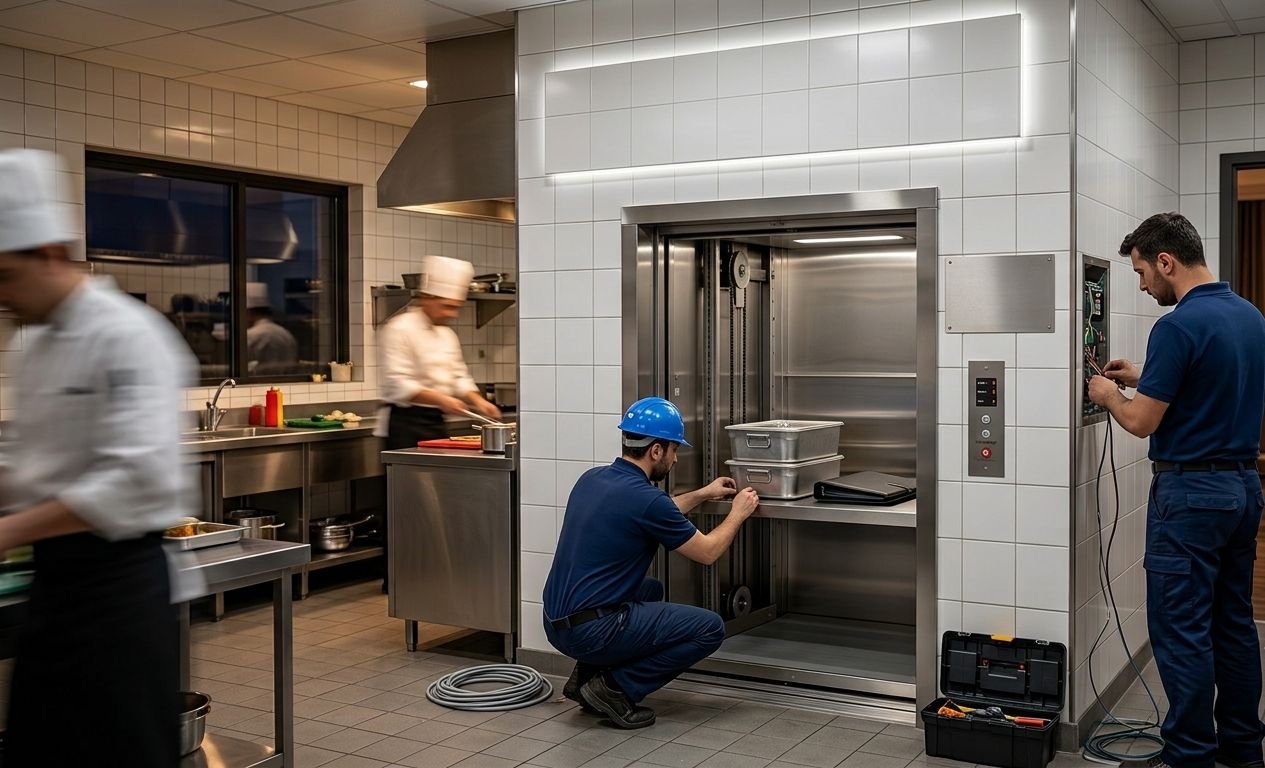
The following manufacturer profiles evaluate the most relevant dumbwaiter and service lift manufacturers for Syrian commercial, hospitality, healthcare, and residential applications. Each profile is assessed specifically on the criteria that matter most in the Syrian market: engineering quality, Syria-relevant product range, parts availability in Syria, and price positioning.
| [TIER 1 — GLOBAL LEADER] KONE (Finland) | Finland | Global operations | Middle East regional hub: Dubai |
| Product Range: Full service lift range from 50 kg residential dumbwaiters to 500 kg industrial hotel systems. KONE’s MonoSpace service lift platform is widely deployed in Middle Eastern hospitality and healthcare. Comprehensive IoT monitoring (KONE 24/7 Connected Services) available on all commercial units. Syria Market Suitability: Excellent engineering quality. Strong technical support through KONE Middle East network. Premium pricing (50–70% above mid-market) makes KONE appropriate for flagship hotel, five-star hospitality, and premium healthcare specifications. Not the most cost-effective choice for standard Syrian restaurant or residential applications. Parts Availability in Syria: KONE maintains parts stock at Dubai regional hub. Standard parts arrive in Syria within 2–3 weeks. For non-standard configurations, lead time can extend to 6–8 weeks. Hard System is not a KONE-authorised installer we can advise on specifications and coordinate with KONE’s regional network. |
| [TIER 1 — GLOBAL LEADER] Schindler (Switzerland) | Switzerland | Global operations | Middle East presence: multiple GCC offices |
| Product Range: Schindler’s service lift range covers residential dumbwaiters (50–100 kg), commercial food service lifts (100–250 kg), and industrial service elevators (250–600 kg). Known for precise engineering and strong safety system specifications. Schindler’s SynCity platform offers building integration capability for hotel and commercial applications. Syria Market Suitability: Highest engineering quality tier. Strong in premium commercial and healthcare specifications. Price premium comparable to KONE (50–70% above mid-market). Most appropriate for projects with international brand standards requiring Swiss/European manufacture certification. Syrian market presence through regional distributors. Parts Availability in Syria: Schindler parts availability in Syria is through regional distributors — typically 3–5 week lead time for standard parts, longer for non-standard components. Parts for Schindler units are generally not stocked in-country. This parts availability profile is the primary consideration when evaluating Schindler for Syrian projects without international brand mandates. |
| [TIER 1 — GLOBAL LEADER] Thyssenkrupp Elevator (Germany/TK Elevators) | Germany | Global operations | Rebranded to TK Elevators 2020 |
| Product Range: TK Elevators produces the TWIN service lift range with a focus on high-cycle commercial and industrial applications. Particularly strong in hospital and healthcare service lift specifications. Their multi-door configuration options make them suitable for complex multi-access hospital installations. Syria Market Suitability: Premium engineering quality with particular strength in healthcare and industrial applications. TK Elevator’s hospital service lift specifications are among the most comprehensive in the industry. Price positioning similar to KONE and Schindler. Most appropriate for large-scale Syrian hospital and hotel projects with international specifications. Parts Availability in Syria: TK Elevators operates through a regional distributor network in the Middle East. Parts availability timeline to Syria is comparable to KONE — 2–4 weeks for standard parts from Dubai hub. Hard System works with TK Elevator’s regional network for projects specifying their equipment. |
| [TIER 1 — REGIONAL STANDARD] Mitsubishi Electric (Japan) | Japan | Global operations | Strong Middle East presence |
| Product Range: Mitsubishi Electric’s service lift range is particularly strong in the Asia-Pacific and Middle East markets. The ELENESSA and standard dumbwaiter lines cover residential to commercial-industrial applications. Mitsubishi’s energy efficiency engineering and advanced VFD control systems are well-regarded in the industry. Syria Market Suitability: Strong quality with particularly good energy efficiency specifications — relevant for Syrian hotels with high F&B service volumes. Mitsubishi has established distribution relationships in Syria through regional agents. Price positioning is at the upper mid-range of Tier 1 — typically 30–50% above mid-market alternatives. Well-suited to premium Syrian hotel and healthcare specifications. Parts Availability in Syria: Better parts availability in Syria than other Tier 1 European manufacturers — Mitsubishi’s established regional distribution includes Syrian agents for their elevator product line. Standard parts typically available within 2–4 weeks. Control boards and drive components may require 4–8 weeks. |
| [TIER 2 — SPECIALIST MANUFACTURER] Flohr Industrietechnik (Germany) | Germany | European focus with Middle East exports | Specialist service lift manufacturer |
| Product Range: Flohr is one of Europe’s leading specialist service lift and dumbwaiter manufacturers — producing exclusively dumbwaiters, service lifts, and small goods elevators rather than full passenger lift ranges. Their DE and DK series cover applications from 25 kg residential units to 500 kg industrial units. Particularly well-regarded for engineering precision and product longevity. Syria Market Suitability: Excellent engineering quality from a specialist manufacturer with deep expertise in the service lift sector. Flohr units are specified in premium European hotels and healthcare facilities. Their Syrian market presence is through specialist importers and authorised installers. Price positioning is 15–25% below Tier 1 generalist manufacturers with comparable quality. Recommended for Syrian hotel and hospital applications where European specification quality is required without full Tier 1 pricing. Parts Availability in Syria: Flohr parts are imported on project basis — not stocked in-country. Lead time to Syria is 4–8 weeks for standard parts. For critical spares, Hard System recommends ordering a strategic set at installation. Flohr’s modular component design makes fault diagnosis and part identification straightforward compared to some Asian manufacturers. |
| [TIER 2 — ESTABLISHED ASIAN] Hyundai Elevator (South Korea) | South Korea | Strong Middle East and Asia presence | Wide product range |
| Product Range: Hyundai Elevator’s service lift and dumbwaiter range covers 30–500 kg capacity across residential, commercial, and industrial applications. Strong CE certification and ISO 9001 quality management. Their Middle East sales and service network is well-established, with parts distribution through UAE and Saudi Arabia hubs. Hyundai provides a competitive combination of Asian manufacturing cost efficiency and European-equivalent quality certification. Syria Market Suitability: Strong quality-to-cost ratio — typically 20–35% below European Tier 1 manufacturers with comparable quality certification. Hyundai is widely deployed in Middle East hotel and commercial projects. Their Syrian market presence through regional distributors makes parts lead times more predictable than European-only manufacturers. Recommended as the primary consideration for Syrian commercial restaurants, mid-range hotels, and institutional projects requiring certified quality without premium European pricing. Parts Availability in Syria: Better regional parts availability than European manufacturers. UAE and Saudi Arabia distribution hubs stock standard parts for most Hyundai service lift models. Lead time to Syria: 2–3 weeks for standard parts, 4–6 weeks for non-standard. Hard System maintains working relationships with Hyundai’s regional distribution network. |
| [TIER 2 — ESTABLISHED ASIAN] Sigma Elevator (South Korea / Global) | South Korea | Distributed internationally | Strong commercial focus |
| Product Range: Sigma Elevator produces a comprehensive dumbwaiter and service lift range from compact residential units to industrial food service systems. Strong focus on the commercial food service and hospitality market. CE-certified across all commercial product lines. Competitive pricing with solid engineering — particularly well-regarded for their control board reliability under varying power supply conditions. Syria Market Suitability: Sigma’s control board specification tolerates a wider input voltage range than many competitors — a specific advantage for Syrian power supply conditions. Price positioning is comparable to Hyundai — 20–30% below European Tier 1 manufacturers. Suitable for standard Syrian commercial dumbwaiter applications across all sectors. Hard System has installation experience with Sigma units in Syrian commercial facilities. Parts Availability in Syria: Regional parts availability through UAE distributor. Standard control boards and motor components typically available within 3–4 weeks. Hard System maintains a stock of common Sigma replacement parts for contract maintenance clients. |
| [TIER 2 — ESTABLISHED ASIAN] Fuji Elevator (China/Japan Heritage Brand) | China | Japan-heritage brand | Widely distributed in Middle East |
| Product Range: Fuji Elevator (not to be confused with Fujitec Japan) is a Chinese manufacturer operating under a Japanese-heritage brand identity. Their dumbwaiter and service lift range is wide — from 30 kg residential units to 300 kg commercial food service systems. CE certification is available on designated export product lines. Pricing is in the lower end of Tier 2, overlapping with Tier 3 at entry-level configurations. Syria Market Suitability: Fuji’s CE-certified product lines offer reasonable engineering quality at competitive prices. The brand’s wider distribution network in the Middle East means parts availability is better than many generic Chinese OEMs. Suitable for Syrian mid-range commercial applications where cost is a significant constraint and CE certification is required. Due diligence on specific product line certification is recommended Fuji’s product quality varies more across their range than European Tier 2 manufacturers. Parts Availability in Syria: Moderate in-region parts availability. UAE and Lebanese distributors stock some Fuji parts. Lead time to Syria: 3–6 weeks for standard parts. Control boards and drive systems may require longer lead times. Hard System recommends strategic spare parts stocking at installation for critical components. |
| [TIER 3 — CERTIFIED OEM] Established CE-Certified Chinese OEMs (Category, not single brand) | China | Export-focused | Variable quality within category |
| Product Range: This category covers Chinese manufacturers that produce dumbwaiter units with verifiable CE certification, documented quality management systems (ISO 9001), and traceable component sourcing. Examples include manufacturers that supply to European CE-marking importers under white-label arrangements. These units are significantly cheaper than Tier 1 and Tier 2 — typically 40–60% below Tier 2 prices but with more variable engineering quality and limited regional support. Syria Market Suitability: Appropriate for Syrian budget-constrained applications with lower cycle rates residential dumbwaiters, small office food service, minor commercial applications with fewer than 30 cycles per day. The CE certification and ISO 9001 documentation provide a minimum quality baseline. Always verify that the CE certificate is issued by a recognised Notified Body — not self-declared. Hard System can verify certification authenticity for specific OEM products upon request. Parts Availability in Syria: Limited to no in-country parts availability. Parts ordered direct from Chinese factory: lead time 8–16 weeks to Syria. This parts availability profile makes certified Chinese OEM units appropriate only where an alternative manual transport option is available during potential repair periods. Strategic spare parts stocking at installation is strongly recommended. |
Section 3: The Seven Criteria for Selecting the Right Manufacturer for Syria
Manufacturer selection for Syrian projects must be evaluated against criteria that are specifically weighted for Syria’s operating environment — not global averages. The following seven criteria cards present each evaluation dimension with its Syria-specific weighting and practical application.
| 1. Parts Availability in Syria — The Most Critical Criterion |
| This is the single most important manufacturer selection criterion for Syria. Ask every candidate manufacturer or their representative: where is the nearest parts distribution hub? What is the typical lead time for a control board replacement for this specific model to arrive in Syria? Do you maintain any parts stock in-country? The answers to these three questions will reveal more about the true operational risk of the manufacturer choice than any product specification sheet. Syria-Specific: In Syria’s parts supply environment, the difference between a 2-week parts lead time and a 3-month lead time is the difference between a minor service interruption and a major operational crisis. Hard System maintains in-country stock of critical spare parts for every brand we install — but this capability can only be maintained for brands with sufficient installation volume and stable product lines. This is one reason why Hard System’s recommended manufacturer list is deliberately focused on established brands with proven regional distribution. |
| 2. Power Supply Compatibility and Protection |
| Syria’s commercial power supply delivers voltage fluctuations of ±15–25% and periodic frequency deviations. Every manufacturer’s control board specification lists an input voltage range — typically ±10% of rated voltage for standard units and ±15% for enhanced-specification units. Any manufacturer whose control board cannot tolerate Syria’s actual voltage variation range requires AVR protection as mandatory, not optional. Verify this specification for every manufacturer under consideration. Syria-Specific: Manufacturers whose control boards include built-in voltage regulation or enhanced voltage tolerance (typically listed as ‘wide input range’ or ‘voltage tolerance ±20%’) provide an additional layer of protection in Syria’s power environment. Sigma and some Korean manufacturers specifically design for wider voltage tolerance ranges due to their experience in developing-market power supply environments. Always confirm the control board’s voltage tolerance specification in writing before purchase. |
| 3. Ambient Temperature Rating |
| Syria’s summer ambient temperatures exceed 40°C in most commercial building environments and reach 45°C+ in outdoor or poorly ventilated machine room locations. Every manufacturer specifies their motor’s maximum ambient temperature rating. Standard international ratings are 40°C — meaning the motor operates at its rated capacity exactly at Syria’s typical summer maximum, with no thermal margin. Manufacturers offering 50°C ambient motor ratings provide appropriate thermal headroom for Syrian summer conditions. Syria-Specific: Ask every manufacturer for the motor’s IEC ambient temperature class and the motor’s thermal protection trip point. Avoid manufacturers who cannot provide this documentation — it means either the motor is not rated to a documented standard, or the manufacturer’s sales channel in Syria cannot access technical documentation. Both scenarios are red flags for the long-term support quality you will receive from this manufacturer relationship. |
| 4. Certification and Standards Compliance |
| The baseline certification requirement for any commercial dumbwaiter in Syria’s formal commercial and institutional market is CE marking (European Conformity) — indicating the product meets EU safety, health, and environmental protection standards. For healthcare applications, EN 81-3 (the European standard specifically for service lifts and dumbwaiters) compliance should be verified. For hotel applications, the manufacturer should be able to provide documentation suitable for international hotel brand pre-opening inspections. Syria-Specific: In Syria, not all CE certificates are equal — some are legitimately issued by accredited Notified Bodies (identifiable by their four-digit Notified Body number on the certificate), while others are self-declared by the manufacturer with no third-party verification. Always request the Notified Body number and verify it against the European NANDO database. Hard System can perform this verification for any manufacturer certificate presented to us. |
| 5. Authorised Installer Network in Syria |
| A manufacturer’s product quality is delivered to the Syrian buyer through the installation quality of the local installer. The best-engineered dumbwaiter in the world, installed incorrectly, will fail prematurely and generate warranty disputes. Verify that any manufacturer under consideration has an authorised installer in Syria who has received factory training on the specific product being purchased — not just general lift installation training. Syria-Specific: Ask the manufacturer to provide written confirmation of the installer’s authorisation status for the specific product line. This documentation is the single most reliable quality assurance measure available to Syrian buyers beyond the product specification itself. Hard System holds authorised installer status for all the Tier 2 brands in our recommended list and can provide this documentation upon request. |
| 6. Warranty Terms and Exclusion Clauses |
| Manufacturer warranties for dumbwaiters typically cover 12 months for mechanical components and 12 months for electrical/control components from date of commissioning. However, the warranty exclusion clauses are where the real risk lies. Most warranties exclude: damage from power supply conditions outside the specified range, damage from ‘improper maintenance’, and failures caused by ‘incorrect installation’. In Syria’s power supply environment, without AVR protection, every control board failure could technically be attributed to ‘power supply conditions outside the specified range’ and excluded from warranty coverage. Syria-Specific: Before purchase, request a copy of the full warranty terms — not a summary. Read the exclusion clauses specifically. Verify whether the warranty covers the cost of parts only, or parts and labour. Confirm that the AVR system you will install satisfies the manufacturer’s power supply specification requirements and eliminates the exclusion risk. Hard System provides clients with a warranty compatibility checklist for every manufacturer we work with. |
| 7. Total Cost of Ownership Over 10 Years |
| The purchase price is a small fraction of the 10-year total cost of ownership for a commercial dumbwaiter in Syria. The major cost components over 10 years are: preventive maintenance (typically 35–45% of TCO), wear parts replacement (20–25% of TCO), energy consumption (10–15% of TCO), and reactive repair (5–15% depending on maintenance quality). The manufacturer choice affects all of these — through component longevity, parts availability and cost, energy efficiency specification, and the reliability of the control and drive systems. Syria-Specific: Hard System provides a 10-year TCO estimate for each manufacturer we recommend, based on our field data from Syrian installations. This analysis consistently shows that the 10-year TCO of a Tier 1 or high-quality Tier 2 manufacturer unit is 15–25% lower than a generic Tier 3 unit of equivalent initial specification — despite the Tier 3 unit’s lower purchase price. The difference is driven by higher maintenance frequency, shorter component life, and higher reactive repair costs. |
Section 4: Manufacturer Comparison — The Syria Market Quick Reference
The following comparison table consolidates the manufacturer evaluation across the seven selection criteria into a single Syria-market reference. Use this table to orient your shortlist before conducting detailed due diligence on your specific application requirements.
| Manufacturer | Tier | Syria Parts | Power Tolerance | Syria Price Index | Best For in Syria |
| KONE (Finland) | T1 Global | 2–3 wks (Dubai) | Standard ±10% | 160–180 | 5-star hotel, flagship commercial |
| Schindler (Switzerland) | T1 Global | 3–5 wks | Standard ±10% | 160–175 | International brand hotel, premium healthcare |
| TK Elevators (Germany) | T1 Global | 2–4 wks (Dubai) | Standard ±10% | 155–170 | Large hospital, industrial hotel application |
| Mitsubishi Electric (Japan) | T1 Regional | 2–4 wks | Standard ±10% | 130–150 | Premium hotel, energy-efficient commercial |
| Flohr (Germany) | T2 Specialist | 4–8 wks | Standard ±10% | 115–135 | European-spec hotel, premium restaurant |
| Hyundai Elevator (Korea) | T2 Established | 2–3 wks (UAE/KSA) | Enhanced ±15% | 90–110 | Commercial restaurant, mid-range hotel, hospital |
| Sigma Elevator (Korea) | T2 Established | 3–4 wks (UAE) | Enhanced ±20% | 85–105 | Commercial restaurant, budget hotel, standard office |
| Fuji Elevator (China/Japan) | T2 Lower | 3–6 wks | Standard ±10% | 70–90 | Budget commercial, standard residential |
| CE-Certified Chinese OEM | T3 Certified | 8–16 wks (China) | Variable | 45–65 | Low-cycle residential, budget small restaurant |
| Non-certified Chinese OEM | T3 Generic | Unknown | Unknown | 30–50 | NOT RECOMMENDED for commercial Syria use |
Price Index: 100 = Hard System standard mid-market baseline for a 100 kg commercial dumbwaiter, 2 floors, fully installed including AVR and UPS in Syria.
| Hard System does not install or recommend non-certified Chinese OEM dumbwaiters for any commercial application in Syria. The combination of unverifiable quality, no CE certification, and parts availability measured in months rather than weeks makes these units an unacceptable operational and liability risk for Syrian commercial, hotel, and healthcare clients. |
Section 5: Manufacturer Recommendations by Syrian Application Type
The optimal manufacturer choice depends not only on general quality and price criteria but on the specific demands of the application. The following application-by-application recommendations are based on Hard System’s experience across Syrian commercial, hospitality, healthcare, and residential sectors.
| Application | Primary Recommendation | Alternative Recommendation | Key Reason |
| Syrian 5-star / international brand hotel | KONE or Schindler | Mitsubishi Electric | International brand compliance, warranty depth |
| Syrian 3–4 star hotel (room service) | Hyundai Elevator | Sigma Elevator | Regional parts, enhanced voltage tolerance |
| Banquet / large event hotel | TK Elevators or Hyundai | Flohr (Germany) | Industrial capacity, burst-load rating |
| Multi-floor Syrian restaurant (busy) | Hyundai Elevator | Sigma Elevator | Cycle rate rating, parts availability |
| Small Syrian restaurant or café | Sigma or Fuji | CE-certified OEM | Cost efficiency, adequate for lower cycle rate |
| Syrian hospital (clinical nutrition) | KONE, Schindler, or TK | Hyundai (with clinical spec) | Clinical hygiene spec, regulatory compliance |
| Syrian hospital (general supply) | Hyundai Elevator | Sigma Elevator | Cost efficiency, regional parts, robust engineering |
| Syrian commercial building / office | Sigma or Hyundai | Fuji Elevator | Commercial cycle rate, cost efficiency |
| Luxury Syrian residential penthouse | Mitsubishi or Flohr | Hyundai (quiet drive spec) | Quiet operation, aesthetic integration options |
| Budget Syrian residential | CE-certified OEM via Hard System | Local assembly | Cost constraint, lower cycle rate acceptable |
| Pharmacy / retail supply | Sigma or Hyundai | CE-certified OEM | Access control option, reliability |
Section 6: Hard System’s Role — Manufacturer Access, Installation Quality & Parts Support
Understanding what Hard System does in the manufacturer ecosystem helps Syrian buyers navigate their procurement decisions more effectively. Hard System is not a manufacturer — we are a vertical transportation solutions provider that holds authorised installer status for multiple dumbwaiter and service lift manufacturer brands, manages the full import and installation process, and provides ongoing maintenance support for every brand we install.
6.1 What ‘Authorised Installer’ Means for You
An authorised installer has received factory training on the specific manufacturer’s product range, has access to manufacturer technical documentation and spare parts supply channels, can perform installations that maintain the manufacturer’s product warranty, and is recognised by the manufacturer as a qualified service provider. When you purchase a dumbwaiter through Hard System, you receive the manufacturer’s product warranty in full — not voided by installation by an unqualified party.
In Syria’s market, where many elevator installation companies install products from any available source without manufacturer authorisation, the authorised installer distinction is commercially significant. A warranty claim on a unit installed by an unauthorised installer is typically rejected by the manufacturer — leaving the building owner with no coverage for manufacturing defects. Hard System’s authorised status eliminates this risk.
6.2 Hard System’s Manufacturer Portfolio
Hard System works with an evaluated portfolio of dumbwaiter and service lift manufacturers across the Tier 1 and Tier 2 segments — selected based on engineering quality, parts availability for the Syrian market, and our direct installation experience with their products. Our portfolio approach allows us to match the right manufacturer to each project’s specific requirements — rather than representing a single manufacturer whose products may not always be the optimal choice for every application.
Our manufacturer relationships include direct import arrangements that allow us to bring equipment to Syria with optimised customs classification, full documentation, and coordinated logistics — reducing the landed cost and import timeline compared to ad-hoc procurement. We share the benefit of these established import arrangements with clients directly in our project pricing.
6.3 The Hard System In-Country Parts Advantage
Hard System maintains in-country parts inventory for every dumbwaiter brand we actively install and maintain in Syria. This stock includes the components with the highest failure rates under Syrian operating conditions: control boards, motor contactor sets, drive chain sections, comb plate components, and landing door mechanism parts. For contract maintenance clients, critical parts are available for same-day replacement — eliminating the 2–8 week international parts lead time for the most common failure scenarios.
This in-country parts capability is only sustainable for brands where our installation volume justifies the inventory investment. This is a direct reason why Hard System’s manufacturer recommendations focus on established brands with consistent product lines rather than the widest possible range of options — breadth of brand coverage and depth of parts support are in direct tension.
| Hard System can source and install dumbwaiter units from any manufacturer that a client specifies — including brands not on our standard recommended list. In these cases, we provide the client with a written parts availability assessment and a recommended strategic spare parts kit to mitigate the risk of extended parts lead times for non-standard brands. |
Section 7: How to Verify a Manufacturer’s Credentials — The Syrian Buyer’s Due Diligence Checklist
Every Syrian building owner, hotel developer, or hospital administrator should conduct structured due diligence on any dumbwaiter manufacturer before committing to a purchase. The following checklist documents every verification step that Hard System performs on behalf of clients evaluating manufacturer options.
- CE Certificate verification: Request the full CE certificate with the Notified Body number. Verify the Notified Body is currently accredited at ec.europa.eu/growth/tools-databases/nando
- ISO 9001 certificate verification: Request the current ISO 9001 certificate with accreditation body details and expiry date. Certificates older than 3 years without renewal are a concern.
- Control board voltage tolerance: Request the control board data sheet showing input voltage range specification. Minimum acceptable for Syria: ±15%. Preferred: ±20% or AVR-integrated.
- Motor ambient temperature rating: Request the motor data sheet showing maximum ambient temperature rating. Minimum acceptable for Syria: 45°C. Preferred: 50°C.
- Motor duty cycle class: Request the motor duty cycle classification (S2, S3, S6). Commercial applications: minimum S3. High-cycle hotel or hospital applications: S6 mandatory.
- Regional parts distribution: Ask for the address of the manufacturer’s nearest regional parts distribution hub and the documented lead time to Syria for a control board replacement.
- Authorised installer status: Ask the proposed installer to provide written confirmation of their authorisation status directly from the manufacturer — not self-declared.
- Warranty exclusion clauses: Request the full warranty document — not a summary. Review exclusion clauses for power supply conditions and maintenance requirements.
- Reference installations in Syria or region: Request contact details for at least two reference installations of equivalent specification in Syria or the surrounding region.
- Import documentation: Verify that the manufacturer provides a Certificate of Origin and full technical specifications in a format accepted by Syrian customs authorities.
Section 8: Verified External Resources
- Grand View Research — Global Elevator & Service Lift Market Report (2023): grandviewresearch.com/elevator-industry
The authoritative global market sizing and forecast report for the elevator and service lift industry, providing market context and manufacturer segment data referenced in this guide.
- European NANDO Database — Notified Body Verification: ec.europa.eu/growth/tools-databases/nando
The official European Commission database for verifying the accreditation status of CE Notified Bodies. Essential for verifying that a manufacturer’s CE certificate was issued by a legitimately accredited third-party certifier — not self-declared.
- Elevator World — Manufacturer Technical Reference: elevator-world.com
The leading global trade publication for the vertical transportation industry. Provides independent technical analysis, manufacturer product reviews, and industry standard updates relevant to dumbwaiter and service lift procurement decisions.
Frequently Asked Questions (FAQ)
Q1: What is the most important thing to ask a dumbwaiter manufacturer representative in Syria?
The single most important question is: ‘Where is the nearest parts distribution hub for this specific unit, and what is the documented lead time for a replacement control board to arrive in Syria?’ This question bypasses marketing language and forces a concrete answer about the real operational risk of the purchase decision. A manufacturer whose nearest parts hub is Dubai with a 2-week lead time is fundamentally different from one whose parts come from the factory in China with a 3-month lead time — and this difference will determine whether your first repair takes 3 days or 3 months.
Q2: Are Korean-manufactured dumbwaiters a good choice for Syria?
Yes — for the majority of Syrian commercial and institutional applications, established Korean dumbwaiter manufacturers (Hyundai Elevator, Sigma Elevator) represent the optimal quality-to-cost-to-parts-availability combination. Korean manufacturers have extensive Middle East deployment experience, their control boards are designed for wider input voltage tolerance than many European equivalents, their CE certification is legitimately third-party verified, and their regional distribution networks provide 2–4 week parts lead times to Syria. Hard System has significant installation and maintenance experience with Korean manufacturer units in Syrian commercial facilities.
Q3: Is a cheaper Chinese-manufactured dumbwaiter ever appropriate for a Syrian commercial project?
Yes — under specific conditions. A CE-certified Chinese dumbwaiter from an established manufacturer with verifiable quality certification is appropriate for Syrian commercial applications with low cycle rates (fewer than 30 cycles per day), where a manual transport alternative is available during potential repair periods, and where the initial cost constraint makes a Tier 2 manufacturer genuinely unaffordable. It is never appropriate for high-cycle-rate hotel, hospital, or busy restaurant applications where parts lead times of 8–16 weeks would cause serious operational disruption. Hard System evaluates each project individually and recommends the minimum manufacturer tier appropriate for the operational requirement.
Q4: Do all dumbwaiter manufacturers include a warranty in Syria, and what does it typically cover?
All credible manufacturers include a 12-month product warranty from date of commissioning. This warranty typically covers manufacturing defects in mechanical and electrical components — but not wear parts (step chains, drive belts, lubricants) or damage caused by installation error, misuse, or power supply conditions outside the specified range. Hard System provides a 12-month installation warranty separately from the manufacturer’s product warranty — covering our installation workmanship regardless of the manufacturer’s warranty position. This combination of product warranty plus installation warranty provides the most complete coverage available to Syrian buyers.
Q5: Can I buy directly from a dumbwaiter manufacturer and have a local Syrian company install it?
Technically yes — but with significant risks. Purchasing directly from a manufacturer without going through their authorised installer typically voids the manufacturer’s product warranty, as manufacturers require installation by authorised partners to maintain quality control. Additionally, a local installer without factory training on the specific manufacturer’s product may install it incorrectly — creating problems that are neither covered by the product warranty (voided) nor correctable without detailed technical documentation that the non-authorised installer cannot access. Hard System strongly recommends working through an authorised installer for any manufacturer to maintain full warranty coverage and installation quality assurance.
Q6: How do I verify that a dumbwaiter manufacturer’s CE certificate is genuine?
Three steps: First, look for the four-digit Notified Body number on the CE certificate — if it is absent, the certification is self-declared and should not be accepted. Second, visit the European NANDO database at ec.europa.eu/growth/tools-databases/nando and verify that the Notified Body number corresponds to a currently accredited organisation for the relevant product category. Third, check that the certificate was issued for the specific product model you are purchasing — not a different model from the same manufacturer. Hard System performs this verification for every manufacturer product we present to clients.
Q7: What is the difference between a dumbwaiter manufacturer and a dumbwaiter brand?
This distinction is more significant than it appears. In the global elevator market, many ‘brands’ are not manufacturers — they are importers, distributors, or white-label resellers who sell products manufactured by another company under their own brand name. A ‘brand’ with no manufacturing facility and no engineering team has no ability to support the product technically after sale and no ability to ensure parts supply continuity if their supplier changes product specifications. When evaluating a dumbwaiter supplier in Syria, always ask: ‘Where is this product manufactured — do you manufacture it, or is it sourced from a third-party factory?’ The answer determines whether you are dealing with a manufacturer or a reseller, with significantly different implications for long-term support.
Q8: How does Hard System help Syrian buyers navigate the manufacturer selection process?
Hard System provides a structured manufacturer selection consultation as a free service for all Syrian commercial and institutional projects above USD 3,000 in value. This consultation includes: a review of the project’s operational requirements and cycle rate to determine the appropriate manufacturer tier, a comparison of available manufacturers in our portfolio against the project’s criteria, a parts availability assessment for each shortlisted manufacturer, and a 10-year TCO estimate for each option. The goal is not to sell the most expensive manufacturer — it is to identify the manufacturer whose total cost of ownership is lowest for the client’s specific application. Contact us at hard-sy.com to schedule your consultation.
Conclusion: The Right Manufacturer Is the Foundation of Every Successful Installation
Every dumbwaiter installation in Syria begins with a manufacturer choice — and that choice echoes through 20 years of operation, maintenance bills, parts sourcing challenges, and operational reliability. Choosing based on purchase price alone is the most reliable path to the most expensive outcome. Choosing based on a structured evaluation of quality, parts availability, power compatibility, warranty coverage, and total cost of ownership is the path to an installation that performs reliably and economically throughout its operational life.
The global dumbwaiter manufacturer market offers Syrian buyers extraordinary choice — from the world’s most advanced vertical transportation engineering to the most cost-competitive production. The skill is matching the right tier and the right manufacturer to the specific demands of each Syrian project. A Tier 1 European manufacturer is the right choice for a five-star Damascus hotel with international brand standards. A Tier 2 Korean manufacturer is the right choice for a busy Syrian commercial restaurant with high cycle rates and cost constraints. A CE-certified OEM may be the right choice for a low-cycle residential application where cost is the binding constraint.
Hard System exists to navigate this choice on behalf of Syrian clients — with the manufacturer relationships, the technical knowledge, the installation capability, and the in-country parts support to deliver the right solution for every project. We do not sell a single manufacturer’s product line. We evaluate each project and recommend the manufacturer whose product best serves the client’s 20-year operational interest.
| Need Help Selecting the Right Dumbwaiter Manufacturer for Your Syrian Project? Hard System provides free manufacturer selection consultations for all Syrian commercial, hotel, hospital and residential projects. Our team evaluates your specific requirements, compares available manufacturers, and recommends the optimal solution — with full installation, parts support, and maintenance coverage. Visit hard-sy.com | Book Your Free Manufacturer Consultation Syria’s Most Trusted Dumbwaiter Installation & Maintenance Partner
|