
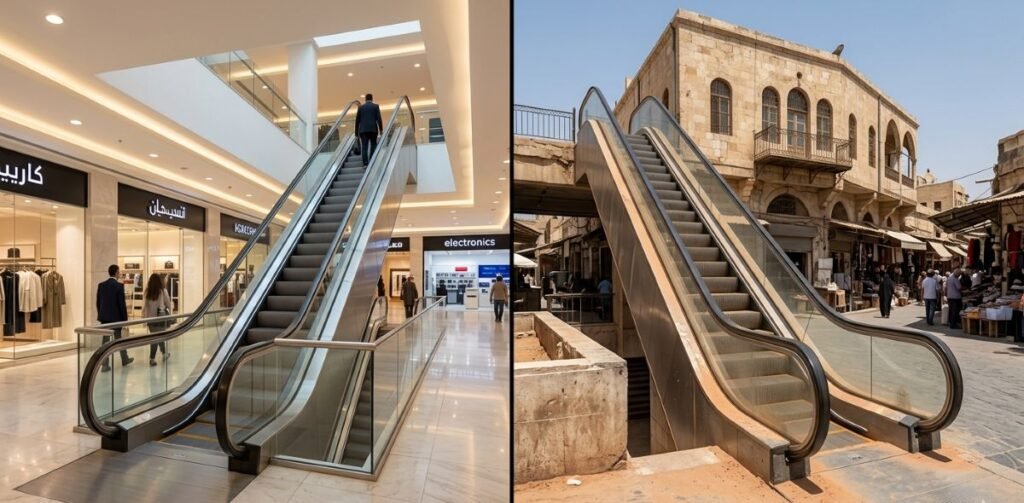
Introduction: One Wrong Decision Can Cost You Everything
Imagine a luxury open-air commercial complex in Latakia — gleaming, modern, and designed to impress. Now imagine that the escalators installed between its terraced levels are shutting down every summer because the motors were never rated for 45°C ambient heat. Or picture an indoor shopping mall in Damascus whose escalator warranty was voided within 18 months because the units were outdoor-specification — over-engineered for conditions that simply do not exist inside the building, and priced accordingly.
Both scenarios happen. Both are entirely preventable. And both come down to the same root cause: the decision-maker did not fully understand the fundamental differences between indoor and outdoor escalators before signing the procurement contract.
This guide fixes that. Whether you are a real estate developer planning a mixed-use complex, a mall manager specifying escalators for a covered retail court, a hospital administrator designing a multi-level facility, or an architect specifying vertical circulation for a landmark project — this is the most complete and Syria-specific comparison of indoor versus outdoor escalators you will find anywhere.
By the end, you will know exactly which type your project needs, what it will cost, what safety features are non-negotiable, and how Hard System delivers the right solution every time.
Section 1: What Actually Makes an Escalator ‘Indoor’ or ‘Outdoor’?
The distinction between indoor and outdoor escalators is not simply about whether they are placed inside or outside a building. It is a fundamental engineering classification that affects materials specification, motor rating, electrical enclosure standards, lubrication chemistry, safety system design, and long-term maintenance requirements.
An indoor escalator is designed to operate in a controlled environment protected from direct weather, with stable ambient temperatures, no precipitation, limited dust ingress, and predictable humidity. It is optimised for smooth, quiet operation in the climate-controlled interior spaces of malls, hospitals, airports, hotels, and commercial towers.
An outdoor escalator, by contrast, must operate reliably across the full range of ambient conditions at its installation site direct sunlight, rain, wind-borne dust and debris, temperature extremes from near-freezing winter nights to scorching summer afternoons, and the cumulative effect of UV radiation on exposed materials. Every component from the structural frame to the lubrication oil must be specified to handle these conditions without accelerated degradation.
| 40%–60% | Higher long-term maintenance cost for outdoor escalators compared to equivalent indoor units the most consistent finding across global facilities management benchmarking studies. (Source: KONE Global Service Research, 2022) |
| Key principle: An indoor escalator installed outdoors will fail prematurely. An outdoor escalator installed indoors will work reliably but at unnecessary cost. Matching the specification to the environment is the single most important escalator procurement decision you will make. |
Section 2: Indoor vs. Outdoor Escalators
The table below compares the two escalator types across every specification and operational dimension relevant to commercial decision-making in Syria. Each row represents a real procurement or operational variable not a theoretical distinction.
| Specification | Indoor Escalator | Outdoor Escalator |
| Structural Frame Material | Standard galvanised steel | Marine-grade stainless steel or hot-dip galvanised |
| Motor Ambient Temp Rating | Up to 40°C standard | Up to 50°C+ (tropical-rated) |
| IP Rating (Enclosure) | IP20 – IP43 (standard) | IP55 – IP66 (weatherproof, dust-tight) |
| Step Material | Standard aluminium alloy | Anti-corrosion treated or stainless steel |
| Handrail Material | Standard rubber compound | UV-stabilised, weather-resistant compound |
| Lubrication System | Standard grease / oil | Sealed bearings, weather-grade lubricants |
| Control Board Enclosure | Standard NEMA 1 / IP20 | NEMA 4X / IP65 sealed enclosure |
| Balustrade / Cladding | Standard glass or painted steel | Toughened safety glass, corrosion-resistant frame |
| UV Resistance | Not required | Full UV-stabilised treatment on all exposed parts |
| Step Drainage System | Not required | Perforated steps + drainage channels mandatory |
| Anti-freeze System | Not applicable | Optional for coastal/mountain sites |
| Noise Emission | Lower (28–38 dB(A) typical) | Higher due to weather seals (32–44 dB(A)) |
| Energy Consumption | Standard baseline | +8–15% due to enhanced motor & sealing |
| Initial Cost Premium | Baseline (0%) | +20–40% over equivalent indoor unit |
| Annual Maintenance Cost | Baseline | +40–60% over indoor unit |
| Expected Service Life (maintained) | 20–25 years | 15–20 years (Syria conditions) |
| Warranty Void Risk | Low (controlled environment) | Higher — strict maintenance interval compliance required |
Section 3: Indoor Escalators — Deep Dive
3.1 Where Indoor Escalators Excel in Syria
Indoor escalators are the backbone of Syria’s commercial vertical transportation landscape. Every major commercial mall in Damascus, Aleppo, Latakia, and Homs relies on indoor escalators for its primary floor-to-floor passenger circulation. Their controlled operating environment allows for lighter specification, lower maintenance frequency, and a wider choice of aesthetic finishes that contribute to the interior design quality of the space.
In Syrian hospital multi-floor facilities, indoor escalators provide high-capacity movement of patients, visitors, and staff between levels. In hotel lobbies and luxury residential towers, they function as both circulation infrastructure and architectural statement pieces. The controlled environment means that premium finish options polished stainless steel balustrades, frameless glass cladding, and LED-lit step edges remain visually pristine throughout their service life without the accelerated degradation that outdoor exposure causes.
3.2 Key Specification Considerations for Syrian Indoor Installations
Even in indoor environments, Syria’s specific conditions require specification choices that differ from standard European or North American defaults. The most important is power conditioning: Syrian commercial buildings experience voltage fluctuations that standard indoor escalator control boards are not designed to handle. Every indoor escalator installation by Hard System includes an Automatic Voltage Regulator (AVR) as standard not as an optional extra.
Indoor temperature management is the second consideration. Syria’s summers push indoor commercial spaces to 30–35°C even with active air conditioning in high-occupancy periods. Motors specified for European indoor conditions (maximum 25°C ambient) are marginal in these conditions. Hard System specifies motors with a minimum 40°C ambient rating for all Syrian indoor commercial installations.
Dust ingress is the third indoor-specific factor. Syria’s dust environment particularly in cities like Deir ez-Zor and in buildings near construction activity introduces fine particulate into indoor spaces at levels significantly above European norms. This accelerates wear on bearings and step chain links. Hard System’s indoor maintenance programme for Syria operates at monthly rather than quarterly intervals to account for this elevated dust exposure.
3.3 Indoor Escalator Aesthetic Options
Because indoor escalators are protected from weather-related degradation, they offer the widest range of aesthetic specification options. Balustrade configurations range from frameless full-glass panels to stainless steel mullion systems, painted steel budget options, and fully bespoke architectural designs for landmark projects. Step finishes include standard grooved aluminium, brushed stainless steel, and rubber-inlay anti-slip inserts for healthcare environments.
LED step edge lighting increasingly specified in Syrian premium malls and hotel lobbies requires a sealed step edge design that maintains its appearance over time. In outdoor installations, LED systems require weatherproof enclosures that add cost and complexity. The indoor environment makes this feature both more affordable and more visually impactful.
| 68% | of all new escalator installations in Middle East commercial buildings between 2020 and 2024 were indoor units in covered retail and mixed-use developments. (Source: Elevator World Industry Report, 2024) |
Section 4: Outdoor Escalators — Deep Dive
4.1 Where Outdoor Escalators Are Specified in Syria
Outdoor escalators in Syria are specified across a distinct range of project types. Open-air commercial terraces and markets particularly in coastal cities use outdoor escalators to connect pedestrian levels. Tourism and heritage site access infrastructure increasingly incorporates outdoor escalators to provide accessible movement across steep terrain. Mixed-use developments with partially covered external circulation use outdoor units for their exposed sections.
Public infrastructure projects including metro station access, pedestrian bridge connections, and municipal facility upgrades represent a growing segment of outdoor escalator demand in Syria. As reconstruction and urban development accelerates, the specification of appropriate outdoor-rated escalators for these public installations is a critical design decision one where the consequences of under-specification are borne by the public and the operating authority for decades.
4.2 The Syrian Climate Challenge for Outdoor Escalators
Syria’s climate presents a particularly demanding set of conditions for outdoor escalator specifications more demanding than many international manufacturers’ standard outdoor ratings assume. The combination of extreme summer heat (regularly exceeding 40°C and reaching 46°C in eastern regions), significant winter rainfall in coastal and northern areas, high UV radiation intensity, wind-borne desert dust from eastern regions, and salinity-laden coastal air in Latakia and Tartus creates a multi-vector degradation challenge.
Standard outdoor escalator specifications from European manufacturers are designed for temperate climates with maximum summer temperatures of 35–40°C, moderate humidity, and no salinity exposure. In Syria’s coastal and eastern regions, these specifications are insufficient. Hard System’s outdoor specification for Syrian installations includes tropical-rated motors (50°C ambient), IP65 control board enclosures, marine-grade fasteners and structural connections, and UV-stabilised polymer components throughout.
| CRITICAL SPECIFICATION ALERT: Standard outdoor escalator specifications frequently fail to account for Syria’s combination of high UV intensity, summer temperatures exceeding 40°C, and coastal salinity. Always verify that quoted outdoor units carry explicit ratings for these conditions not just a generic ‘outdoor’ designation. Hard System provides full environmental specification documentation with every outdoor quotation. |
4.3 The IP Rating System — What the Numbers Mean for Your Project
The IP (Ingress Protection) rating system defines how well an electrical enclosure resists solid particle and liquid ingress. For outdoor escalators, the IP rating of the control board enclosure, motor terminal box, and safety switch housings is one of the most critical specifications and one that is routinely under-specified in budget outdoor installations.
IP55 provides protection against dust ingress sufficient to prevent harmful deposits and protection against low-pressure water jets from any direction the minimum acceptable standard for Syrian outdoor installations. IP66 provides complete dust-tight protection and protection against powerful water jets the recommended specification for coastal Syrian installations and open sites exposed to heavy rainfall.
An outdoor escalator with IP43-rated electrical enclosures (a common cost-saving substitution in budget quotations) will experience control board failures within 2–3 seasons in Syrian coastal conditions. The cost of a control board replacement USD 3,500–8,000 per incident far exceeds the initial saving from specifying a lower IP rating.
4.4 Drainage Systems — The Detail That Most Buyers Miss
Rain, cleaning water, and condensation will accumulate on outdoor escalator steps and in the interior of the truss structure. Without an engineered drainage system, this water accelerates corrosion of the step chain, bearing housings, and structural steel dramatically shortening service life. A properly specified outdoor escalator includes perforated step treads that allow water to pass through, internal truss drainage channels that direct water to drain points at the pit level, and sealed drain sumps with clear-out access.
Hard System’s outdoor installations include drainage system design as a standard component of the site survey and civil works specification because a drainage system that was not designed in at the civil works stage cannot be effectively retrofitted later without expensive structural intervention.
| 2–3 yrs | Typical time to first major structural corrosion failure in an outdoor escalator without proper drainage system specification in high-humidity coastal environments. (Source: Otis Global Engineering Technical Bulletin, 2021) |
4.5 Canopy and Shelter — A Critical Companion Decision
One of the most consequential decisions in any outdoor escalator project is whether to provide a canopy or shelter structure over the escalator. A well-designed canopy reduces direct UV exposure by 90%+, eliminates precipitation ingress, reduces motor ambient temperature by 8–12°C in direct sunlight conditions, and extends service intervals significantly.
The canopy decision should be made at the same time as the escalator specification not added as an afterthought after installation. The canopy structure must be engineered to clear the escalator’s handrail and safety systems, must not obstruct emergency egress, and must be designed to prevent wind uplift in Syria’s coastal and mountain environments.
Hard System provides integrated canopy specification and coordination as part of our outdoor escalator project delivery service including structural interface drawings that allow the building’s civil engineer to design the canopy support structure correctly.
Section 5: Safety Features — Indoor vs. Outdoor Requirements
The core safety features required for escalators emergency stop systems, handrail speed synchronisation, comb plate safety switches, anti-reversal devices, and overspeed governors are mandatory for both indoor and outdoor units. However, outdoor escalators require additional safety provisions that address the specific hazards of exposed environments.
5.1 Safety Features Common to Both Types
- Emergency stop buttons at upper and lower landings (mandatory for both)
- Handrail-to-step speed synchronisation monitoring
- Comb plate impact and jam sensors
- Anti-reversal mechanical brake
- Overspeed and underspeed governor
- Skirt brush anti-entrapment system
- UPS-connected emergency braking (essential in Syria for both types)
- Fire/smoke interlock for commercial buildings
5.2 Additional Safety Features Required for Outdoor Escalators
- Anti-slip step treatment (enhanced grade): Wet steps are significantly more slip-hazardous than dry. Outdoor steps require higher-grade anti-slip grooves and non-skid edge inserts rated for wet conditions.
- Water ingress detection sensors: Sensors in the pit that detect abnormal water accumulation and trigger a controlled stop before electrical systems are compromised by flooding.
- Wind speed interlock: For outdoor escalators in exposed locations (coastal or elevated sites), a wind speed sensor that triggers a controlled stop when wind exceeds safe operating limits prevents handrail instability and step sway.
- Anti-frost step heating (mountain/northern sites): Step surface heating elements prevent ice formation on step treads at sites where winter temperatures approach or reach 0°C.
- UV-stabilised comb plate combs: Standard nylon comb plate teeth become brittle under prolonged UV exposure. Outdoor units require UV-stabilised polymer or stainless steel comb teeth.
- Enhanced handrail entry safety brushes: Outdoor handrail entry points accumulate debris that increases entrapment risk. Enhanced brush guards with more frequent replacement intervals are required.
| 3× | Higher frequency of safety-related escalator incidents reported for outdoor units without proper weatherproofing compared to equivalent specification indoor units in the same facilities. (Source: U.S. Consumer Product Safety Commission, Escalator Incident Database 2022) |
Section 6: Maintenance Requirements — A Practical Comparison for Syria
Understanding the maintenance burden of each escalator type before procurement is essential for lifecycle cost planning. The following comparison reflects Hard System’s experience maintaining both escalator types across Syrian commercial, healthcare, and infrastructure projects.
| Maintenance Item | Indoor (Syria) | Outdoor (Syria) |
| Preventive service interval | Monthly | Monthly (min) fortnightly on coast |
| Step chain lubrication | Every 3 months | Every 6–8 weeks |
| Drive chain inspection | Every 6 months | Every 3 months |
| Bearing replacement interval | Every 4–5 years | Every 2–3 years |
| Control board inspection | Annually | Every 6 months |
| Handrail replacement interval | Every 6–8 years | Every 4–5 years |
| Step replacement (wear) | Every 10–12 years | Every 6–8 years |
| Full lubrication changeover | Every 3 years | Every 18 months |
| IP enclosure seal inspection | Not required | Every 12 months |
| Drainage system clear-out | Not required | Every 3 months |
| Corrosion treatment / re-coat | Not required | Every 3–5 years |
| Annual maintenance cost (USD) | $2,400 – $4,200 | $4,000 – $7,500 |
| Hard System operates dedicated maintenance teams for both indoor and outdoor escalator types, with service routes structured to match the different interval requirements of each specification. Our outdoor maintenance contracts include bi-annual corrosion assessment reports a service not offered by most Syrian maintenance providers. |
Section 7: Cost Comparison — Initial Investment and 15-Year Total Cost
The cost difference between indoor and outdoor escalators is one of the most consistently misunderstood aspects of escalator procurement in Syria. Many buyers understand that outdoor units cost more — but few have a clear quantitative picture of how much more, and how that premium accumulates over the unit’s service life.
| Cost Category | Indoor Unit (USD) | Outdoor Unit (USD) |
| Unit purchase + installation (mid-range, 1,000mm, 4m rise) | $35,000 – $50,000 | $48,000 – $72,000 |
| Civil works (pit, structural, drainage) | $4,000 – $9,000 | $7,000 – $18,000 |
| Electrical (AVR, UPS, cabling) | $3,000 – $6,500 | $4,500 – $9,000 |
| Canopy / shelter structure (outdoor only) | N/A | $8,000 – $25,000 |
| Annual maintenance contract | $2,400 – $4,200 | $4,000 – $7,500 |
| 15-year cumulative maintenance | $36,000 – $63,000 | $60,000 – $112,500 |
| Wear parts (15 years) | $12,000 – $22,000 | $22,000 – $42,000 |
| Estimated 15-Year TCO | $90,000 – $150,500 | $149,500 – $278,500 |
The practical implication is clear: an outdoor escalator costs 60–85% more over its 15-year life than an equivalent indoor unit. This is not a reason to avoid outdoor escalators where they are genuinely needed it is a reason to plan for the true cost accurately, and to avoid specifying outdoor units where a covered indoor connection would eliminate the need for outdoor specification entirely.
| ARCHITECT AND DEVELOPER NOTE: In many mixed-use Syrian projects, the difference between an outdoor and indoor escalator specification comes down to the decision to cover or enclose the escalator circulation area. A canopy or enclosed connector structure that costs USD 15,000–40,000 to build can reduce the escalator specification from outdoor to indoor, saving USD 60,000–130,000 over 15 years. This trade-off is worth explicit evaluation at the design stage. |
Section 8: The Decision Framework — Which Type Does Your Project Need?
Use this structured decision framework to determine the correct escalator specification for your project. Each branch reflects a genuine engineering or economic principle not arbitrary rules.
Step 1: Is the escalator location directly exposed to weather?
- If YES: Outdoor specification is mandatory. Proceed to Step 2.
- If NO (fully enclosed, climate-controlled): Indoor specification. Proceed to Step 3.
- If PARTIALLY COVERED (canopy but open sides): Evaluate Step 2 treat as outdoor unless the canopy provides 100% precipitation protection and limits ambient temperature to indoor levels.
Step 2: Outdoor — Determine the Environmental Classification
- Coastal site (within 5km of sea Latakia, Tartus, coastal Homs): Marine-grade specification mandatory. IP66 enclosures, stainless steel fasteners, enhanced corrosion treatment.
- Inland hot-arid site (Deir ez-Zor, eastern regions): Tropical motor rating mandatory. Enhanced dust ingress protection. UV-stabilised polymer components.
- Elevated or northern site (mountain regions): Anti-frost option evaluation required. Wind speed interlock for exposed sites.
- Urban standard (Damascus, Aleppo, Homs urban): Standard outdoor specification with AVR. IP55 minimum.
Step 3: Indoor — Determine the Application Classification
- High-traffic commercial (mall, transport hub): 1,000mm step width. 0.5 m/s. AVR mandatory. Cascade or parallel configuration. Monthly maintenance.
- Healthcare (hospital, clinic): 1,000mm step width. 0.5 m/s. Enhanced anti-slip specification. Smooth, quiet drive unit for clinical environment.
- Hospitality / luxury (hotel, premium retail): Aesthetic specification priority. LED lighting, premium balustrade, quiet helical gearbox.
- Office / mixed-use commercial: 800–1,000mm step width. Standard specification with AVR.
Step 4: Evaluate the Canopy Trade-Off
Before finalising an outdoor specification, calculate: Cost of canopy/enclosure structure vs. incremental outdoor specification premium and maintenance cost over 15 years. If the canopy cost is less than 40% of the 15-year incremental maintenance premium of outdoor vs. indoor specification, the canopy is the economically superior choice. Hard System’s project consultants perform this calculation for every project where the option exists.
Section 9: Verified External Resources for Further Research
- Grand View Research — Escalator & Moving Walkway Global Market Report (2023): grandviewresearch.com/industry-analysis/escalator-moving-walkway-market
Authoritative global market sizing, technology trend analysis, and regional demand forecasting for the escalator industry. Provides the statistical foundation for global market data referenced in this guide.
- Elevator World — Industry Knowledge Centre & Technical Resources: elevator-world.com
The leading global trade publication for the vertical transportation industry. Essential reference for maintenance benchmarking, outdoor escalator engineering standards, and technical specification guidance.
- U.S. Consumer Product Safety Commission — Escalator Safety Research: cpsc.gov/escalators
Government safety research documenting escalator incident patterns, safety feature effectiveness, and the correlation between maintenance quality and safety outcomes — including data on outdoor vs. indoor incident rates.
Frequently Asked Questions (FAQ)
Q1: Can I convert an existing indoor escalator to outdoor use if my building design changes?
In theory, partial conversion is possible upgrading the motor, control board enclosure, and lubrication system. In practice, the structural frame, step chain, handrails, balustrade, and cladding of an indoor escalator are all specified below outdoor requirements, and replacing them typically costs more than purchasing a purpose-built outdoor unit. Hard System strongly advises against conversion retrofits and recommends specifying the correct unit from the outset, including at the design stage.
Q2: How do I know if a quoted ‘outdoor’ escalator is truly rated for Syrian conditions?
Ask the supplier to provide: the motor’s ambient temperature rating (must be 50°C or higher for most Syrian outdoor sites), the IP rating of all electrical enclosures (IP55 minimum, IP66 for coastal sites), the corrosion protection specification of the structural steel (hot-dip galvanising or marine-grade stainless steel), and the UV resistance certification of all polymer components. If the supplier cannot provide all four in writing, the unit is not fully specified for Syrian outdoor conditions.
Q3: Are there escalators designed specifically for the transition between indoor and outdoor environments?
Yes transition-rated units, sometimes called semi-outdoor or partially exposed escalators, are manufactured by several major brands for environments that are protected from direct rain but exposed to temperature extremes and dust. These units carry specifications between standard indoor and full outdoor typically IP43–IP55 enclosures, enhanced motor ratings, and treated structural components without the full marine-grade specification. Hard System specifies transition-rated units for Syrian partially-covered installations where the full outdoor premium is economically unjustifiable.
Q4: How often should an outdoor escalator in coastal Syria be serviced?
For coastal Syrian sites (Latakia, Tartus, and coastal Homs governorate), Hard System recommends fortnightly preventive maintenance visits as a minimum, with a full comprehensive service including corrosion assessment and drainage system clear-out every quarter. This is significantly more frequent than the standard international recommendation of quarterly visits and reflects the documented acceleration of corrosion and marine atmospheric degradation in Syria’s coastal environment.
Q5: Do outdoor escalators require special civil works beyond what indoor installations need?
Yes substantially. Outdoor escalators require engineered drainage sumps and channels at the pit level, waterproofed and sealed pit walls, non-corrodible pit anchor bolts and support structures, structural provisions for canopy attachment if relevant, and wider access clearances for maintenance activities that cannot be conducted in weather-protected conditions. Hard System provides a full civil works specification document as part of every outdoor escalator proposal a deliverable that significantly reduces the risk of civil contractor errors during construction.
Q6: What is the minimum warranty period I should expect for an outdoor escalator installation?
A credible outdoor escalator installation should come with a minimum 12-month comprehensive installation warranty covering all components, labour, and travel. Given the higher failure risk of outdoor units in Syrian conditions, Hard System recommends negotiating an 18–24 month warranty for new outdoor installations, particularly in coastal or harsh environments. Extended warranty periods are available from Hard System for qualifying projects and are documented in the installation contract.
Q7: Can outdoor escalators operate during heavy rainfall?
A properly specified outdoor escalator should operate safely during moderate rainfall the step drainage system, weatherproof electrical enclosures, and enhanced anti-slip step surfaces are designed for exactly this condition. However, operation during extreme weather events flooding, standing water at the pit level, or wind speeds above the design limit should be suspended via the emergency stop or wind speed interlock systems. Hard System programs site-specific weather interlocks during commissioning based on the installation site’s documented climate profile.
Q8: Is there a visible difference between indoor and outdoor escalators that visitors will notice?
Yes, and the differences are intentional. Outdoor escalators typically feature more visible corrosion protection treatments on structural elements, more robust and utilitarian balustrade designs (heavy-gauge stainless steel rather than frameless glass in most cases), perforated rather than solid step treads, and drainage channels visible at the pit level. The overall aesthetic is more industrial and functional than the refined interior design aesthetic of premium indoor units. For projects where architectural appearance is a priority, a canopy enclosure that enables indoor specification is often the correct design decision — achieving both weather protection and aesthetic quality.
Conclusion: Make the Right Choice Once — and Make It Last 20 Years
The choice between an indoor and outdoor escalator is not a minor procurement detail. It is a foundational engineering decision that determines whether your installation performs reliably for two decades or becomes a recurring maintenance problem and budget drain within the first five years.
The good news is that the decision framework is clear: match the specification to the genuine environmental demands of the installation site. Do not over-specify where it is not needed and never under-specify where it genuinely is. For Syrian projects, this means accounting for the specific combination of heat, UV, coastal salinity, dust, and power variability that makes Syrian conditions different from the temperate climates most international specifications assume.
Hard System brings to every escalator project in Syria the engineering knowledge, the in-country parts inventory, and the after-sales maintenance capability to make the right specification decision, execute it correctly, and support it throughout the unit’s operational life. We do not sell escalators we deliver vertical transportation solutions that work, reliably, in Syria’s specific conditions.
| Ready to Specify the Right Escalator for Your Project? |