The Moving Backbone of Modern Commercial Spaces
Picture this: it is peak shopping hour at a busy commercial mall in Damascus. Thousands of visitors flow between floors — smoothly, safely, and continuously. Now imagine that flow suddenly stopped by a poorly chosen, inadequately maintained, or wrong type of escalator. The result? Lost revenue, safety incidents, and a reputation that takes years to rebuild.
Escalators are not simply mechanical stairs. They are the circulatory system of every high-traffic commercial building — from malls and hospitals to airports and metro stations. Yet despite their critical role, many building owners, real estate developers, and facility managers in Syria make their purchasing decisions without a full understanding of what they are buying.
This guide changes that. Whether you are a mall manager evaluating your next installation, a hospital administrator planning your facility’s expansion, or an architect specifying systems for a new commercial tower, you will find here everything you need — escalator types, critical safety features, Syrian market-specific considerations, and how Hard System stands ready to deliver the right solution.
| Key insight: The global escalator and moving walkway market was valued at USD 16.3 billion in 2022 and is projected to reach USD 24.1 billion by 2030, growing at a CAGR of 5.0% (source: Grand View Research, 2023). |
Section 1: Why Escalator Type Selection Is a Critical Business Decision
Choosing the wrong escalator type for your commercial building is not just an aesthetic mistake — it can mean tens of thousands of dollars in retrofitting costs, regulatory non-compliance, and passenger safety risks. In the Syrian market, where infrastructure projects have accelerated in recent years alongside urban reconstruction, the stakes are even higher.
Commercial buildings in Syria face unique challenges: voltage fluctuations are common, spare parts availability is limited to specific brands and suppliers, and extreme summer temperatures can stress mechanical components. The right escalator type, paired with the right supplier, determines whether your investment performs for 20+ years or becomes a maintenance liability within 3.
| 80% | of escalator failures in commercial settings globally are linked to improper installation or mismatch between escalator type and building traffic load. (Source: KONE Elevator Research, 2021) |
| 25 yrs | is the average operational lifespan of a properly selected and maintained commercial escalator. Poor selection reduces this to under 10 years. |
Section 2: The Main Types of Escalators for Commercial Buildings
2.1 Parallel Escalators (The Commercial Standard)
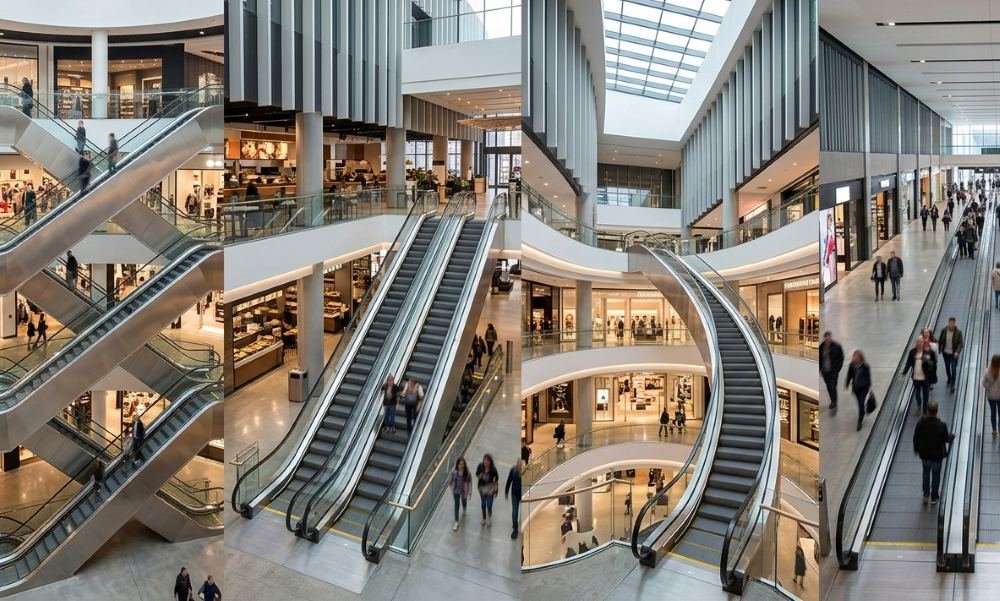
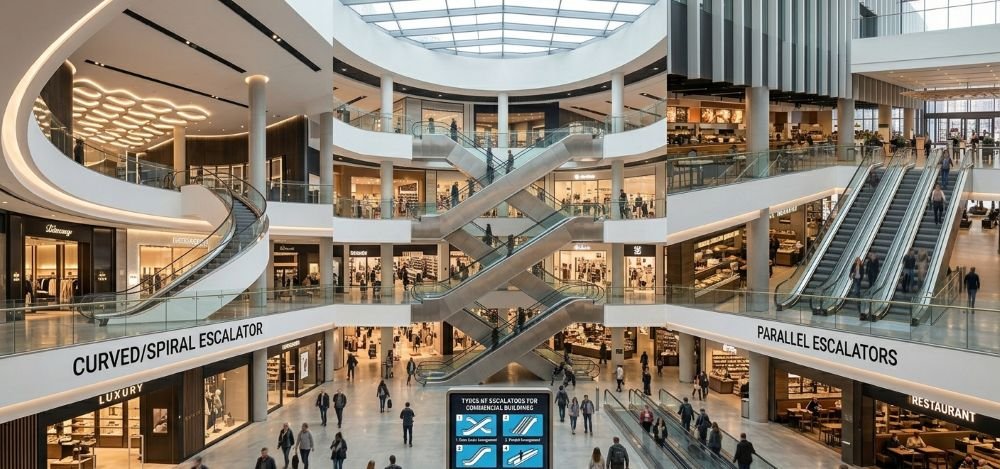
Parallel escalators are the most common type found in Syrian commercial malls and large retail spaces. In this configuration, the up and down escalators run side by side in the same direction but on opposite sides, allowing passengers to see one another across the unit.
Parallel escalators are ideal for high-traffic retail environments such as shopping malls and department stores. They encourage impulse browsing because shoppers can see merchandise on nearby floors as they travel. Their main advantage is space efficiency — they can be arranged in crisscross patterns to maximize floor area usage.
Best for: Shopping malls, department stores, large retail complexes, and multi-level commercial towers in Syria.
Typical step width range: 600mm, 800mm, or 1,000mm — with 1,000mm being standard for high-capacity commercial use.
2.2 Crisscross (Scissor) Escalators
In crisscross escalators, the units are stacked and positioned so that one escalator ascends on one side while another descends on the other, crossing in the middle. This configuration is extremely space-efficient and popular in buildings with limited floor space.
For Syrian commercial buildings where maximizing rentable square footage is a priority, crisscross escalators are particularly valuable. They reduce the footprint by approximately 35-40% compared to parallel configurations while handling similar traffic volumes.
Best for: Mid-sized malls, hotel lobbies, airport terminals, and commercial buildings with limited central floor space.
2.3 Multiple Parallel (Cascade) Escalators
Multiple parallel escalators, sometimes called cascade configurations, involve three or more escalators placed side by side — typically one dedicated down escalator, one dedicated up escalator, and one reversible unit for peak hour management. This is the configuration of choice for the highest-traffic commercial environments.
Hospitals with high visitor footfall, large transportation hubs, and major commercial malls with anchor tenants exceeding 10,000 square meters benefit most from cascade configurations. The reversible third unit allows facility managers to adjust directional capacity based on time of day.
Best for: Large-capacity hospitals, major transportation hubs, flagship commercial malls, and public sector infrastructure projects in Syria.
2.4 Curved (Spiral) Escalators
Curved or spiral escalators are architecturally striking units that travel in a helical path — following the contours of a building’s atrium or curved facade. They are the most complex escalators to manufacture and install, and they command a premium price point.
Mitsubishi Electric holds the dominant patent on commercial spiral escalators, making them a rare but impactful statement piece for flagship commercial projects. In the Syrian market, curved escalators are beginning to appear in luxury real estate developments, high-end hotel lobbies, and premium retail flagship stores.
Best for: Luxury commercial developments, hotel flagship lobbies, premium retail flagship stores, and landmark public buildings.
Note: Lead times for curved escalator components are longer. Hard System recommends factoring 16-20 weeks into project timelines for these units.
2.5 Moving Walkways (Travelators) — The Horizontal Companion
Technically distinct from escalators, moving walkways (also called travelators or moving pavements) are the horizontal or low-incline equivalents. They are essential in airports, large hospital corridors, metro stations, and large commercial complexes where pedestrians need to cover significant horizontal distances efficiently.
Moving walkways come in two primary forms: flat (0-degree inclination) for direct horizontal movement, and inclined (up to 12 degrees) for gentle elevation changes without steps. In Syria, they are increasingly specified in airport expansion projects and large commercial developments.
Best for: Airports, large hospital corridors, metro stations, large commercial complexes, and logistics facilities.
| Hard System installs and maintains all five escalator and moving walkway types described above. Our engineering team assesses each building’s specific traffic load, architectural constraints, and power infrastructure before recommending the optimal configuration. |
Section 3: Escalator Specifications — What the Numbers Actually Mean
Speed
Standard commercial escalator speeds range from 0.45 m/s to 0.65 m/s. The 0.5 m/s speed is the most common specification for shopping malls. Higher speeds (0.65 m/s) are used in metro stations and airports where passenger throughput is the primary concern.
In Syria, where many users may include elderly visitors, patients in healthcare facilities, and children, specifying 0.5 m/s is generally the safer and more comfortable choice for most commercial and healthcare applications.
Step Width
Step width directly determines passenger capacity. A 600mm step allows single-file travel (approximately 4,500 persons/hour), an 800mm step allows one person with a bag or two slim passengers (approximately 6,750 persons/hour), and a 1,000mm step allows two people standing side by side (approximately 9,000 persons/hour).
For Syrian commercial malls expecting peak footfall during Eid and national holidays, specifying 1,000mm step width escalators is strongly recommended. Under-specifying step width is one of the most common and costly mistakes in commercial escalator procurement.
Rise Height (Vertical Travel Distance)
Escalators are designed to cover specific vertical travel ranges. Units designed for less than 3 meters of rise are considered low-rise configurations, while units covering up to 6 meters are standard commercial units. For larger vertical distances, multiple escalators in series are typically used.
When rise height exceeds the designed maximum of a single unit, the solution is to break the travel into segments with intermediate landings — a common and effective approach in multi-level Syrian commercial malls and hospitals.
| Specification | Standard Mall | Hospital / Transport | Luxury / Landmark |
| Step Width | 1,000mm | 1,000mm | 800-1,000mm |
| Speed | 0.5 m/s | 0.5 m/s | 0.45-0.5 m/s |
| Config Type | Parallel / Crisscross | Cascade / Walkways | Curved / Spiral |
Section 4: Must-Have Safety Features for Commercial and Home Escalators
Safety is not a differentiator — it is a baseline requirement. In commercial settings, an escalator safety failure exposes building owners to legal liability, insurance claims, regulatory shutdowns, and reputational damage. In home elevator and residential escalator contexts, the stakes are personal.
Below are the non-negotiable safety features that Hard System specifies and verifies in every installation — and that every building owner, mall manager, and facility director in Syria should demand from any escalator supplier.
4.1 Emergency Stop System (E-Stop)
Every commercial escalator must be equipped with clearly marked, easily accessible emergency stop buttons at both the top and bottom landing areas. These stops must cut power to the drive motor within milliseconds of activation and lock the steps in position to prevent continued movement under passenger load.
In the Syrian context, emergency stop buttons should also be connected to a backup power relay that ensures braking function even during power supply interruptions. This is particularly critical given Syria’s infrastructure realities.
4.2 Handrail Speed Synchronization
The handrail must move at exactly the same speed as the steps. Any differential between handrail speed and step speed causes passengers to lose their grip and balance — one of the most common causes of escalator falls globally. Speed synchronization sensors should be installed and regularly calibrated.
| 2nd | Handrail-step speed mismatch is the 2nd most common cause of escalator passenger injuries globally, after loose clothing entrapment. (Source: U.S. Consumer Product Safety Commission) |
4.3 Anti-Skid Step Surfaces
Step surfaces must feature yellow demarcation lines at the step edges and anti-slip grooved surfaces across the full step tread. These are not aesthetic choices — they are safety mandates. In environments with wet or oily footwear (such as near food courts or hospital entrances), anti-skid step treatment should be specified at a higher grade.
4.4 Comb Plate Safety Switches
The comb plates — the toothed metal plates at the top and bottom of every escalator where steps emerge and disappear — must be equipped with impact and jam sensors. If a foreign object (shoe, bag strap, clothing) becomes caught in the comb plate, the safety switch must trigger an immediate stop before injury occurs.
Comb plate entrapment is the most frequently reported escalator injury in commercial settings. Modern comb plate safety switches using optical or mechanical detection are a mandatory specification for any new installation.
4.5 Skirt Brush Safety System
The gap between the moving steps and the stationary skirt panels on either side of the escalator is a known entrapment hazard — particularly for children and people wearing loose clothing or open footwear. Skirt brushes are nylon bristle barriers installed along the full length of the skirt panel that deflect clothing and feet away from the gap before entrapment can occur.
In Syria’s commercial malls, where families with young children are high-volume visitors, skirt brush systems are not optional — they should be a mandatory specification in every procurement contract.
4.6 UPS and Power Failure Braking
Given Syria’s documented challenges with power supply reliability, every commercial escalator installation must include an Uninterruptible Power Supply (UPS) connected to the braking system. When power fails, the UPS must trigger controlled deceleration and full stop within the safe stopping distance — preventing passengers from experiencing a sudden jolt stop while in transit.
Hard System’s standard escalator installations include integrated UPS braking systems specifically calibrated for the voltage and frequency variability typical of the Syrian power grid.
4.7 Overspeed and Underspeed Governors
Speed governors monitor the escalator’s operational speed in real time. If the speed rises above 20% of the rated speed (overspeed) or falls below a minimum threshold (underspeed), the governor triggers an emergency stop. Overspeed conditions can develop from drive chain failures; underspeed from motor overload.
4.8 Anti-Reversal Device
For inclined escalators, the anti-reversal device prevents the escalator from running in reverse under load — a catastrophic failure mode that can cause mass falls. This device is a mechanical brake activated immediately when retrograde movement begins, functioning independently of the main electrical system.
4.9 Step Leveling and Monitoring Systems
Modern escalators feature step-level monitoring that detects if any individual step has become misaligned, buckled, or damaged. Misaligned steps are trip hazards at the landing areas where passengers embark and disembark. Automated monitoring systems allow facility managers to receive alerts before a damaged step enters service.
4.10 Firefighting and Smoke Interlock
In commercial buildings required to comply with fire safety codes, escalators must be connected to the building’s fire alarm system via a smoke interlock that stops all escalator movement when smoke is detected. This prevents escalators from acting as chimneys that spread smoke and fire between floors.
In Syria, as building codes continue to evolve and align with international standards, fire interlock compliance is increasingly required for commercial occupancy permits. Hard System ensures all installations are interlock-compliant.
| IMPORTANT FOR HOME ELEVATOR BUYERS: Many of these safety features — particularly UPS braking, anti-reversal devices, and emergency stop systems — are equally critical for home elevator installations. Hard System’s residential elevator packages include all essential safety features tailored for private residences. |
Section 5: The Syrian Market Reality — What Your Escalator Supplier Must Understand
5.1 Power Supply Variability
Syria’s power grid operates with significant variability in voltage and frequency. Standard international escalators are designed for 380V/50Hz three-phase power supply. In practice, Syrian commercial buildings may experience voltage variations of +/-15% or more and periodic frequency deviations.
Escalators installed without power conditioning systems are vulnerable to motor burnout, control board failures, and premature bearing wear under these conditions. Hard System specifies automatic voltage regulation (AVR) systems as a standard component of every Syrian commercial installation.
5.2 Spare Parts and Supply Chain
One of the most frequently overlooked factors in escalator procurement in Syria is post-installation parts availability. Purchasing a low-cost escalator from an obscure manufacturer may save 15-20% upfront but can result in 6-12 month lead times for critical spare parts — turning a minor repair into a multi-month service outage.
Hard System maintains in-country stock of the most common wear parts for every brand and model we install. Our procurement network includes direct partnerships with established European and Asian manufacturers, ensuring critical parts arrive within days, not months.
5.3 Summer Temperature Considerations
Syrian summer temperatures regularly exceed 40°C in many regions. Escalator drive motors, gearboxes, and lubrication systems must be specified for high-ambient-temperature operation. Standard units rated for European ambient conditions (max 40°C) operate at their thermal limit in Syrian summers and will experience accelerated wear.
Hard System specifies tropical-rated motors and extended-temperature lubricants for all Syrian installations as standard — not as a premium add-on.
5.4 Seismic and Structural Considerations
Syria lies in a seismically active region. Commercial escalator installations in permanent structures should include flexible mounting systems that allow limited relative movement between the escalator structure and the building frame during seismic events, preventing structural damage from becoming escalator damage.
Section 6: How to Evaluate Escalator Suppliers in Syria — A Procurement Checklist
Not all escalator suppliers operating in Syria offer the same depth of technical capability, parts support, or after-sales service. Use this checklist to evaluate any supplier before signing a procurement contract.
- Does the supplier have certified installation engineers with documented factory training from the escalator manufacturer?
- Does the supplier maintain in-country spare parts inventory for the models they sell?
- Does the supplier provide a written 12-month minimum installation warranty separate from the manufacturer’s product warranty?
- Does the supplier have documented experience installing escalators in buildings with Syrian-grade power supply conditions?
- Can the supplier provide references from at least three comparable completed commercial installations in Syria?
- Does the supplier offer a structured preventive maintenance program with defined service intervals?
- Does the supplier’s team include licensed civil and electrical engineers who can coordinate with structural consultants?
- Does the supplier provide emergency response service (not just scheduled maintenance) with a documented response time SLA?
Hard System meets all eight of these criteria and can provide detailed documentation upon request. Visit us at hard-sy.com to request a supplier qualification dossier.
Section 7: Verified External Resources for Further Research
- Grand View Research — Escalator & Moving Walkway Market Report 2023: grandviewresearch.com/industry-analysis/escalator-moving-walkway-market
An authoritative market sizing report covering global demand, regional growth rates, and technology trends in the escalator industry. Essential reading for investors and developers evaluating commercial escalator procurement.
- U.S. Consumer Product Safety Commission — Escalator Safety Research: cpsc.gov/Safety-Education/Safety-Education-Centers/Escalators
Detailed government research on escalator injury patterns, safety feature effectiveness, and maintenance-related failure analysis. Provides the statistical basis for safety feature specifications referenced in this guide.
- EN 115-1:2017 — Safety of Escalators and Moving Walks (European Standard): en-standard.eu
The primary international technical standard governing the design, installation, and maintenance of escalators. All Hard System installations comply with EN 115-1 requirements as the baseline specification framework.
Frequently Asked Questions (FAQ)
Q1: What is the difference between an escalator and a moving walkway?
An escalator transports passengers vertically between floors using moving steps on an inclined track (typically 30-35 degrees). A moving walkway (travelator) transports passengers horizontally or on a very shallow incline (up to 12 degrees) using a continuous moving belt or linked palette surface. Both are manufactured using similar drive technology but serve fundamentally different spatial functions.
Q2: How many people per hour can a standard commercial escalator carry?
A 1,000mm wide escalator running at 0.5 m/s has a theoretical capacity of approximately 9,000 persons per hour at full loading. In practice, realistic throughput is 40-50% of theoretical capacity due to irregular loading patterns, making a realistic figure of 4,000-4,500 persons per hour for planning purposes in Syrian commercial facilities.
Q3: What maintenance schedule does a commercial escalator require in Syria?
Hard System recommends monthly preventive maintenance for all commercial escalators in Syria, versus the standard international recommendation of quarterly maintenance. The additional frequency accounts for higher dust levels, power quality variation, and thermal stress from summer temperatures. Monthly maintenance includes lubrication, tension checks, safety system testing, and step condition inspection.
Q4: Can escalators be reversed to run in both directions?
Yes. Reversible escalators are commercially available and are commonly used in the middle position of three-escalator cascade configurations. The direction is changed electromechanically at the control panel and takes approximately 30-60 seconds to complete safely. Hard System’s installation team configures reversible units with direction-change interlocks to ensure the unit fully stops and clears before reversing.
Q5: What certifications should an escalator installation company in Syria hold?
At minimum, look for: ISO 9001 quality management certification for the company’s installation processes, manufacturer-issued installation authorization certificates for the specific brands they install, and documentation that the installation team has completed factory-level technical training. Hard System holds all of the above and can provide copies upon request.
Q6: How long does a commercial escalator installation typically take?
A standard parallel escalator installation in an existing commercial building typically takes 4-6 weeks from equipment arrival on site to commissioning. New-build installations where the pit and support structure are built to specification can be completed in 3-4 weeks. Curved or spiral escalators require 8-12 weeks due to the precision required in their installation. Project timelines in Syria may be extended by customs clearance, which Hard System manages on behalf of clients.
Q7: Are there specific escalator safety standards mandatory in Syria?
Syria currently applies a combination of Arab Standard specifications and international EN 115-1 guidelines for vertical transportation safety. In practice, the most rigorous projects — particularly those involving international investors or government infrastructure — specify full EN 115-1 compliance. Hard System designs all installations to EN 115-1 as the default standard, exceeding the minimum local requirements.
Q8: What is the typical cost range for a commercial escalator installation in Syria?
Escalator costs vary significantly by type, specifications, and market conditions. As a general orientation: standard parallel escalators for commercial use range from USD 35,000 to USD 65,000 per unit installed, depending on rise height, step width, and finish quality. Curved or spiral escalators can range from USD 150,000 to USD 400,000+ per unit. Hard System provides detailed cost proposals based on your specific project brief — contact us at hard-sy.com for a no-obligation consultation.
Conclusion: The Right Escalator Decision Starts with the Right Partner
Selecting and installing the correct type of escalator for your commercial building in Syria is a decision that will affect your facility’s safety, operational efficiency, visitor experience, and total cost of ownership for the next 20-30 years. It is not a decision to be made on price alone, on brand recognition alone, or on a supplier’s sales pitch alone.
It requires a partner with deep technical expertise, genuine understanding of Syria’s operating conditions, a robust supply chain for parts and service, and a track record of delivering on their commitments. The information in this guide gives you the framework to ask the right questions and evaluate suppliers with confidence.
Hard System has spent years establishing itself as Syria’s leading vertical transportation specialist — installing and maintaining elevators, escalators, and moving walkways across commercial, healthcare, hospitality, and residential projects throughout the country. Our engineers understand Syrian power infrastructure, our warehouse stocks critical parts in-country, and our service team is available when you need them — not just when it is convenient.
Ready to Specify the Right Escalator for Your Project?
Contact Hard System today for a free technical consultation, site assessment, and detailed cost proposal tailored to your building’s specific requirements.
Visit hard-sy.com | Request a Free Consultation