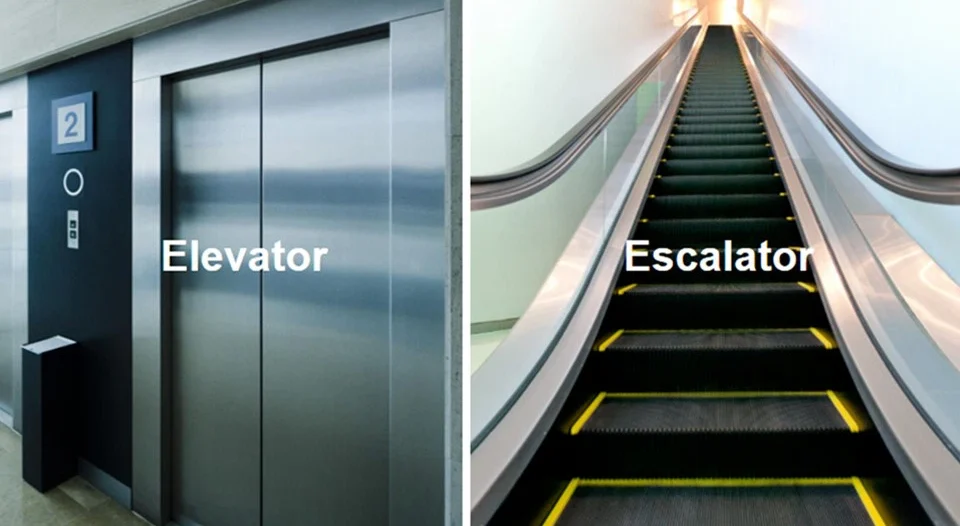
The Vertical Mobility Dilemma
Syria’s cities are changing fast. In Damascus and Aleppo, new projects rise every year. Mixed-use buildings are now common. They combine shops, offices, and residential spaces in one place.
In this modern landscape, one question matters more than ever:
Should you invest in elevators or escalators?
- Is the priority comfort, privacy, and accessibility?
- Or is it fast movement and high traffic flow?
The right choice can improve safety, user experience, and long-term value. The wrong one can limit your building’s success. This 2026 guide will help you decide.
Key Differences at a Glance: Elevators vs. Escalators
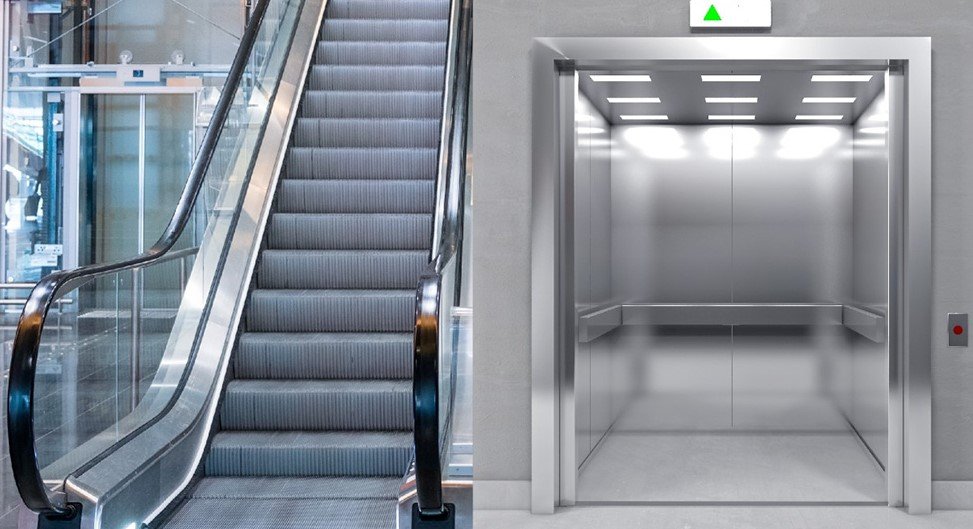
Choosing between elevators and escalators is a strategic decision that directly impacts user comfort, traffic flow, and long-term return on investment.
To help you decide faster, the comparison below clearly explains how each system performs in real commercial and mixed-use buildings in Syria.
| Feature | Elevators (Lifts) | Escalators |
| Traffic Capacity | Ideal for controlled movement, carrying 8–20 people per trip | Designed for heavy traffic with continuous flow of up to 9,000 people per hour |
| Space Requirements | Compact vertical footprint, perfect for high-rise buildings | Requires wider horizontal and vertical space |
| Accessibility | Essential for people with disabilities, strollers, and elderly users | Not suitable for wheelchairs or strollers |
| Energy Efficiency | Energy is used only when the elevator is moving | Operates continuously, with higher energy demand |
| Investment Cost | Lower initial cost, starting from $15,000 to $50,000 | Higher upfront investment, starting from $40,000 to $100,000+ |
This side-by-side comparison helps developers, investors, and business owners in Syria make smarter decisions aligned with 2026 building trends, safety standards, and operational goals.
When Should You Choose an Elevator?
Choosing an elevator becomes the right decision when your building needs safe, comfortable, and efficient vertical movement.
In fact, in many modern projects across Syria, elevators are no longer optional—they are essential.
Accessibility and inclusion come first.
Elevators are essential for people with disabilities, elderly users, and families with strollers.
They fully comply with international safety standards such as EN 81, making them the correct choice for public and residential buildings.
They save space and work best in tall buildings.
If your project has 10 floors or more, escalators become impractical. Elevators require only a vertical shaft, which makes them ideal for high-rise towers, offices, and residential buildings in Damascus and Aleppo.
Privacy and comfort add real value.
Elevators provide a private and smooth ride. For this reason, they are widely used in luxury villas, residential compounds, and high-end corporate offices where comfort and image matter.
Modern projects prefer MRL technology.
Today, 65% of residential projects in the Middle East choose Machine-Room-Less (MRL) elevators.
These systems save space, reduce construction costs, and improve energy efficiency—making them a smart investment for 2026 and beyond.
When Should You Choose an Escalator?
An escalator is the best choice when your building depends on fast, continuous movement.
In busy commercial spaces, managing high visitor flow is critical to success.
First of all, escalators are essential for traffic management.
Shopping malls, airports, and transit hubs cannot function efficiently without them. Unlike elevators, escalators move people continuously.
As a result, they eliminate waiting time and reduce crowding during peak hours.
In addition, escalators improve customer flow inside retail spaces.
They guide visitors naturally through different floors and product displays.
Because customers keep moving, studies show that escalators can increase impulse purchases by 20–30%, making them a powerful tool for retail growth.
Moreover, escalators create strong visual impact.
Panoramic and glass escalators add a modern and premium look to buildings.
For this reason, many malls and commercial projects use them as an architectural feature that enhances brand image and attracts visitors.
Cost Analysis & ROI for the Syrian Market (2026)
Investing in elevators or escalators is a key decision for your building’s efficiency and visitor experience. Here’s a simple breakdown for 2026 in Syria:
Upfront Costs
The price of escalators in Syria is usually higher than elevators. This is because escalators need careful shipping and skilled installation.
However, this investment ensures smooth and reliable operation for many years.
Energy and Operating Costs
Modern escalators use energy-saving VVVF drives. These sensors slow down the escalator when no one is using it, saving up to 40% on electricity bills.
This means lower operating costs without affecting performance.
Maintenance Needs
Regular maintenance keeps the system safe and reliable. Elevators need monthly safety checks, while escalators require chain lubrication and comb-plate inspections.
Working with a professional company ensures fewer breakdowns and smooth operation.
Decision Factors: The Hard-System Checklist
Choosing between an elevator and an escalator is a key decision for any building project. Here’s how to make the right choice:
- Building Height
For buildings with 4 floors or more, elevators are usually the best solution. For shorter buildings, escalators provide fast, continuous movement and handle high traffic efficiently. - Peak Traffic
If your building sees over 500 people moving between floors per hour, escalators are the smart choice.
They reduce wait times and keep visitors moving smoothly, ensuring a seamless experience. - Budget Considerations
Think about your main goal: initial savings or long-term efficiency? Elevators cost less upfront, but escalators offer higher capacity and better traffic flow over time.
Many commercial buildings combine both elevators and escalators to achieve the best mix of accessibility, convenience, and smooth traffic management.
Safety Standards & Local Regulations
When it comes to elevators and escalators, safety is the top priority.
Hard-System ensures that every installation fully complies with Syrian Engineering Syndicate standards and international safety protocols.
- Fire Safety:
Our 2026 models use fire-rated materials to protect your building and passengers during emergencies. - Emergency Systems:
Equipped with advanced emergency stop controls, Hard- System elevators and escalators guarantee passenger safety at all times. - Peace of Mind:
By choosing Hard- System, you not only invest in vertical transportation but also in reliable, secure, and fully compliant solutions that enhance the safety and reputation of your building.
Make the Right Choice for Your Building
For multi-story buildings, using both elevators and escalators is often the smartest solution.
This combination keeps visitors moving smoothly, improves accessibility, and enhances the overall experience.
Act Now: Unsure which option suits your building? Contact Hard-System today for a free site survey and a detailed, customized quote.
Get the best solution for safety, efficiency, and visitor satisfaction.